HuagongsheHuagongshe Chemistry Print Report · For research reference only
HCID 15836633Generated: October 25, 2026
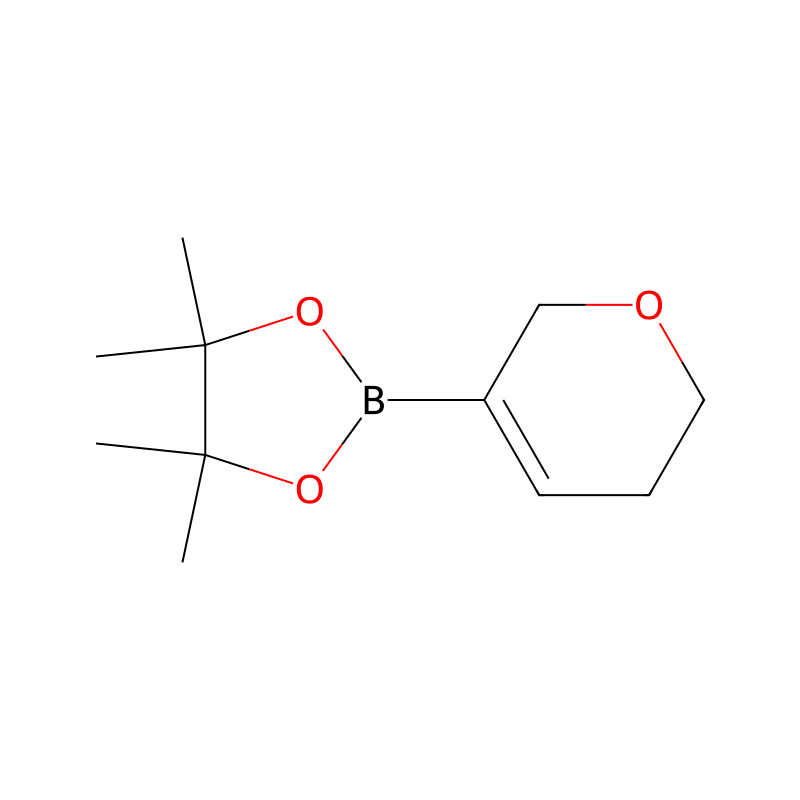
2-(5,6-dihydro-2H-pyran-3-yl)-4,4,5,5-tetramethyl-1,3,2-dioxaborolane
2-(5,6-Dihydro-2H-pyran-3-yl)-4,4,5,5-tetramethyl-1,3,2-dioxaborolane · 3,6-dihydropyran-5-boronic ester · 5,6-Dihydro-2H-pyran-3-boronic Acid Pinacol Ester · (5,6-DIHYDRO-2H-PYRAN-3-YL)BORONIC ACID PINACOL ESTER · 2-(3,6-dihydro-2H-pyran-5-yl)-4,4,5,5-tetramethyl-1,3,2-dioxaborolane · 5-(4,4,5,5-Tetramethyl-[1,3,2]dioxaborolan-2-yl)-3,6-dihydro-2H-pyran · 2H-Pyran, 3,6-dihydro-5-(4,4,5,5-tetramethyl-1,3,2-dioxaborolan-2-yl)- · 2-(5,6-Dihydro-2H-pyran-3-yl)-4,4,5,5-tetramethyl-1,3,2-dioxaborolane - [D22318]
https://huagongshe.com/en/chemical/15836633
Identifiers & Physical Properties
| CAS No. | 212127-81-6 |
|---|
| Molecular formula | C11H19BO3 |
|---|
| Average molar mass | 210.08 g/mol |
|---|
| Monoisotopic mass | 210.1427246 g/mol |
|---|
| SMILES | CC1(C)OB(C2=CCCOC2)OC1(C)C |
|---|
| InChIKey | ABXRLUFQGNZBME-UHFFFAOYSA-N |
|---|
| PubChem CID | 15836633 |
|---|
| EC No. | 827-656-8 |
|---|
| DTXSID | DTXSID30578747 |
|---|
Chemical & Physical Properties
| Topological polar surface area | 27.7 |
|---|
| Hydrogen bond donors | 0 |
|---|
| Hydrogen bond acceptors | 3 |
|---|
| Rotatable bonds | 1 |
|---|
| Heavy atoms | 15 |
|---|
| Formal charge | 0 |
|---|
| Complexity | 268 |
|---|
| Boiling point | 238.6±50.0 °C(Predicted) |
|---|
| Density | 1.01±0.1 g/cm3(Predicted) |
|---|
| Storage conditions | Storage temp. 2-8°C |
|---|
| Appearance | Colorless to light yellow Liquid |
|---|
| GHS pictogram | GHS07 |
|---|
| Signal word | Warning |
|---|
| GHS hazard statements | H319-H315-H302-H335 |
|---|
| GHS precautionary statements | P264-P280-P302+P352-P321-P332+P313-P362-P264-P280-P305+P351+P338-P337+P313P-P264-P270-P301+P312-P330-P501 |
|---|
Safety & Regulations
| GHS classification | WarningH302 (100%): Harmful if swallowed [Warning Acute toxicity, oral]H315 (100%): Causes skin irritation [Warning Skin corrosion/irritation]H319 (100%): Causes serious eye irritation [Warning Serious eye damage/eye irritation]H335 (100%): May cause respiratory irritation [Warning Specific target organ toxicity, single exposureRespiratory tract irritation]P261, P264, P264+P265, P270, P271, P280, P301+P317, P302+P352, P304+P340, P305+P351+P338, P319, P321, P330, P332+P317, P337+P317, P362+P364, P403+P233, P405, and P501 (click each P-code to see the statement)The GHS information provided by 1 company from 1 notification to the ECHA C&L Inventory. |
|---|
| Hazard Classes and Categories | Acute Tox. 4 (100%)Skin Irrit. 2 (100%)Eye Irrit. 2A (100%)STOT SE 3 (100%) |
|---|
| Signal word | Warning |
|---|
| GHS pictogram | GHS07 |
|---|
| GHS hazard statements | H319-H315-H302-H335 |
|---|
| GHS precautionary statements | P264-P280-P302+P352-P321-P332+P313-P362-P264-P280-P305+P351+P338-P337+P313P-P264-P270-P301+P312-P330-P501 |
|---|