Paraquat dichloride
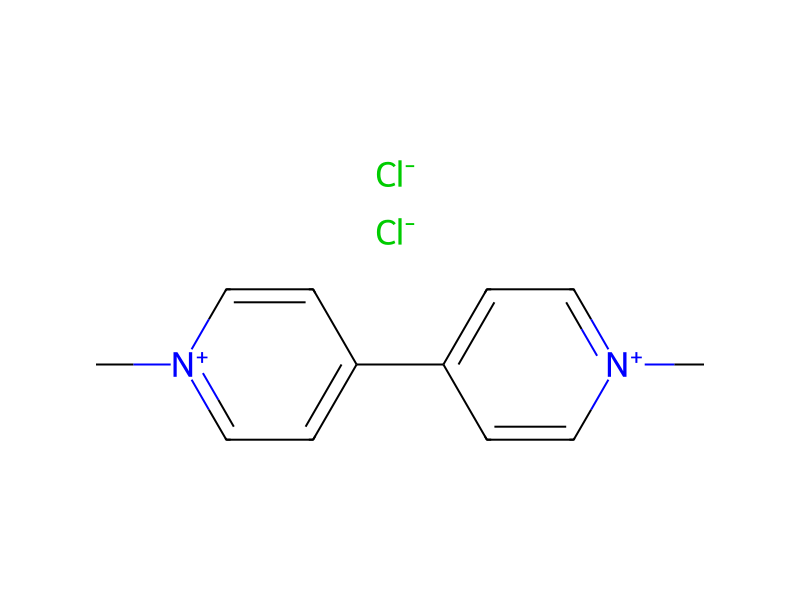
Basic information
- CAS
1910-42-5- Standard SMILES
C[n+]1ccc(-c2cc[n+](C)cc2)cc1.[Cl-].[Cl-]- InChIKey
FIKAKWIAUPDISJ-UHFFFAOYSA-L- Molecular formula
- C12H14N2.2Cl
- Average molar mass
- 257.16 g/mol
- Monoisotopic mass
- 256.0534038
Overview
Paraquat dichloride is a colorless to yellow crystalline solid. Used as a contact herbicide and desiccant. (EPA, 1998)
Names & identifiers
- Preferred name
- Paraquat dichloride
- IUPAC
- 1-methyl-4-(1-methylpyridin-1-ium-4-yl)pyridin-1-ium dichloride
- English name
- Paraquat dichloride
- Molecular formula
- C12H14Cl2N2
- Molecular weight
- 257.16
Names & synonyms
Paraquat dichloride1910-42-5Methyl viologenMethyl viologen dichloridePathclearPillarxoneCrisquatDexuronGramixelGramuronEsgramToxer total
Show more names
TOTALPARAQUAParaquat dichloridPARAQUAT DICHLORIDE TETRAHYDRATE
Ortho paraquat clParaquat-dichloride1,1'-Dimethyl-4,4'-bipyridinium dichlorideCekuquatGaloksonGramoxoneHerbaxonHerboxone
Database identifiers
- CAS
1910-42-5、4685-14-7- PubChem CID
- 15938
- DTXSID
DTXSID7024243- ChEMBL
CHEMBL458019- ChEBI
CHEBI:28786- UNII
- 2KZ83GSS73
- EC Number
- 217-615-7
Properties
Computed structural properties
- Topological polar surface area
- 7.8 Ų
- Hydrogen bond donors
- 0
- Hydrogen bond acceptors
- 2
- Rotatable bonds
- 1
- Heavy atoms
- 16
- Formal charge
- 0
- Complexity
- 145
Experimental & physicochemical properties
Pesticides
Pesticide -> EPA IRIS
Pesticides -> Herbicides, Bipyridyl
LogP-4.5
Density
1.24 to 1.26 at 68 °F (NTP, 1992)
1.24 g/cm³
1.24
1.24
Solubility
greater than or equal to 100 mg/mL at 66 °F (NTP, 1992)
Solubility in water, g/100ml at 20 °C: 62
Miscible
Endocrine DisruptorsPotential endocrine disrupting compound
Boiling Point
Decomposes (NIOSH, 2024)
decomposes
Decomposes
Decomposition300 °C
Melting Point
Decomposes 572 °F (EPA, 1998)
572 °F (decomposes)
572 °F (Decomposes)
Vapor Pressure
Approximately 0 (EPA, 1998)
0.0000001 [mmHg]
Safety & regulation
Safety information is for reference only and does not replace the supplier’s Safety Data Sheet (SDS), applicable regulations, or professional assessment.
GHS classification
GHS Classification
Danger
H301: Toxic if swallowed [Danger Acute toxicity, oral]
P260, P261, P262, P264, P264+P265, P270, P271, P273, P280, P284, P301+P316, P302+P352, P304+P340, P305+P351+P338, P316, P319, P320, P321, P330, P332+P317, P337+P317, P361+P364, P362+P364, P391, P403+P233, P405, and P501 (click each P-code to see the statement)
Danger
H290 (13.6%): May be corrosive to metals [Warning Corrosive to Metals]
P234, P260, P261, P262, P264, P264+P265, P270, P271, P273, P280, P284, P301+P316, P302+P352, P304+P340, P305+P351+P338, P316, P319, P320, P321, P330, P332+P317, P337+P317, P361+P364, P362+P364, P390, P391, P403+P233, P405, P406, and P501 (click each P-code to see the statement)
Hazard information
Regulatory Information
Hazard Traits - Hazard Trait Undefined
Paraquat dichloride is listed in the dataset of EPA Human Health Benchmarks for Pesticides under the Safe Drinking Water Act (40 eCFR 141)
REACH registered substance: Paraquat-dichloride (EC: 217-615-7)
Paraquat dichloride: Does not have an individual approval but may be used as a component in a product covered by a group standard. It is not approved for use as a chemical in its own right.
The New Jersey Worker and Community Right to Know Act requires public and private employers to provide information about hazardous substances at their workplaces. (N.J.S.A. 34:5A-1 et. seq.)
Other Safety InformationIMAP assessments - 4,4'-Bipyridinium, 1,1'-dimethyl-, dichloride: Human health tier I assessment
DOT LabelPoison
Fire Hazards
Avoid strong oxidizers. (EPA, 1998)
Not combustible. Gives off irritating or toxic fumes (or gases) in a fire.
Chemistry & industry
Pharmacology
Biological Half-LifeAnimal studies: less than 6 hours; other animal studies have found measurable paraquat 26 days after ingestion; [TDR, p. 991]
Metabolism/Metabolites
Paraquat is poorly absorbed after oral exposure. It is not metabolized but is reduced to an unstable free radical which is then re-oxidized to reform the cation and produce a superoxide anion. It is excreted moslty in the urine,and in small fraction also in the feces (A606, L1008).
MeSH Pharmacological ClassificationPesticides used to destroy unwanted vegetation, especially various types of weeds, grasses (POACEAE), and woody plants. Some plants develop HERBICIDE RESISTANCE.
Uses & manufacturing
Uses
Used as a contact herbicide on weeds; [EXTOXNET] Used in animal experiments as a model of Parkinson's syndrome at doses several orders of magnitude greater than occupational exposure levels; [PMID 16217247]
Farming (Pesticides) [Category: Industry]
Paraquat is used as a quaternary ammonium herbicide; one of the most widely used herbicides in the world. It is also often used in science to catalyze the formation of reactive oxygen species (ROS). (L421).
Use ClassificationHERBICIDES
Applications
DescriptionParaquat dichloride is a dark blue liquid, non-combustible, stable herbicide chemical. It is incompatible with strong oxidising agents. On contact with fire paraquat decomposes gives off irritating or toxic fumes (or gases), nitrogen oxides, and hydrogen chloride. Paraquat dichloride contact and storage destroys metal. Paraquat dichloride hydrolyses in alkaline media and reacts with aluminium to produce hydrogen gas. Paraquat (N,N′-dimethyl-4,4′-bipyridinium dichloride) is one of the most widely used herbicides in the world. Paraquat dichloride is a herbicide currently registered to control weeds and grasses in many agricultural and non-agricultural areas. It is used preplant or preemergence on vegetables, grains, cotton, grasses, sugar cane, peanuts, potatoes, and tree plantation areas; post-emergence around fruit crops, vegetables, trees, vines, grains, soybeans, and sugar cane. It is also used on non-crop areas such as public airports, electric transformer stations, and around commercial buildings to control weeds. It has been reported that about seven pesticide products are registered which contain the active ingredient paraquat dichloride and classified as restricted use pesticides (RUPs). Paraquat dichloride and the products are primarily intended for ‘Occupational Use’. In the United States, Paraquat is classified as ‘restricted commercial use’, and people must obtain a license to use the product.
Related reactions
3 records

Compound notes
Loading…