
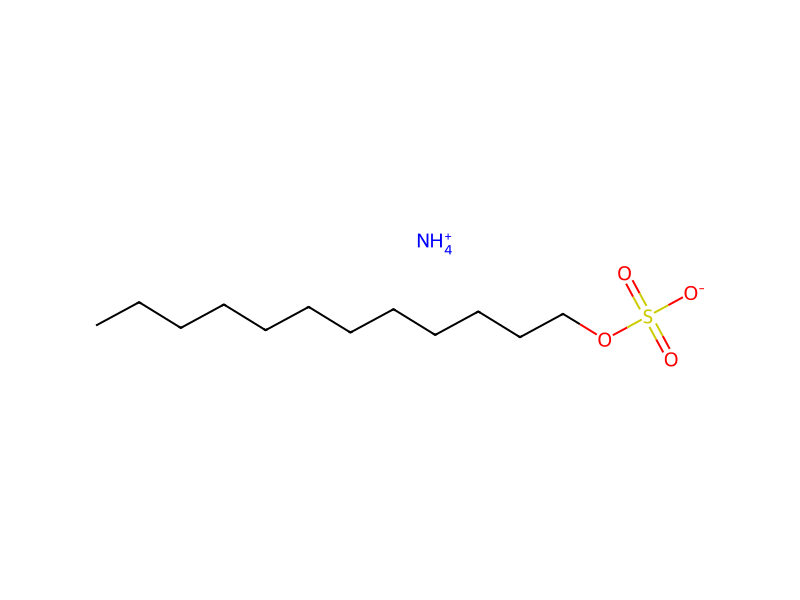
Basic information
- CAS
2235-54-3- Standard SMILES
CCCCCCCCCCCCOS(=O)(=O)[O-].[NH4+]- InChIKey
BTBJBAZGXNKLQC-UHFFFAOYSA-N- Molecular formula
- C12H29NO4S
- Average molar mass
- 283.43 g/mol
- Monoisotopic mass
- 283.18172958
Names & identifiers
- Preferred name
- Ammonium Lauryl Sulfate
- IUPAC
- azanium dodecyl sulfate
- English name
- Ammonium lauryl sulfate
- Molecular formula
- C12H26O4S.H3N
- Molecular weight
- 283.43
Names & synonyms
Ammonium dodecyl sulfate2235-54-3AMMONIUM LAURYL SULFATEPresulinAmmonium dodecyl sulphateSinoponTexapon specialConco sulfate AMaprofix NHRichonol AMSterling AMNeopon LAM
Show more names
Hydroxypyrimidineneoponlamsiponla30siprol422siproll22Texapon Amaprofixnhrichonolam
Akyposal als 33Montopol LA 20Siprol L22Siprol 422Texapon A 400Lauryl ammonium sulfateSipon LA 30Caswell No. 044B
Database identifiers
- CAS
2235-54-3- PubChem CID
- 16700
- DTXSID
DTXSID2027462- UNII
- Q7AO2R1M0B
- EC Number
- 218-793-9
Properties
Computed structural properties
- Topological polar surface area
- 75.8 Ų
- Hydrogen bond donors
- 1
- Hydrogen bond acceptors
- 4
- Rotatable bonds
- 11
- Heavy atoms
- 18
- Formal charge
- 0
- Complexity
- 230
Experimental & physicochemical properties
Density1.03 at 68 °F (USCG, 1999) - Denser than water; will sink
Color/FormClear liquid
Physical Description
Ammonium lauryl sulfate appears as light yellow liquid. May float or sink and mix with water. (USCG, 1999)
Liquid
Clear liquid; [HSDB] Light yellow liquid; [CAMEO] Commercial material is liquid; Pure material is light yellow solid; [CHEMINFO] Opaque yellow liquid (30% aqueous solution); [MSDSonline]
Physicochemical properties
- Density
- 1.02 g/mL · 1.02 g/mL at 20 °C
- refractive index
- 20 · n20/D 1.37
- Flash point
- 110 °C · 110 °C
- storage temp.
- 15 · 15-25°C
- solubility
- 20 °C · water: soluble at 20 °C
- form
- liquid
- color
- Colorless to Very Light Yellow and Colorless to Very Light Green-Yellow
- PH
- 6.8 · 6.8
- Water Solubility
- 20 °C · water: soluble at20°C
- BRN
- 5188379 · 5188379
- Stability
- Stable. Incompatible with strong oxidizing agents.
- Major Application
- cleaning products
- Cosmetics Ingredients Functions
- CLEANSINGFOAMINGSURFACTANT - CLEANSING
- Cosmetic Ingredient Review (CIR)
- Ammonium lauryl sulfate (2235-54-3)
- InChI
- InChI=1S/C12H26O4S.H3N/c1-2-3-4-5-6-7-8-9-10-11-12-16-17(13,14)15;/h2-12H2,1H3,(H,13,14,15);1H3
- InChIKey
- BTBJBAZGXNKLQC-UHFFFAOYSA-N
- SMILES
- [NH4+].S([O-])(OCCCCCCCCCCCC)(=O)=O
- LogP
- 5.395 · 5.395 (est)
- CAS DataBase Reference
- 2235 · 2235-54-3(CAS DataBase Reference)
- Indirect Additives used in Food Contact Substances
- AMMONIUM LAURYL SULFATE
- FDA 21 CFR
- 175.105 · 175.105; 175.210; 176.170;177.1200
- EWG's Food Scores
- 1 · 1
- FDA UNII
- 7 AO2R1M0B · Q7AO2R1M0B
- EPA Substance Registry System
- Ammonium lauryl sulfate (2235-54-3)
- Cosmetics Info
- Ammonium Lauryl Sulfate
- UNSPSC Code
- 12352100 · 12352100
- NACRES
- 22 · NA.22
- Symbol(GHS)
- 7 · GHS07
- Signal word
- Warning
- Hazard statements
- 315 · H315-H319-H412
- Precautionary statements
- 264 · P264-P273-P280-P302+P352-P305+P351+P338-P332+P313
- Hazard Codes
- Xi,N
- Risk Statements
- 36 · 36/38-52/53-51/53
- Safety Statements
- 26 · 26-36/37-61
- WGK Germany
- 3 · 3
- TSCA
- TSCA listed
- Storage Class
- 10 · 10 - Combustible liquids
- Hazard Classifications
- 3 Eye · Aquatic Chronic 3Eye Irrit. 2Skin Irrit. 2
- Hazardous Substances Data
- 2235 · 2235-54-3(Hazardous Substances Data)
Safety & regulation
GHS classification
GHS Classification
This chemical does not meet GHS hazard criteria for 0.3% (2 of 617) of reports.
Danger
H302 (71.8%): Harmful if swallowed [Warning Acute toxicity, oral];H315 (27.9%): Causes skin irritation [Warning Skin corrosion/irritation];H318 (17.7%): Causes serious eye damage [Danger Serious eye damage/eye irritation];H319 (82%): Causes serious eye irritation [Warning Serious eye damage/eye irritation]
P264, P264+P265, P270, P280, P301+P317, P302+P352, P305+P351+P338, P305+P354+P338, P317, P321, P330, P332+P317, P337+P317, P362+P364, and P501 (click each P-code to see the statement)
Aggregated GHS information provided per 617 reports by companies from 9 notifications to the ECHA C&L Inventory. Each notification may be associated with multiple companies.;Reported as not meeting GHS hazard criteria per 2 of 617 reports by companies.;There are 8 notifications provided by 615 of 617 reports by companies with hazard statement code(s).;Information may vary between notifications depending on impurities, additives, and other factors. The percentage value in parenthesis indicates the notified classification ratio from companies that provide hazard codes. Only hazard codes with percentage values above 10% are shown. For more detailed information, please visit ECHA C&L website.
Hazard information
Regulatory Information
Chemical: Sulfuric acid, monododecyl ester, ammonium salt
Sulfuric acid, monododecyl ester, ammonium salt (1:1) is listed on the EPA's Chemical Data Reporting (CDR) system. Manufacturers and importers of Sulfuric acid, monododecyl ester, ammonium salt (1:1) are required to report information about their production and use of this chemical to the EPA under the Toxic Substances Control Act (TSCA). (40 eCFR Part 711)
Dodecyl ammonium sulphate: Does not have an individual approval but may be used under an appropriate group standard
Other Safety InformationIMAP assessments - Sodium, ammonium and potassium lauryl sulfate: Human health tier II assessment;Evaluation - Lauryl (dodecyl) sulfates
Fire HazardsSpecial Hazards of Combustion Products: Toxic oxides of nitrogen and sulfur may form in fires. (USCG, 1999)
Health HazardsContact with liquid irritates eyes and may have drying effect on the skin. Prolonged contact will cause skin irritation. (USCG, 1999)
Hazards Summary
A skin and eye irritant; Emergency treatment: Detergents and soaps- anionic and nonionic; [HSDB] Moderate eye irritant and severe skin irritant in rabbits; [RTECS] Concentrations greater than 20% may be corrosive to skin and eyes; [CHEMINFO] An irritant; May cause serious eye injury; May cause respiratory sensitization (28% aqueous solution); [Medisca MSDS]
Reactive GroupEsters, Sulfate Esters, Phosphate Esters, Thiophosphate Esters, and Borate Esters;Hydrocarbons, Aliphatic Unsaturated;Salts, Acidic
EPA Safer ChemicalChemical: Ammonium lauryl sulfate; Green circle - The chemical has been verified to be of low concern based on experimental and modeled data.
FIFRA Requirements
As the federal pesticide law FIFRA directs, EPA is conducting a comprehensive review of older pesticides to consider their health and environmental effects and make decisions about their future use. Under this pesticide reregistration program, EPA examines health and safety data for pesticide active ingredients initially registered before November 1, 1984, and determines whether they are eligible for reregistration. In addition, all pesticides must meet the new safety standard of the Food Quality Protection Act of 1996. Pesticides for which EPA had not issued Registration Standards prior to the effective date of FIFRA, as amended in 1988, were divided into three lists based upon their potential for human exposure and other factors, with List B containing pesticides of greater concern and List D pesticides of less concern. Ammonium lauryl sulfate is found on List D. Case No: 4061; Pesticide type: insecticide, fungicide, rodenticide, antimicrobial; Case Status: RED Approved 09//93; OPP has made a decision that some/all uses of the pesticide are eligible for reregistration, as reflected in a Reregistration Eligibility Decision (RED) document.; Active ingredient (AI): Ammonium lauryl sulfate; AI Status: The active ingredient is no longer contained in any registered pesticide products ... "cancelled."
Reactivity Profile
Acidic inorganic salts, such as AMMONIUM LAURYL SULFATE, are generally soluble in water. The resulting solutions contain moderate concentrations of hydrogen ions and have pH's of less than 7.0. They react as acids to neutralize bases. These neutralizations generate heat, but less or far less than is generated by neutralization of inorganic acids, inorganic oxoacids, and carboxylic acid.
Air and Water ReactionsWater soluble.
Hazard Classes and Categories
Acute Tox. 4 (71.8%);Skin Irrit. 2 (27.9%);Eye Dam. 1 (17.7%);Eye Irrit. 2 (82%)
Eye damage - category 1;Skin irritation - category 2;Specific target organ toxicity (single exposure) - category 3;Acute toxicity (dermal) - category 4;Acute toxicity (ingestion) - category 4
Skin, Eye, and Respiratory IrritationsIrritating to skin and eyes.
Safety & protection
First AidEYES OR SKIN: flush with water. (USCG, 1999)
Firefighting HazardsPoisonous gases may be produced in fire.
Disposal Methods
SRP: At the time of review, criteria for land treatment or burial (sanitary landfill) disposal practices are subject to significant revision. Prior to implementing land disposal of waste residue (including waste sludge), consult with environmental regulatory agencies for guidance on acceptable disposal practices.
Personal Protective Equipment (PPE)
Rubber gloves; goggles or face shield (USCG, 1999)
Personal Protective Equipment: Rubber gloves; googles or face shield
Toxicology
Health EffectsIn high concentrations ALS may cause severe irritation to eyes and skin. Inhalation and ingestion may also cause irritation. ALS may react to produce nitrosamines, which are believed to be carcinogenic. (L1890, L1891)
Adverse EffectsDermatotoxin - Skin burns.
Exposure RoutesOral (L1891) ; inhalation (L1891) ; dermal (L1891)
Toxicity Summary
Sodium Lauryl Sulfate and Ammonium Lauryl Sulfate appear to be safe in formulations designed for discontinuous, brief use followed by thorough rinsing from the surface of the skin. In products intended for prolonged contact with skin, concentrations should not exceed 1%.
Safe for use in cosmetics, with qualifications
While ammonium lauryl sulfate itself is not toxic, it is a nitrosating agent. Nitrosating agents may decompose and/or react to cause nitrosamine contamination. Nitrosamines are produced from secondary amines and amides in the presence of nitrite ions and are believed to be carcinogenic. Once in the body, nitrosamines are activated by cytochrome P-450 enzymes. They are then believed to induce their carcinogenic effects by forming DNA adducts at the N- and O-atoms. (L1889, L1890, A2878, A2879, A2880)
Signs and SymptomsIn high concentrations ALS may cause severe irritation to eyes and skin. Inhalation and ingestion may also cause irritation. (L1891)
Human Toxicity Excerpts
BRANCHED-CHAIN PRODUCTS HAVE...SIGNIFICANT PERCUTANEOUS TOXICITY. SKIN IRRITATION MAY BE ENCOUNTERED... /ALKYL SODIUM SULFATES/
Contact with liquid irritates eyes and may have drying effect on the skin. Prolonged contact will cause skin irritation.
Carcinogen ClassificationNot listed by IARC. Certain nitrosamines are classified by IARC as either probably or possibly carcinogenic to humans (Groups 2A and 2B, respectively). (L135)
Non-Human Toxicity Excerpts
SURFACTANTS FOR PREPN OF MYCOBACTERIAL SUSPENSIONS CAUSED INDUCTION OF CHROMOGENIC STRAINS IN M TUBERCULOSIS & BOVIS, AMMONIUM LAURYL SULFATE WAS LESS EFFECTIVE THAN NA LAURYL SULFATE. GUINEA PIGS INOCULATED WITH THESE STRAINS SHOWED NO TUBERCULOUS LESIONS.
EVALUATION OF IRRITANCY OF SURFACE ACTIVE AGENTS UPON UPPER RESP TRACT OF GUINEA-PIGS, MICE & RABBITS.
Regulatory information
Regulatory Information
Chemical: Sulfuric acid, monododecyl ester, ammonium salt
Sulfuric acid, monododecyl ester, ammonium salt (1:1) is listed on the EPA's Chemical Data Reporting (CDR) system. Manufacturers and importers of Sulfuric acid, monododecyl ester, ammonium salt (1:1) are required to report information about their production and use of this chemical to the EPA under the Toxic Substances Control Act (TSCA). (40 eCFR Part 711)
Dodecyl ammonium sulphate: Does not have an individual approval but may be used under an appropriate group standard
FIFRA Requirements
As the federal pesticide law FIFRA directs, EPA is conducting a comprehensive review of older pesticides to consider their health and environmental effects and make decisions about their future use. Under this pesticide reregistration program, EPA examines health and safety data for pesticide active ingredients initially registered before November 1, 1984, and determines whether they are eligible for reregistration. In addition, all pesticides must meet the new safety standard of the Food Quality Protection Act of 1996. Pesticides for which EPA had not issued Registration Standards prior to the effective date of FIFRA, as amended in 1988, were divided into three lists based upon their potential for human exposure and other factors, with List B containing pesticides of greater concern and List D pesticides of less concern. Ammonium lauryl sulfate is found on List D. Case No: 4061; Pesticide type: insecticide, fungicide, rodenticide, antimicrobial; Case Status: RED Approved 09//93; OPP has made a decision that some/all uses of the pesticide are eligible for reregistration, as reflected in a Reregistration Eligibility Decision (RED) document.; Active ingredient (AI): Ammonium lauryl sulfate; AI Status: The active ingredient is no longer contained in any registered pesticide products ... "cancelled."
Safety data
- wgk
- 3
- tsca
- TSCA listed
- risk_code
- 36/38-52/53-51/53
- Signal word
- Warning
- Symbol(GHS)
- GHS07
- hazard_code
- Xi,N
- safety_code
- 26-36/37-61
- Storage Class
- 10 - Combustible liquids
- Hazard statements
- H315-H319-H412
- Hazard Classifications
- Aquatic Chronic 3Eye Irrit. 2Skin Irrit. 2
- Precautionary statements
- P264-P273-P280-P302+P352-P305+P351+P338-P332+P313
- Hazardous Substances Data
- 2235-54-3(Hazardous Substances Data)
Chemistry & industry
Pharmacology
Metabolism/MetabolitesNitrosamines can enter the body via ingestion, inhalation, or dermal contact. Once in the body, nitrosamines are metabolized by cytochrome P-450 enzymes, which essentially activates them into carcinogens. (A2878, A2879)
Uses & manufacturing
Uses
CIR ingredient: Ammonium Lauryl Sulfate
Used as an anionic detergent or surface-active agent in hair and rug shampoos, bath products, detergents, skin cleansing preparations, hand soaps, hair dyes, conditioners, and shaving products; [CHEMINFO]
Dressing Hair [Category: Other]
The active ingredient is no longer contained in any registered pesticide products ... "cancelled."
SURFACE-ACTIVE INGREDIENT OF HAIR SHAMPOOS, RUG SHAMPOOS
ANIONIC DETERGENT /ALKYL SODIUM SULFATES/
U.S. Exports(1972) No Data
U.S. Imports(1972) No Data
U.S. Production
2023: 250,000 - <400,000 lb;2022: 1,000,000 - <5,000,000 lb;2021: 1,000,000 - <5,000,000 lb;2020: 550,000 - <700,000 lb
(1972) 1.21X10+9 GRAMS
Consumer UsesSurfactant (surface active agent);Cleaning agent;Not Known or Reasonably Ascertainable
Industry UsesIntermediate;Surfactant (surface active agent);Foamant
Methods of ManufacturingREACTION OF N-DODECYL ALCOHOL WITH CHLOROSULFONIC ACID FOLLOWED BY NEUTRALIZATION WITH AMMONIA
Formulations/Preparations28-30% and 27-29% Active anionics, pale yellow liquid grades.
Household ProductsInformation on 278 consumer products that contain Ammonium lauryl sulfate in the following categories is provided:;• Auto Products;• Commercial / Institutional;• Home Maintenance;• Inside the Home;• Personal Care;• Pet Care
Use Classification
EPA Safer Chemical Functional Use Classes -> Surfactants
Safer Chemical Classes -> Green circle - The chemical has been verified to be of low concern
Cosmetics -> Cleansing; Foaming; Surfactant
General Manufacturing Information
Soap, Cleaning Compound, and Toilet Preparation Manufacturing;All Other Basic Organic Chemical Manufacturing
Sulfuric acid, monododecyl ester, ammonium salt (1:1): ACTIVE
Applications
Usesammonium lauryl sulfate is a surfactant with emulsifying capabilities. given its detergent properties, at mild acidic pH levels it can be used as an anionic surfactant cleanser. It is considered one of the most irritating surfactants, causing dryness and skin redness. Today, it is either combined with anti-irritant ingredients to reduce sensitivity or replaced with a less irritating but similar surfactant, such as ammonium laureth sulfate.
UsesAmmonium lauryl sulfate is an anionic surfactant which can be used in the preparation of porous building ceramics by gelcasting and formulation of cosmetic products. It can also be used as a corrosion inhibitor for carbon steel in acidic solution.
General DescriptionLight yellow liquid. May float or sink and mix with water.
Suppliers100 total
北京华美互利生物化工010-56205725 · [email protected]
湖北永阔科技有限公司027-59223108 15972152991 · [email protected]
上海阿拉丁生化科技股份有限公司400-6206333 13167063860 · [email protected]
Shandong chuangyingchemical Co., Ltd.18853181302 · [email protected]
湖北万得化工有限公司15377098680 15377098680 · [email protected]
南通润丰石油化工有限公司66017690 19952660367 · [email protected]
武汉欣扬瑞和化学科技有限公司13720274133 · [email protected]
武汉欣扬瑞和化学科技有限公司153-07155313 15307155313 · [email protected]
河北创海生物科技有限公司+86-86-13131129325 · [email protected]
河北展药生物科技有限公司15369953316 +8615369953316 · [email protected]
Dayang Chem (Hangzhou) Co.,Ltd.+86-0571-88938639 17705817739 · [email protected]
武汉绿景丰华生物科技有限公司19972070065 · [email protected]
毕佳索(上海毕得医药科技股份有限公司)400-6005915 · [email protected]
江苏普乐司生物科技有限公司0513-66017706 18551496367 · [email protected]
安耐吉化学&3A(安徽泽升科技股份有限公司)400-0056266 · [email protected]
武汉卡诺斯科技有限公司027-83238443 15327105076 · [email protected]
广东云星生物技术有限公司0751-18902340975/189023400307 18902340307 · [email protected]
上海瀚鸿科技股份有限公司021-54306202 13764082696 · [email protected]
山东洛克化工有限公司17653113209 13065062079 · [email protected]
湖北广奥生物科技有限公司027-02702759223056 18162699093 · [email protected]
合肥天健化工有限公司551-65418679 15856988503;15837135945 · [email protected]
山东西亚化学有限公司13355009207 13355009207 · [email protected]
四川库利南科技有限公司400-1166-196 18981987031 · [email protected]
Xiamen AmoyChem Co., Ltd+86-86-5926051114 · [email protected]
Hebei Qige Biological Technology Co. Ltd+86 +8618733132031
武汉吉业升化工有限公司027-13545242311 13545242311 · [email protected]
武汉欣扬瑞和化学科技有限公司027-83855316 18171155316
湖北隆信化工实业有限公司15271551270 · [email protected]
安徽科迪达化工有限公司0554-2106669 · [email protected]
成都零六生物科技有限公司400-1166-196 13458535857 · [email protected]
上海御略医药科技有限公司021-60345187 13671753212 · [email protected]
上海麦克林生化科技股份有限公司15221275939 15221275939 · [email protected]
南京恰风和医药科技有限公司025-57018978 18251899859 · [email protected]
江苏艾康生物医药研发有限公司025-66028182 17714375163 · [email protected]
上海兴鲁化工科技有限公司02120970332 · [email protected]
池州凯隆进出口贸易有限公司[email protected]
Sigma-Aldrich西格玛奥德里奇(上海)贸易有限公司021-61415566 800-8193336 · [email protected]
康迪斯化工(湖北)有限公司13343438265 · [email protected]
尤尼威尔化学品(上海)有限公司021-61932772 13012862996 · [email protected]
广东翁江化学试剂有限公司0751-2815987 13927875076 · [email protected]
厦门志信化学有限公司+86-5922680277 +86-13806087780 · [email protected]
山东智尚新材料有限公司+8617653113209 · [email protected]
泰安市江舟生物科技有限公司1385-13854830759 13854830759 · [email protected]
武汉匠信生物科技有限公司19272768272 18007157445 · [email protected]
浙江珲达生物科技有限公司0571-89903022 18679456698 · [email protected]
上海源叶生物科技有限公司13636370518 · [email protected]
上海西格生物科技有限公司021-57810052 18930344717 · [email protected]
武汉市承天精细化工有限公司18164098996 · [email protected]
湖北齐飞医药化工有限公司027-59322506 18071128681 · [email protected]
武汉克米克生物医药技术有限公司027-13163388153 13163388153 · [email protected]
Related reactions
1 records
Compound notes
Loading…