
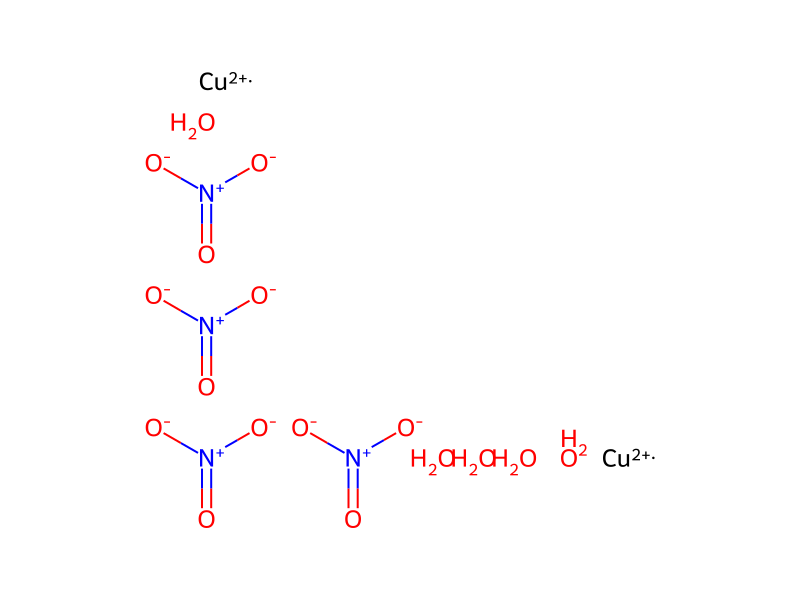
Basic information
- Standard SMILES
O.O.O.O.O.O=[N+]([O-])[O-].O=[N+]([O-])[O-].O=[N+]([O-])[O-].O=[N+]([O-])[O-].[Cu+2].[Cu+2]- InChIKey
IZDJJEMZQZQQQQ-UHFFFAOYSA-N- Molecular formula
- Cu2H10N4O17
- Average molar mass
- 465.19 g/mol
- Monoisotopic mass
- 463.86328986
Names & identifiers
- Preferred name
- Copper(II) nitrate hemipentahydrate
- IUPAC
- dicopper;tetranitrate;pentahydrate
- English name
- CUPRIC NITRATE, HYDRATE
- Molecular formula
- CuH3NO4
- Molecular weight
- 144.57
Names & synonyms
19004-19-4Copper II nitrate hemipentahydrateCopper(II) nitrate hemi(pentahydrate)copper(II) nitrate hemipentahydrateCopper nitrate pentahydrateCopper nitrate hemipentahydrateDTXSID90172467Cupric nitrate hemipentahydrateRefChem:578903DTXCID4094958dicopper;tetranitrate;pentahydrateSCHEMBL67093
Show more names
COPPER (II) NITRATECupric Nitrate, ReagentCUPRIC NITRATE, HYDRATECOPPER NITRATE, HYDRATEPROTEINASE K 20MG/ML SOL.Copper (II) Nitrate, flakeCopper Nitrate 2.5-hydrateCUPRIC NITRATE, 2.5-HYDRATECOPPER (II) NITRATE, HYDRATECOPPER(II) NITRATE-2,5-HYDRATE
copper (II) nitrate hemipentahydrateCopper(II)nitrate hemi(pentahydrate)AKOS015915858dicopper(2+) pentahydrate tetranitrateNitric acid copper salt hydrate (2:5)Copper(2+) nitrate--water (2/4/5)FN145361NS00129558
Database identifiers
- CAS
19004-19-4- PubChem CID
- 167780
- DTXSID
DTXSID90172467- EC Number
- 606-197-5
Properties
Computed structural properties
- Topological polar surface area
- 257 Ų
- Hydrogen bond donors
- 5
- Hydrogen bond acceptors
- 17
- Rotatable bonds
- 0
- Heavy atoms
- 23
- Formal charge
- 0
- Complexity
- 18.8
Experimental & physicochemical properties
Chemical ClassesMetals -> Metals, Inorganic Compounds
Melting Point115 °C
Physical DescriptionBlue odorless crystals; Hygroscopic; [Alfa Aesar MSDS]
Physicochemical properties
- Melting point
- 114.5 °C · 114.5 °C (dec.)(lit.)
- Boiling point
- 170 °C · 170°C
- Density
- 2.32 · 2.32
- Flash point
- 170 °C · 170°C
- form
- Powder/Solid
- Specific Gravity
- 2.05 · 2.05
- color
- Blue
- Water Solubility
- Soluble in water, ammonia and ethanol
- Sensitive
- Hygroscopic
- Merck
- 14 · 14,2643
- Exposure limits
- 1 mg/m3NIOSH: · ACGIH: TWA 1 mg/m3NIOSH: IDLH 100 mg/m3; TWA 1 mg/m3
- Major Application
- electroplatingmaterial synthesis precursor
- InChI
- 1S/2Cu.4NO3.5H2O/c;;4*2-1(3)4;;;;;/h;;;;;;5*1H2/q2*+2;4*-1;;;;;
- InChIKey
- IZDJJEMZQZQQQQ-UHFFFAOYSA-N
- SMILES
- O.O.O.O.O.[Cu++].[Cu++].[O-][N+]([O-])=O.[O-][N+]([O-])=O.[O-][N+]([O-])=O.[O-][N+]([O-])=O
- CAS DataBase Reference
- 19004 · 19004-19-4(CAS DataBase Reference)
- UNSPSC Code
- 12352302 · 12352302
- NACRES
- 23 · NA.23
- Symbol(GHS)
- 3 · GHS03,GHS05,GHS07,GHS09
- Signal word
- Danger
- Hazard statements
- 271 · H271-H290-H302-H314-H410
- Precautionary statements
- 210 · P210-P260-P280-P305+P351+P338-P370+P378-P371+P380+P375
- PPE
- 95 · dust mask type N95 (US), Eyeshields, Gloves
- Hazard Codes
- O,C,N,Xn
- Risk Statements
- 8 · 8-22-34-50/53-41-38
- Safety Statements
- 17 · 17-26-36/37/39-45-61-60-39
- RIDADR
- 3085 · UN 3085 5.1/PG 2
- WGK Germany
- 2 · 2
- RTECS
- 7400000 · QU7400000
- TSCA
- Yes
- HazardClass
- 5.1 · 5.1
- PackingGroup
- III
- HS Code
- 28342990 · 28342990
- Storage Class
- 5.1 A · 5.1A - Strongly oxidizing hazardous materials
- Hazard Classifications
- 4 OralAquatic · Acute Tox. 4 OralAquatic Acute 1Aquatic Chronic 1Eye Dam. 1Met. Corr. 1Ox. Sol. 1Skin Corr. 1B
- Excepted Quantities
- Not Permitted as Excepted Quantity
Safety & regulation
GHS classification
GHS Classification
This chemical does not meet GHS hazard criteria for 5.7% (5 of 87) of reports.
Danger
H272 (93.1%): May intensify fire; oxidizer [Danger Oxidizing liquids; Oxidizing solids]
P210, P220, P264, P264+P265, P270, P273, P280, P301+P317, P302+P352, P305+P351+P338, P305+P354+P338, P317, P321, P330, P332+P317, P337+P317, P362+P364, P370+P378, P391, and P501 (click each P-code to see the statement)
Aggregated GHS information provided per 87 reports by companies from 7 notifications to the ECHA C&L Inventory. Each notification may be associated with multiple companies.
Hazard information
Regulatory Information
Chemical: Nitric acid, copper(2+) salt, hydrate (2:5)
Nitric acid, copper(2+) salt, hydrate (2:5): Does not have an individual approval but may be used under an appropriate group standard
Hazards Summary
Acute copper poisoning after ingestion can cause liver injury, methemoglobinemia, and hemolytic anemia. Acute renal failure may result, secondary to massive hemoglobinuria. [Goldfrank, p. 1259] oxidizer that may cause fire on contact with combustible materials; Causes burns; Harmful by ingestion; [Alfa Aesar MSDS] See Copper. See NITRATES and NITRITES.
Hazard Classes and CategoriesOx. Sol. 2 (93.1%)
Safety & protection
Exposure Control and Personal Protection0.01 [mg/m3], respirable fraction (Cu, inorganic cmpnds)[German Research Foundation (DFG)]
Threshold Limit Values (TLV)1.0 [mg/m3], as Cu
Permissible Exposure Limit (PEL)1.0 [mg/m3], as Cu
Protective Action Criteria (PAC)
0.15 [mg/m3]
65 [mg/m3]
390 [mg/m3]
Immediately Dangerous to Life or Health (IDLH)100.0 [mg/m3], as Cu
Toxicology
Adverse EffectsOccupational hepatotoxin - Secondary hepatotoxins: the potential for toxic effect in the occupational setting is based on cases of poisoning by human ingestion or animal experimentation.
Safety data
- PPE
- dust mask type N95 (US), Eyeshields, Gloves
- wgk
- 2
- tsca
- Yes
- rtecs
- QU7400000
- ridadr
- UN 3085 5.1/PG 2
- hs_code
- 28342990
- risk_code
- 8-22-34-50/53-41-38
- Signal word
- Danger
- Symbol(GHS)
- GHS03,GHS05,GHS07,GHS09
- hazard_code
- O,C,N,Xn
- safety_code
- 17-26-36/37/39-45-61-60-39
- hazard_class
- 5.1
- Storage Class
- 5.1A - Strongly oxidizing hazardous materials
- packing_group
- III
- Hazard statements
- H271-H290-H302-H314-H410
- Excepted Quantities
- Not Permitted as Excepted Quantity
- Hazard Classifications
- Acute Tox. 4 OralAquatic Acute 1Aquatic Chronic 1Eye Dam. 1Met. Corr. 1Ox. Sol. 1Skin Corr. 1B
- Precautionary statements
- P210-P260-P280-P305+P351+P338-P370+P378-P371+P380+P375
Chemistry & industry
Uses & manufacturing
Household ProductsInformation on 1 consumer products that contain Copper II nitrate hemipentahydrate in the following categories is provided:
Applications
UsesCatalyst, nitrating agent for aromatic organosilicon compounds, nickel-plating baths, coloring copper black and producing a burnished effect on ironCopper(II) nitrate hemi(pentahydrate) is used for the catalytic oxidative coupling of 2,6-dimethylphenol to produce a polymer which is an important engineering material. Its solutions are used in textiles and polishing agents for other metals. It is commonly used in school laboratories to demonstrate chemical voltaic cell reactions.
UsesCatalyzes oxidative coupling of 2,6-dimethylphenol to produce a polymer which is an important engineering material.
UsesCUPRIC NITRATE HYDRATE is used in preparation of copper standard solutions.
General DescriptionCopper(II) nitrate hemi(pentahydrate) is an inorganic copper salt.
Suppliers46 total
湖南韵邦生物科技股份有限公司85561037 15386497078 · [email protected]
江苏艾康生物医药研发有限公司025-025-66113011 15955137747 · [email protected]
Aladdin Scientific[email protected]
上海迈瑞尔生化科技有限公司4006356688 18621169109 · [email protected]
阿法埃莎(中国)化学有限公司400-6106006 · [email protected]
安耐吉化学&3A(安徽泽升科技股份有限公司)400-0056266 · [email protected]
梯希爱(上海)化工贸易有限公司021-61109150 · [email protected]
上海瀚鸿科技股份有限公司021-54306202 13764082696 · [email protected]
广东方信生物科技有限公司0751-2838688 13376594225 · [email protected]
天津希恩思生化科技有限公司400 638 7771 · [email protected]
斯百全化学(上海)有限公司021-021-021-67601398-809-809-809 15221380277 · [email protected]
赛默飞世尔科技(中国)有限公司800-810-5118 · [email protected]
北京伊诺凯科技有限公司400-810-7969 010-59572699 · [email protected]
上海创赛科技有限公司400-6087598 15021221957 · [email protected]
上海麦克林生化科技股份有限公司15221275939 15221275939 · [email protected]
Sigma-Aldrich西格玛奥德里奇(上海)贸易有限公司021-61415566 800-8193336 · [email protected]
九鼎化学(上海)科技有限公司4009209199 · [email protected]
上海玻尔化学试剂有限公司19102157732 · [email protected]
艾吉析科技(上海)有限公司17721401538;17717235263 17721401538 · [email protected]
上海阿拉丁生化科技股份有限公司6206333 13167063860 · [email protected]
陕西缔都医药化工有限公司029-029-81120477 17792793610 · [email protected]
陕西缔都医药化工有限公司+86-29-81139210 +86-17392587031 · [email protected]
艾万拓威达优尔国际贸易(上海)有限公司400-821-8006 · [email protected]
成都艾娜华化学制剂有限公司028-86612776; 13699069380 · [email protected]
广东翁江化学试剂有限公司0751-2886750 13927877953 · [email protected]
广州市金华大化学试剂有限公司020-84383047 · [email protected]
上海贤鼎生物科技有限公司021-021-52271985 17721149837 · [email protected]
Shanghai Acmec Biochemical Technology Co., Ltd.+86-18621343501 · [email protected]
上海易恩化学技术有限公司400-400-1332688 18019345275 · [email protected]
厦门盈融达化工有限公司+86-0592-6210733 · [email protected]
天津希恩思生化科技有限公司400-6387771-6039 18920764717 · [email protected]
上海帅燊实业有限公司021-37590756 57450129
上海吉至生化科技有限公司021-4009004166/18616739031 18616739031 · [email protected]
career henan chemical co+86-0371-86658258 · [email protected]
北京迈瑞达科技有限公司010-82387566 · [email protected]
上海鼎芬化学科技有限公司021-37590756 · [email protected]
海蔚化学86-21-51086038 · [email protected]
爆牛贸易重庆有限公司+86-023-6139-8061 +86-86-13650506873 · [email protected]
XIAMEN AMITY INDUSTRY AND TRADE CO., LTD.+8618950047208 · [email protected]
SHANGHAI KEAN TECHNOLOGY CO., LTD.+8613817748580 · [email protected]
北京百灵威科技有限公司18210857532 18210857532 · [email protected]
上海阿摩尔生物科技有限公司13370042665 18916960931 · [email protected]
宝鸡福诺康实业有限公司0917-3236817 13220096790 · [email protected]
上海科醚化学科技有限公司021-58690851 15690882017 · [email protected]
Henan Fengda Chemical Co., Ltd+86-371-86557731 +86-13613820652 · [email protected]
广东胜克生化科技股份有限公司18925113981 18925113981 · [email protected]
Related reactions
17 records





Linked notes
Loading…