Ascorbate Oxidase
ASO · AOX · Ascorbate Oxidase from microorganism · ASOD · C:C&B8 · ASO-311 · ASCORBASE · EC 1.10.3.3
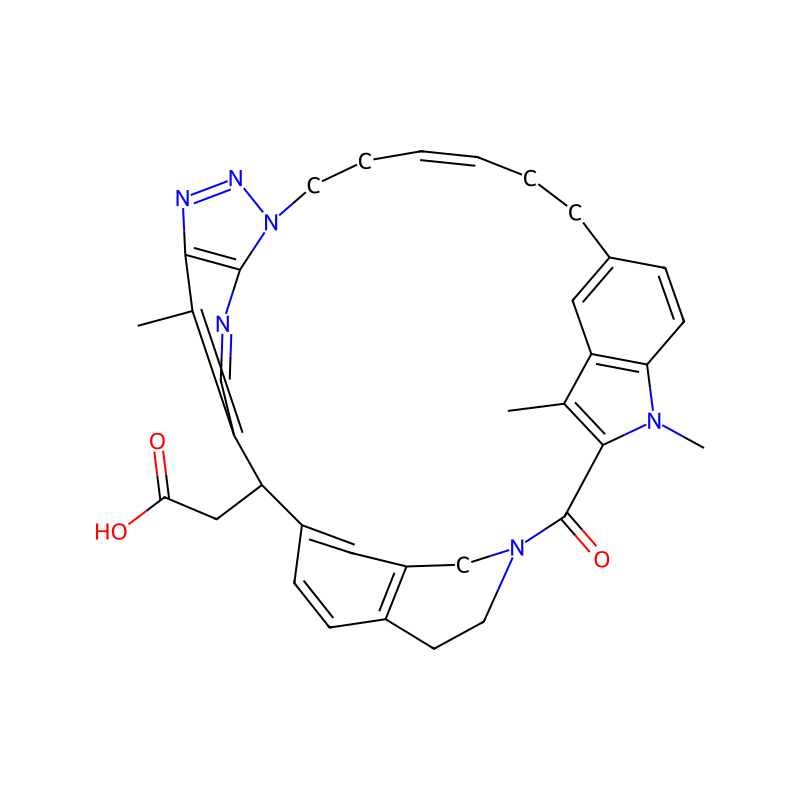
Identifiers & Physical Properties
| CAS No. | 9029-44-1 |
|---|---|
| Molecular formula | C35H36N6O3 |
| Average molar mass | 588.7 g/mol |
| Monoisotopic mass | 588.28488903 g/mol |
| SMILES | Cc1c2n(C)c3ccc(cc13)CCC=CCCn1nnc3c(C)c(cnc31)C(CC(=O)O)c1ccc3c(c1)CN(CC3)C2=O |
| InChIKey | IJDQXSQWJLQCRL-UHFFFAOYSA-N |
| PubChem CID | 168009863 |
| EC No. | 232-852-6 |
Chemical & Physical Properties
| XLogP | 5.1 |
|---|---|
| Topological polar surface area | 106 |
| Hydrogen bond donors | 1 |
| Hydrogen bond acceptors | 6 |
| Rotatable bonds | 2 |
| Heavy atoms | 44 |
| Formal charge | 0 |
| Complexity | 1,090 |
| Storage conditions | 2-8°C |
| Solubility | Soluble in aqueous buffers. |
| Physical state | powder |
| Color | faintly bluish |
| Biological source | plant (Cucurbita spp.) |
| Specific Activity | 1,000-3,000units/mg protein |
| UNSPSC Code | 12352204 |
| NACRES | NA.54 |
| GHS pictogram | GHS07 |
| Signal word | Warning |
| GHS hazard statements | H315-H319-H335 |
| GHS precautionary statements | P302+P352-P305+P351+P338-P362+P364 |
| Personal protective equipment (PPE) | Eyeshields, Gloves, type N95 (US) |
| Safety statements (S) | 24/25 |
| Water hazard class (WGK) | 3 |
| F | 10-21 |
| Customs code | 35079090 |
| Storage class | 11 - Combustible Solids |
| Hazard class | Resp. Sens. 1 |
Safety & Regulations
| GHS classification | This chemical does not meet GHS hazard criteria for 14.3% (1 of 7) of reports.DangerH334 (85.7%): May cause allergy or asthma symptoms or breathing difficulties if inhaled [Danger Sensitization, respiratory]P233, P260, P271, P284, P304+P340, P342+P316, P403, and P501 (click each P-code to see the statement)Aggregated GHS information provided per 7 reports by companies from 2 notifications to the ECHA C&L Inventory. |
|---|---|
| Regulatory information | Oxidase, ascorbate: Does not have an individual approval but may be used under an appropriate group standard |
| Hazard Classes and Categories | Resp. Sens. 1 (85.7%) |
| F | 10-21 |
| Personal protective equipment (PPE) | Eyeshields, Gloves, type N95 (US) |
| Water hazard class (WGK) | 3 |
| Customs code | 35079090 |
| Signal word | Warning |
| GHS pictogram | GHS07 |
| Safety statements (S) | 24/25 |
| Storage class | 11 - Combustible Solids |
| GHS hazard statements | H315-H319-H335 |
| Hazard class | Resp. Sens. 1 |
| GHS precautionary statements | P302+P352-P305+P351+P338-P362+P364 |
Applications & Uses
Description
Ascorbate oxidase (AO) is a cell wall-localized enzyme that uses oxygen to catalyse the oxidation of ascorbate (AA) to the unstable radical monodehydroascorbate (MDHA) which rapidly disproportionates to yield dehydroascorbate (DHA) and AA, and thus contributes to the regulation of the AA redox state.Ascorbate oxidase is useful for enzymatic determination of ascorbic acid and for eliminating the interference of ascorbic acid in clinical analysis.Effect of Various Chemicals on Ascorbate oxidase.
Uses
Biochemical research.
Uses
Ascorbate oxidase, from Cucurbita sp., may be used to study oxidative stress and heat stress response and tolerance. Also used in ascorbic acid assays to study the heat stress response of Arabidopsis and useful for enzymatic determination of ascorbic acid and for eliminating the interference of ascorbic acid in clinical analysis.
General Description
Ascorbate oxidase is a homodimeric enzyme, which comprises 552 amino acid residues per subunit (zucchini). It corresponds to a molecular mass of 70kDa per subunit. This enzyme is mainly found in plants, fungi and eubacteria.