HomeMCPWorkbenchSkills
HomeWorkbenchNotificationsMe
llms.txt · MCP GuidePrivacy Policy · Terms of Service · Supportv1.8.0
  1. Home
  2. /Compound

2,3,5,6-Tetrachloropyridine

HCID 16990
New noteNew reactionRequest quotes
Print preview
Basic informationNames & identifiersPropertiesSafety & regulationChemistry & industryRelated reactionsCompound notes
Substructure searchFind similar structures

Basic information

CAS
2402-79-1
Standard SMILES
Clc1cc(Cl)c(Cl)nc1Cl
InChIKey
FATBKZJZAHWCSL-UHFFFAOYSA-N
Molecular formula
C5HCl4N
Average molar mass
216.9 g/mol
Monoisotopic mass
214.88630975

Names & identifiers

Preferred name
2,3,5,6-Tetrachloropyridine
IUPAC
2,3,5,6-tetrachloropyridine
English name
2,3,5,6-Tetrachloropyridine
Molecular formula
C5HCl4N
Molecular weight
216.88

Names & synonyms

2,3,5,6-TETRACHLOROPYRIDINE2402-79-1Pyridine, 2,3,5,6-tetrachloro-DTXSID7027467Tetrachloropyridine, 2,3,5,6-NSC-2009MFCD00092428WJR8HAY65EDTXCID107467SCHEMBL2366051NSC20095-20-05-00421 (Beilstein Handbook Reference)
Show more names
SYMTETTetrapyridine2.3.5.6-TetracBifeprunox Impurity 502,3,5,6-tetrachlorpyridine2,3,5,7-tetrachloropyridine2,3,5,6-tetrachloro-pyridin2,3,5,6-Tetrachloropyridine 98+%
AKOS005258026NCGC00257813-01CAS-2402-79-1CS-01284152,3,5,6-TETRACHLOROPYRIDINE [HSDB]NSC 2009EINECS 219-283-9UNII-WJR8HAY65E

Database identifiers

CAS
2402-79-1、33752-16-8
PubChem CID
16990
DTXSID
DTXSID7027467
ChEMBL
CHEMBL3187097
UNII
WJR8HAY65E
EC Number
219-283-9
Nikkaji
J32.653D

Properties

Computed structural properties

XLogP
3.3
Topological polar surface area
12.9 Ų
Hydrogen bond donors
0
Hydrogen bond acceptors
1
Rotatable bonds
0
Heavy atoms
10
Formal charge
0
Complexity
108

Experimental & physicochemical properties

Chemical ClassesNitrogen Compounds -> Pyridines
LogP · 2 items

log Kow= 3.32

3.32

SolubilityVery soluble in ether, ethanol, petroleum ether
Boiling Point250.5 °C
DecompositionWhen heated to decomposition it emits very toxic fumes of /chlorides/ and /nitrogen oxides/.
Melting Point90.5 °C
Vapor Pressure0.00606 [mmHg]
Physical Description · 2 items

Other Solid

White solid; Darkens upon exposure to light and air; [CHEMINFO] White crystals with a camphor-like odor; [AIHA]

Dissociation ConstantspKa= -0.80

Physicochemical properties

Safety & regulation

Safety information is for reference only and does not replace the supplier’s Safety Data Sheet (SDS), applicable regulations, or professional assessment.

GHS classification

GHS Classification · 6 items

Danger

H301 (37.9%): Toxic if swallowed [Danger Acute toxicity, oral]

P261, P264, P270, P272, P273, P280, P301+P316, P301+P317, P302+P352, P321, P330, P333+P317, P362+P364, P391, P405, and P501 (click each P-code to see the statement)

Aggregated GHS information provided per 103 reports by companies from 5 notifications to the ECHA C&L Inventory. Each notification may be associated with multiple companies.

Warning

H302: Harmful if swallowed [Warning Acute toxicity, oral]

Hazard information

Regulatory Information · 3 items

Pyridine, 2,3,5,6-tetrachloro- is listed on the EPA's Chemical Data Reporting (CDR) system. Manufacturers and importers of Pyridine, 2,3,5,6-tetrachloro- are required to report information about their production and use of this chemical to the EPA under the Toxic Substances Control Act (TSCA). (40 eCFR Part 711)

Status: Cease Manufacture Update: 11-06-2014 https://echa.europa.eu/registration-dossier/-/registered-dossier/13192

Pyridine, 2,3,5,6-tetrachloro-: Does not have an individual approval but may be used as a component in a product covered by a group standard. It is not approved for use as a chemical in its own right.

Hazards SummaryMay cause irritation; Effects in high-dose animal studies include fatty liver degeneration; [MSDSonline] A mild skin and eye irritant; Evidence of liver and kidney injury after high-dose feeding studies of rats; [AIHA] See Pyridine.
Hazard Classes and Categories · 2 items

Acute Tox. 3 (37.9%)

Acute toxicity (Oral) - Category 4

Skin, Eye, and Respiratory IrritationsPyridine and its derivatives cause local irritation on contact with the skin, mucous membranes and cornea. /Pyridine and its derivatives/

Chemistry & industry

Uses & manufacturing

Uses · 2 items

Used as a chemical intermediate in the production of chlorpyrifos and triclopyr; [HSDB]

2,3,5,6-Tetrachloropyridine is used as a chemical intermediate in the production of chlorpyrifos and triclopyr.

U.S. Production2023: 5,000,000 - <10,000,000 lb
Industry UsesIntermediate
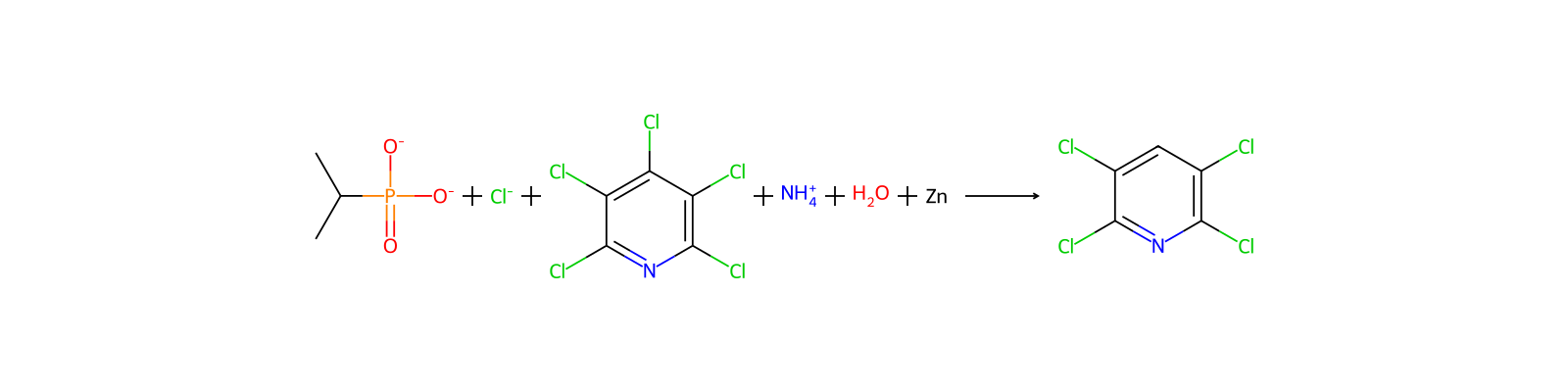
Methods of ManufacturingReduction /of pentachloropyridine/ with zinc, or electrochemically, yields 2,3,5,6-tetrachloropyridine.
General Manufacturing Information · 2 items

Pesticide, Fertilizer, and Other Agricultural Chemical Manufacturing

Pyridine, 2,3,5,6-tetrachloro-: ACTIVE

Applications

Uses2,3,5,6-Tetrachloropyridine is used as a chemical intermediate in the production of chlorpyrifos and triclopyr.

Upstream & downstream products

Downstream products

Sodium 3,5,6-trichloropyridin-2-olateChlorpyrifosTriclopyrChlorpyrifos-methyl2,3,5,6-Tetrafluoropyridine3,5,6-Trichloro-2-pyridinol(3,5,6-Trichloro-pyridin-2-yl)-hydrazine

Related reactions

54 records
New reaction record
HRID 53299 reaction equation
HRID 53299As productuspto-grants-1997_04
HRID 75920 reaction equation
HRID 75920As reactantuspto-grants-2014_09
HRID 90120 reaction equation
HRID 90120As productTraining data from https://doi.org/10.1039/C8SC04228D (2/10)
HRID 103066 reaction equation
HRID 103066As reactantTraining data from https://doi.org/10.1039/C8SC04228D (2/10)
HRID 115187 reaction equation
HRID 115187As productTraining data from https://doi.org/10.1039/C8SC04228D (2/10)
HRID 122383 reaction equation
HRID 122383As reactantTraining data from https://doi.org/10.1039/C8SC04228D (2/10)
HRID 128367 reaction equation
HRID 128367As productuspto-grants-1981_03
HRID 128368 reaction equation
HRID 128368As productuspto-grants-1981_03
Page 1 of 7

Compound notes

Loading…

On this pageBasic informationNames & identifiersPropertiesSafety & regulationChemistry & industryRelated reactionsCompound notes
More actions
New noteNew reactionRequest quotes
Melting point
90.5 °C · 90.5°C
Boiling point
251.6 °C · 251.6°C
Density
2.0309 · 2.0309 (rough estimate)
vapor pressure
3 Pa · 3Pa at 25℃
refractive index
1.6 · 1.6000 (estimate)
Flash point
188 °C · 188°C
storage temp.
Inert atmosphere,Room Temperature
solubility
very soluble in Ether,Ethanol
form
Crystalline
pka
-5.5 · -5.50±0.50(Predicted)
color
White to Almost white
BRN
129639 · 129639
Henry's Law Constant
1.2 · 1.2×10-3 mol/(m3Pa) at 25℃, HSDB (2015)
InChIKey
FATBKZJZAHWCSL-UHFFFAOYSA-N
LogP
3.87 at · 3.87 at 30℃ and pH7
Surface tension
72.4 mN/m · 72.4mN/m at 20.7mg/L and 21.3℃
CAS DataBase Reference
2402 · 2402-79-1(CAS DataBase Reference)
EWG's Food Scores
1 · 1
FDA UNII
8 HAY65E · WJR8HAY65E
EPA Substance Registry System
2 · 2,3,5,6-Tetrachloropyridine (2402-79-1)
Symbol(GHS)
7 · GHS07,GHS06,GHS09
Signal word
Warning
Hazard statements
302 · H302-H315-H319-H301-H335-H401-H411
Precautionary statements
261 · P261-P280a-P301+P310a-P305+P351+P338-P405-P501a-P264-P270-P280-P301+P312+P330-P302+P352+P332+P313+P362+P364-P305+P351+P338+P337+P313-P501
Hazard Codes
Xi
Risk Statements
20 · 20/21/22-36/37/38-51/53
Safety Statements
26 · 26-36/37/39-60-61-36
RIDADR
2811 · 2811
RTECS
8225000 · UT8225000
Hazard Note
Harmful/Irritant
TSCA
TSCA listed
HazardClass
6.1 · 6.1
PackingGroup
III
HS Code
2933392000 · 2933392000
Hazardous Substances Data
2402 · 2402-79-1(Hazardous Substances Data)
Toxicity
50 · mouse,LD50,intraperitoneal,1150mg/kg (1150mg/kg),BEHAVIORAL: SOMNOLENCE (GENERAL DEPRESSED ACTIVITY)LIVER: FATTY LIVER DEGERATIONBEHAVIORAL: ANTIPSYCHOTIC,Toxicology and Applied Pharmacology. Vol. 11, Pg. 361, 1967.
REACH Registrations
Inactive
Limited Quantities
5 L · 5.0 L (1.3 gallons) (liquid) or 5.0 kg (11 lbs) (solid)
Excepted Quantities
Max Inner Pack (30g or 30ml) and Max Outer Pack (1Kg or 1L)

Safety & protection

Disposal Methods · 1 item

SRP: At the time of review, criteria for land treatment or burial (sanitary landfill) disposal practices are subject to significant revision. Prior to implementing land disposal of waste residue (including waste sludge), consult with environmental regulatory agencies for guidance on acceptable disposal practices.

Preventive Measures · 1 item

SRP: The scientific literature for the use of contact lenses in industry is conflicting. The benefit or detrimental effects of wearing contact lenses depend not only upon the substance, but also on factors including the form of the substance, characteristics and duration of the exposure, the uses of other eye protection equipment, and the hygiene of the lenses. However, there may be individual substances whose irritating or corrosive properties are such that the wearing of contact lenses would be harmful to the eye. In those specific cases, contact lenses should not be worn. In any event, the usual eye protection equipment should be worn even when contact lenses are in place.

Personal Protective Equipment (PPE) · 1 item

Depending on the extent of possible contact, workers should be provided with personal protective equipment. A charcoal gas mask canister respirator has been found to be effective against a 2% pyridine concentration at 30 l/min for 1 hr. Rubber and plastic gloves should not be relied upon to prevent skin contact because pyridine and many of its derivatives penetrate these materials ... . /Pyridine, homologs, and derivatives/

Toxicology

Environmental Fate · 3 items

TERRESTRIAL FATE: Based on a classification scheme(1), an estimated Koc value of 1500(SRC), determined from a log Kow of 3.32(2) and a regression-derived equation(3), indicates that 2,3,5,6-tetrachloropyridine is expected to have low mobility in soil(SRC). Volatilization of 2,3,5,6-tetrachloropyridine from moist soil surfaces may be an important fate process(SRC) given an estimated Henry's Law constant of 8.5X10⁻³ atm-cu m/mole(SRC), using a fragment constant estimation method(4) although adsorption to soil surfaces may attenuate the rate of this process(SRC). 2,3,5,6-Tetrachloropyridine is not expected to volatilize from dry soil surfaces(SRC) based upon an estimated vapor pressure of 6.1X10⁻³ mm Hg(SRC), determined from a fragment constant method(5). 2,3,5,6-Tetrachloropyridine is expected to be resistant to biodegradation under aerobic conditions in soil based on data from structurally-similar compounds(SRC). Only <0.1% and 3% of the available nitrogen was released over 64 days following the application of 2,3- and 2,6-dichloropyridine to soil(6). This compound may be susceptible to anaerobic biodegradation via dehalogenation(7).

AQUATIC FATE: Based on a classification scheme(1), an estimated Koc value of 1500(SRC), determined from a log Kow of 3.32(2) and a regression-derived equation(3), indicates that 2,3,5,6-tetrachloropyridine may adsorb to suspended solids and sediment(SRC). Volatilization from water surfaces is expected(3) based upon an estimated Henry's Law constant of 8.5X10⁻³ atm-cu m/mole(SRC), developed using a fragment constant estimation method(4). Using this Henry's Law constant and an estimation method(3), volatilization half-lives for a model river and model lake are 4 hours and 6 days, respectively(SRC). However, volatilization from water surfaces is expected to be attenuated by adsorption to suspended solids and sediment in the water column. The estimated volatilization half-life from a model pond is 2.7 years if adsorption is considered(7). According to a classification scheme(5), an estimated BCF of 70(SRC), from its log Kow(2) and a regression-derived equation(6), suggests the potential for bioconcentration in aquatic organisms is moderate(SRC). 2,3,5,6-Tetrachloropyridine is expected to be resistant to biodegradation under aerobic conditions in water based on soil data from structurally-similar compounds(SRC). Only <0.1% and 3% of the available nitrogen was released over 64 days following the application of 2,3- and 2,6-dichloropyridine to soil(8). This compound may be susceptible to anaerobic biodegradation via dehalogenation(9).

ATMOSPHERIC FATE: According to a model of gas/particle partitioning of semivolatile organic compounds in the atmosphere(1), 2,3,5,6-tetrachloropyridine, which has an estimated vapor pressure of 6.1X10⁻³ mm Hg at 25 °C(SRC), determined from a fragment constant method(2), is expected to exist solely as a vapor in the ambient atmosphere. Vapor-phase 2,3,5,6-tetrachloropyridine is degraded in the atmosphere by reaction with photochemically-produced hydroxyl radicals(SRC); the half-life for this reaction in air is estimated to be nearly 3 years(SRC), calculated from its rate constant of 1.6X10⁻¹⁴ cu cm/molecule-sec at 25 °C(SRC) determined using a structure estimation method(3).

Adverse EffectsOccupational hepatotoxin - Secondary hepatotoxins: the potential for toxic effect in the occupational setting is based on cases of poisoning by human ingestion or animal experimentation.
Soil Adsorption/Mobility · 1 item

The Koc of 2,3,5,6-tetrachloropyridine is estimated as 1500(SRC), using a log Kow of 3.32(1) and a regression-derived equation(2). According to a classification scheme(3), this estimated Koc value suggests that 2,3,5,6-tetrachloropyridine is expected to have low mobility in soil.

Artificial Pollution Sources2,3,5,6-Tetrachloropyridine's production and use as a chemical intermediate in the production of pesticides such as chlorpyrifos and triclopyr(1) may result in its release to the environment through various waste streams(SRC).
Environmental Biodegradation · 1 item

Information pertaining to the biodegradation of 2,3,5,6-tetrachloropyridine in soil and water was not located in the available literature. However, an aerobic biological screening study, which utilized a 10 mg/L yeast extract and an Aeric Ocharaqualf soil for inocula, indicates that chloropyridines are not readily biodegradable(1). At 24 °C and a pH of 7, less than 1% and 14% of the initial 2,3- and 2,6-dichlorpyridine were mineralized within 30 days as evidenced via the release of inorganic nitrogen(1). An aerobic soil grab sample study also demonstrated that dichlorpyridines are not readily biodegradable(2). 2,3- and 2,6-Dichloropyridine were added to fincastle silt loam (Aeric Ochraqualf) with a pH of 6.7 and incubated at 25 °C(2). Within 64 days, less than 0.1% and 3% of the available nitrogen were released to inorganic forms(2). Sterilized controls lost less than 5% of the starting material to volatilization and did not release inorganic nitrogen(2).

Environmental Bioconcentration · 1 item

An estimated BCF of 70 was calculated for 2,3,5,6-tetrachloropyridine(SRC), using a log Kow of 3.32(1) and a regression-derived equation(2). According to a classification scheme(3), this BCF suggests the potential for bioconcentration in aquatic organisms is moderate(SRC).

Volatilization from Water/Soil · 1 item

The Henry's Law constant for 2,3,5,6-tetrachloropyridine is estimated as 8.5X10⁻³ atm-cu m/mole(SRC) using a fragment constant estimation method(1). This Henry's Law constant indicates that 2,3,5,6-tetrachloropyridine is expected to volatilize from water surfaces(2). Based on this Henry's Law constant, the volatilization half-life from a model river (1 m deep, flowing 1 m/sec, wind velocity of 3 m/sec)(2) is estimated as 4 hours(SRC). The volatilization half-life from a model lake (1 m deep, flowing 0.05 m/sec, wind velocity of 0.5 m/sec)(2) is estimated as 6 days(SRC). However, volatilization from water surfaces is expected to be attenuated by adsorption to suspended solids and sediment in the water column. The estimated volatilization half-life from a model pond is 2.7 years if adsorption is considered(4). 2,3,5,6-Tetrachloropyridine's Henry's Law constant(1) indicates that volatilization from moist soil surfaces may occur(SRC). 2,3,5,6-Tetrachloropyridine is not expected to volatilize from dry soil surfaces(SRC) based upon an estimated vapor pressure of 6.1X10⁻³ mm Hg(SRC), determined from a fragment constant method(3).

Environmental Abiotic Degradation · 1 item

The rate constant for the vapor-phase reaction of 2,3,5,6-tetrachloropyridine with photochemically-produced hydroxyl radicals has been estimated as 1.6X10⁻¹⁴ cu cm/molecule-sec at 25 °C(SRC) using a structure estimation method(1). This corresponds to an atmospheric half-life of nearly 3 years at an atmospheric concentration of 5X10+5 hydroxyl radicals per cu cm(1). 2,3,5,6-Tetrachloropyridine is not expected to undergo hydrolysis in the environment due to the lack of hydrolyzable functional groups(2). Pyridine has a weak absorption band that extends into the environmental UV spectrum(3), which suggests that direct photolysis is not likely to be an important fate process for 2,3,5,6-tetrachloropyridine (SRC).

Probable Routes of Human Exposure · 1 item

The most probable human exposure to 2,3,5,6-tetrachloropyridine would be occupational exposure, which may occur through dermal contact or inhalation at places where it is produced or used. NIOSH (NOES Survey 1981-83) has estimated that 311 workers are potentially exposed to 2,3,5,6-tetrachloropyridine in the USA(1).

Environmental Fate/Exposure Summary · 1 item

2,3,5,6-Tetrachloropyridine's production and use as a chemical intermediate in the production of pesticides such as chlorpyrifos and triclopyr may result in its release to the environment through various waste streams. If released to air, an estimated vapor pressure of 6.1X10⁻³ mm Hg at 25 °C indicates 2,3,5,6-tetrachloropyridine will exist solely as a vapor. Vapor-phase 2,3,5,6-tetrachloropyridine will be degraded in the atmosphere by reaction with photochemically-produced hydroxyl radicals; the half-life for this reaction in air is estimated to be 3 years. If released to soil, 2,3,5,6-tetrachloropyridine is expected to have low mobility based upon an estimated Koc of 1500. Volatilization from moist soil surfaces is expected to be an important fate process based upon an estimated Henry's Law constant of 8.5X10⁻³ atm-cu m/mole. 2,3,5,6-Tetrachloropyridine is expected to be resistant to biodegradation under aerobic conditions in both soil and water based on soil data from structurally-similar compounds. Only <0.1% and 3% of the available nitrogen was released over 64 days following the application of 2,3- and 2,6-dichloropyridine to soil. 2,3,5,6-Tetrachloropyridine may be susceptible to anaerobic biodegradation via dehalogenation. If released into water, 2,3,5,6-tetrachloropyridine may adsorb to suspended solids and sediment based upon the estimated Koc. Volatilization from water surfaces may be an important fate process based upon this compound's estimated Henry's Law constant. Estimated volatilization half-lives for a model river and model lake are 4 hours and 6 days, respectively. However, volatilization from water surfaces is expected to be attenuated by adsorption to suspended solids and sediment in the water column; a half-life of 2.7 years is estimated if adsorption is considered in a model pond scenario. An estimated BCF of 70 suggests the potential for bioconcentration in aquatic organisms is moderate. Occupational exposure to 2,3,5,6-tetrachloropyridine may occur through inhalation and dermal contact with this compound at workplaces where 2,3,5,6-tetrachloropyridine is produced or used. (SRC)

Antidote and Emergency Treatment · 2 items

/SRP:/ Basic treatment: Establish a patent airway. Suction if necessary. Watch for signs of respiratory insufficiency and assist ventilations if needed. Administer oxygen by nonrebreather mask at 10 to 15 L/min. Monitor for pulmonary edema and treat if necessary ... . Monitor for shock and treat if necessary ... . Anticipate seizures and treat if necessary ... . For eye contamination, flush eyes immediately with water. Irrigate each eye continuously with normal saline during transport ... . Do not use emetics. For ingestion, rinse mouth and administer 5 ml/kg up to 200 ml of water for dilution if the patient can swallow, has a strong gag reflex, and does not drool ... . Cover skin burns with dry sterile dressings after decontamination ... . /Poison A and B/

/SRP:/ Advanced treatment: Consider orotracheal or nasotracheal intubation for airway control in the patient who is unconscious, has severe pulmonary edema, or is in respiratory arrest. Positive pressure ventilation techniques with a bag valve mask device may be beneficial. Monitor cardiac rhythm and treat arrhythmias as necessary ... . Start an IV with D5W /SRP: "To keep open", minimal flow rate/. Use lactated Ringer's if signs of hypovolemia are present. Watch for signs of fluid overload. Consider drug therapy for pulmonary edema ... . For hypotension with signs of hypovolemia, administer fluid cautiously. Watch for signs of fluid overload ... . Treat seizures with diazepam (Valium) ... . Use proparacaine hydrochloride to assist eye irrigation ... . /Poison A and B/

Toxicity DataLC50 (rat) = 98,000 mg/m3/4h

Safety data

tsca
TSCA listed
rtecs
UT8225000
ridadr
2811
hs_code
2933392000
Toxicity
mouse,LD50,intraperitoneal,1150mg/kg (1150mg/kg),BEHAVIORAL: SOMNOLENCE (GENERAL DEPRESSED ACTIVITY)LIVER: FATTY LIVER DEGERATIONBEHAVIORAL: ANTIPSYCHOTIC,Toxicology and Applied Pharmacology. Vol. 11, Pg. 361, 1967.
risk_code
20/21/22-36/37/38-51/53
Signal word
Warning
Symbol(GHS)
GHS07,GHS06,GHS09
hazard_code
Xi
hazard_note
Harmful/Irritant
safety_code
26-36/37/39-60-61-36
hazard_class
6.1
packing_group
III
Hazard statements
H302-H315-H319-H301-H335-H401-H411
Limited Quantities
5.0 L (1.3 gallons) (liquid) or 5.0 kg (11 lbs) (solid)
Excepted Quantities
Max Inner Pack (30g or 30ml) and Max Outer Pack (1Kg or 1L)
REACH Registrations
Inactive
Precautionary statements
P261-P280a-P301+P310a-P305+P351+P338-P405-P501a-P264-P270-P280-P301+P312+P330-P302+P352+P332+P313+P362+P364-P305+P351+P338+P337+P313-P501
Hazardous Substances Data
2402-79-1(Hazardous Substances Data)