HomeMCPWorkbenchSkills
HomeWorkbenchNotificationsMe
llms.txt · MCP GuidePrivacy Policy · Terms of Service · Supportv1.8.3
  1. Home
  2. /Compound

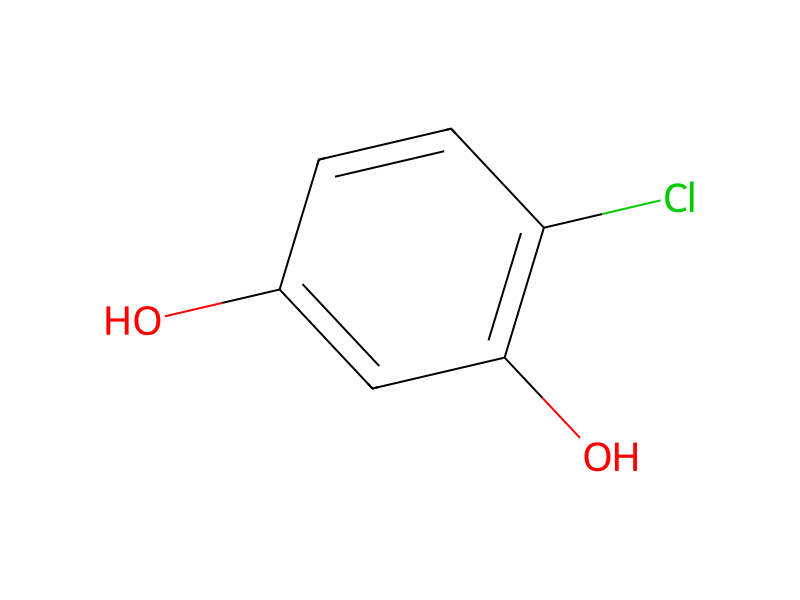
4-Chlororesorcinol

HCID 1731
New reaction
Print

Completing data — refresh the page later to see the latest
Basic informationNames & identifiersPropertiesSafety & regulationChemistry & industryRelated reactionsCompound notes
Substructure searchFind similar structures

Basic information

CAS
95-88-5
Standard SMILES
Oc1ccc(Cl)c(O)c1
InChIKey
JQVAPEJNIZULEK-UHFFFAOYSA-N
Molecular formula
C6H5ClO2
Average molar mass
144.55 g/mol
Monoisotopic mass
143.9978071

Names & identifiers

Preferred name
4-Chlororesorcinol
IUPAC
4-chlorobenzene-1,3-diol
English name
4-Chlororesorcinol
Molecular formula
C6H5ClO2
Molecular weight
144.56

Names & synonyms

4-Chlororesorcinol95-88-54-Chlororesorcinp-Chlororesorcinol1,3-Benzenediol, 4-chloro-6-Chlororesorcinol2,4-DihydroxychlorobenzeneResorcinol, 4-chloro-4-Chloro-1,3-benzenediol4-Chloro-1,3-dihydroxybenzeneC.I. 765101-Chloro-2,4-dihydroxybenzene
Show more names
Chlororesorcinol4-CHLORO RESRCINOLMonochlororesorcinol4- chlorineResorcinolc.i.76510ororesorcinoL4-CHLOROESORCINOL
CI 76510DTXSID8052643RODOL CRSNSC-1569NSC-6298COVASTYLE LP-4CLR87045U29QJCI-76510

Database identifiers

CAS
95-88-5
PubChem CID
1731
DTXSID
DTXSID8052643
UNII
87045U29QJ
EC Number
202-462-0
Nikkaji
J54.290C

Properties

Computed structural propertiesFilling in

XLogP
2.1
Topological polar surface area
40.5 Ų
Hydrogen bond donors
2
Hydrogen bond acceptors
2
Rotatable bonds
0
Heavy atoms
9
Formal charge
0
Complexity
97.1

Experimental & physicochemical properties

Chemical ClassesOther Classes -> Phenols
Cosmetics · 2 items

Cosmetic ingredients (4-Chlororesorcinol) -> CIR (Cosmetic Ingredient Review)

Hair dyeing

LogP1.8
Vapor Pressure0.0012 [mmHg]
Physical DescriptionBeige-brown solid; [EC: SCCS - Opinion] Light beige granular powder with a mild phenolic odor; [Jos. H. Lowenstein and Sons MSDS]
Collision Cross Section122.5 Ų [M-H]- [CCS Type: DT; Buffer gas: N2; Ionization: ESI-; Dataset: TOXCAST; Source Identifier: DTXSID8052643]

Physicochemical properties

Melting point
106 · 106-108 °C (lit.)
Boiling point
147 °C/18 · 147 °C/18 mmHg (lit.)
Density
1.2558 · 1.2558 (rough estimate)
vapor pressure
0.16 Pa · 0.16Pa at 25℃
refractive index
1.462 · 1.4620 (estimate)
Flash point
146 · 146-148°C/18mm
storage temp.
Keep in dark place,Inert atmosphere,Room temperature
solubility
1000 g/l · >1000g/l
pka
8.28 · 8.28±0.10(Predicted)
form
Powder
color
Beige
PH
3.8 · 3.8 (10g/l, H2O, 30℃)
Water Solubility
soluble
BRN
2042864 · 2042864
Stability
Stable. Incompatible with acid chlorides, acid anhydrides, oxidizing agents.
Cosmetics Ingredients Functions
HAIR DYEING
Cosmetic Ingredient Review (CIR)
4 · 4-Chlororesorcinol (95-88-5)
InChI
1S/C6H5ClO2/c7-5-2-1-4(8)3-6(5)9/h1-3,8-9H
InChIKey
JQVAPEJNIZULEK-UHFFFAOYSA-N
SMILES
Oc1ccc(Cl)c(O)c1
LogP
0.895 at · 0.895 at 25℃
CAS DataBase Reference
95 · 95-88-5(CAS DataBase Reference)
EWG's Food Scores
3 · 3-6
FDA UNII
87045 U29QJ · 87045U29QJ
NIST Chemistry Reference
1 · 1,3-Benzenediol, 4-chloro-(95-88-5)
EPA Substance Registry System
4 · 4-Chlororesorcinol (95-88-5)
UNSPSC Code
41116107 · 41116107
NACRES
22 · NA.22
Symbol(GHS)
5 · GHS05,GHS07
Signal word
Danger
Hazard statements
302 · H302-H315-H317-H318-H412
Precautionary statements
261 · P261-P273-P280-P301+P312-P302+P352-P305+P351+P338
Hazard Codes
Xn
Risk Statements
20 · 20/21/22-36/37/38-22
Safety Statements
26 · 26-36-22
WGK Germany
3 · 3
RTECS
450000 · VH0450000
TSCA
TSCA listed
HS Code
29081000 · 29081000
Storage Class
11 · 11 - Combustible Solids
Hazard Classifications
4 OralAquatic · Acute Tox. 4 OralAquatic Chronic 2Eye Dam. 1Skin Irrit. 2Skin Sens. 1
REACH Registrations
Active

Safety & regulation

Safety information is for reference only and does not replace the supplier’s Safety Data Sheet (SDS), applicable regulations, or professional assessment.

GHS classification

GHS Classification · 6 items

This chemical does not meet GHS hazard criteria for 1% (1 of 103) of reports.

Danger

H302 (91.3%): Harmful if swallowed [Warning Acute toxicity, oral]

P261, P264, P264+P265, P270, P271, P272, P273, P280, P301+P317, P302+P352, P304+P340, P305+P351+P338, P305+P354+P338, P317, P319, P321, P330, P332+P317, P333+P317, P337+P317, P362+P364, P391, P403+P233, P405, and P501 (click each P-code to see the statement)

Aggregated GHS information provided per 103 reports by companies from 18 notifications to the ECHA C&L Inventory. Each notification may be associated with multiple companies.

Danger

Hazard information

Regulatory Information · 4 items

Chemical: 1,3-Benzenediol, 4-chloro-

TP - indicates a substance that is the subject of a proposed TSCA section 4 test rule.

REACH registered substance: 4-chlororesorcinol (EC: 202-462-0)

4-Chlororesorcinol: Does not have an individual approval but may be used under an appropriate group standard

Other Safety InformationIMAP assessments - 1,3-Benzenediol, 4-chloro-: Human health tier II assessment
Hazards Summary · 1 item

A skin irritant in rabbits; Corrosive to rabbit eye; Considered a moderate skin sensitizer, based on local lymph node assay (LLNA) of mice; Hematotoxicity observed in 90-day oral study of rats; No evidence of developmental toxicity or teratogenicity in rats at doses up to 200 mg/kg/day; [EC: SCCS - Opinion] A severe skin irritant that may cause burns on prolonged contact; Corrosive to eyes; May cause skin sensitization; Harmful by ingestion; [Jos. H. Lowenstein and Sons MSDS] See Resorcinol.

Hazard Classes and Categories · 2 items

Acute Tox. 4 (91.3%)

Acute toxicity (ingestion) - category 4

Toxicology

Adverse EffectsDermatotoxin - Skin burns.
Toxicity SummarySafe in the present practices of use and concentration. Ingredient, concentration, and use information are available in documents discoverable at https://cir-reports.cir-safety.org

Safety data

wgk
3
tsca
TSCA listed
rtecs
VH0450000
hs_code
29081000
risk_code
20/21/22-36/37/38-22
Signal word
Danger
Symbol(GHS)
GHS05,GHS07
hazard_code
Xn
safety_code
26-36-22
Storage Class
11 - Combustible Solids
Hazard statements
H302-H315-H317-H318-H412
REACH Registrations
Active
Hazard Classifications
Acute Tox. 4 OralAquatic Chronic 2Eye Dam. 1Skin Irrit. 2Skin Sens. 1
Precautionary statements
P261-P273-P280-P301+P312-P302+P352-P305+P351+P338

Chemistry & industry

Uses & manufacturing

Uses · 3 items

CIR ingredient: 4-Chlororesorcinol

Used as a coupler in oxidative hair dyes; [EC: SCCS - Opinion]

Dressing Hair [Category: Other]

Household ProductsInformation on 9 consumer products that contain 4-Chlororesorcinol in the following categories is provided:
Use ClassificationCosmetics -> Hair dyeing
General Manufacturing Information1,3-Benzenediol, 4-chloro-: ACTIVE
Applications · 2 items

Description4-Chlororesorcinol is a relatively safe hair dye agent, exhibiting no embryotoxicity, reproductive toxicity, teratogenic effects, or carcinogenic effects. This ingredient is typically used at concentrations below 1% and is present in over 30 hair dye products. Furthermore, the CIR Expert Panel has concluded that the use of 4-Chlororesorcinol in current hair dye formulations is safe. Furthermore, it may serve as an analytical reagent, functioning as a coupling agent in oxidation coupling reactions to determine the p-aminophenol (p-Amp) content in paracetamol, as well as the concentration of benzocaine (BENZ) and its preparations (ear drops).

Uses4-Chlororesorcinol is a halogenated phenol that can be used as hair dye formulation. It can also be used in the synthesis of series of six coumarin compounds carrying halogen and trifluoromethyl, having antifungal activities.

Preparation methods · 1 item

Preparation4-Chlororesorcinol is synthesized by reacting resorcinol with dichlorosulfuryl. Resorcinol and diethyl ether were mixed, heated to reflux with stirring, and dichlorosulfuryl was slowly added dropwise. The temperature was then raised to 60°C for 1 h. After recovery of ether, atmospheric distillation is carried out, the distillate is subjected to vacuum distillation again, and the 131°C (0.8-0.93kPa) or 160-164°C (4.0kPa) fractions are collected to obtain the finished 4-chlororesorcinol.

Upstream & downstream products

Upstream raw materials

ResorcinolSulfuryl chlorideUrea, N,N-dichloro-3-Chloro-2,6-dimethoxybenzoic acid, 973-Chloro-2,6-dihydroxybenzoic acid2,4-Dihydroxy-5-chlorobenzoic acid4-Chloro-1,3-benzenediamine3-Acetoxy-2-cyclohexen-1-one2,4-Dichlorophenoxyacetic acid2-Chlororesorcinol

Downstream products

4-Chlorobenzene-1,2-diol2',7'-DichlorofluoresceinMethyl (6-chloro-7-hydroxy-4-methyl-2-oxo-2H-chromen-3-yl)acetateAURORA 16054

Related reactions

106 records
New reaction record
HRID 41611 reaction equation
HRID 41611As reactant
HRID 41612 reaction equation
HRID 41612As reactant
HRID 173817 reaction equation
HRID 173817As reactant
HRID 181571 reaction equation
HRID 181571As reactant
HRID 194769 reaction equation
HRID 194769As reactant
HRID 253717 reaction equation
HRID 253717As reactant
HRID 265825 reaction equation
HRID 265825As reactant
HRID 265827 reaction equation
HRID 265827As reactant
PreviousPage 1 of 14

Compound notes

On this pageBasic informationNames & identifiersPropertiesSafety & regulationChemistry & industryRelated reactionsCompound notes