
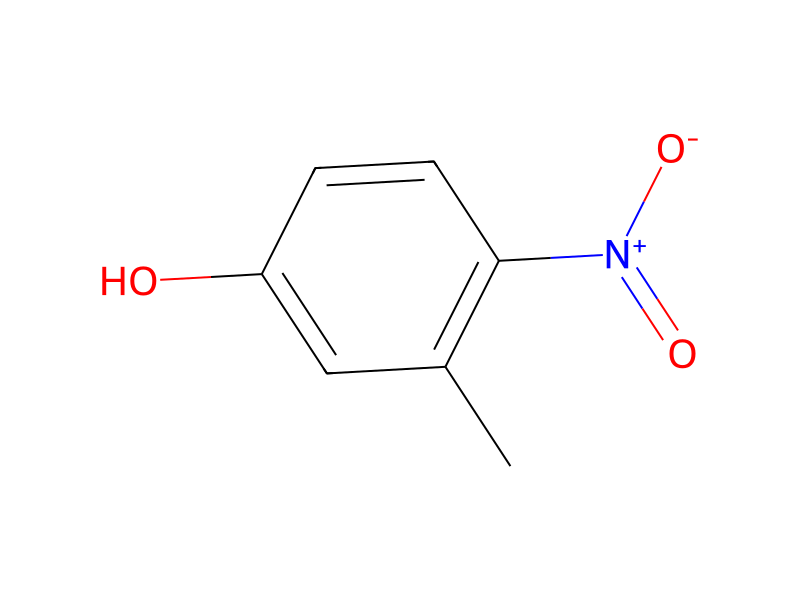
Basic information
- Standard SMILES
Cc1cc(O)ccc1[N+](=O)[O-]- InChIKey
PIIZYNQECPTVEO-UHFFFAOYSA-N- Molecular formula
- C7H7NO3
- Average molar mass
- 153.14 g/mol
- Monoisotopic mass
- 153.04259308
Overview
4-nitro-m-cresol is a C-nitro compound in which the nitro group is attached at C-4 of m-cresol. It is functionally related to a m-cresol.
Names & identifiers
- Preferred name
- 3-Methyl-4-nitrophenol
- IUPAC
- 3-methyl-4-nitrophenol
- English name
- 3-Methyl-4-nitrophenol
- Molecular formula
- C7H7NO3
- Molecular weight
- 153.14
Names & synonyms
3-Methyl-4-nitrophenol2581-34-24-Nitro-m-cresol4-Nitro-3-cresol5-Hydroxy-2-nitrotoluene4-Nitro-3-methylphenol2-Nitro-5-hydroxytoluenePhenol, 3-methyl-4-nitro-4-Nitro-5-methylphenolm-Cresol, 4-nitro-P-NITRO-M-CRESOL2CC94832EU
Show more names
-4-nitrophenoL3-methyl-4-nitro-phenoHA 01-01964-nitro-m-cresoNitrocresol,98%
NSC-69190DTXSID2062535CHEBI:38683RefChem:94775DTXCID2037398219-952-5MFCD000073334-Nitro-1-hydroxy-3-methylbenzene
Database identifiers
- CAS
2581-34-2- PubChem CID
- 17412
- DTXSID
DTXSID2062535- ChEBI
CHEBI:38683- UNII
- 2CC94832EU
- EC Number
- 219-952-5
- Nikkaji
- J55.423E、J886.766F
Properties
Computed structural properties
- XLogP
- 2.5
- Topological polar surface area
- 66.1 Ų
- Hydrogen bond donors
- 1
- Hydrogen bond acceptors
- 3
- Rotatable bonds
- 0
- Heavy atoms
- 11
- Formal charge
- 0
- Complexity
- 154
Experimental & physicochemical properties
Chemical Classes
Nitrogen Compounds -> Nitrophenols
Industrial compound
SpringerMaterials PropertiesFusion temperature
Pesticides
Environmental transformation -> Pesticide transformation products (metabolite, successor)
Pesticide (Fenitrothion metabolite (3-Methyl-4-nitrophenol)) -> USDA PDB
Endocrine DisruptorsPotential endocrine disrupting compound
Vapor Pressure0.000632 [mmHg]
Physical DescriptionDark yellow powder; [Sigma-Aldrich MSDS]
Physicochemical properties
- Melting point
- 125 · 125-130 °C(lit.)
- Boiling point
- 200 ℃ · 200℃(decomposition)
- Density
- 1.2744 · 1.2744 (estimate)
- refractive index
- 1.5744 · 1.5744 (estimate)
- Flash point
- 110 ℃ · 110℃
- storage temp.
- Sealed in dry,Room Temperature
- solubility
- Chloroform (Slightly), Methanol (Sparingly)
- form
- powder to crystal
- pka
- 7.39 · 7.39±0.10(Predicted)
- color
- Light yellow to Yellow to Orange
- Water Solubility
- Soluble in water(1.34g/L).
- BRN
- 1868105 · 1868105
- Henry's Law Constant
- 6.2 · 6.2×102 mol/(m3Pa) at 25℃, Tremp et al. (1993)
- CAS DataBase Reference
- 2581 · 2581-34-2(CAS DataBase Reference)
- EWG's Food Scores
- 1 · 1-3
- FDA UNII
- 2 CC94832EU · 2CC94832EU
- NIST Chemistry Reference
- 4 · 4-Nitro-5-methylphenol(2581-34-2)
- EPA Substance Registry System
- 4 · 4-Nitro-m-cresol (2581-34-2)
- Symbol(GHS)
- 7 · GHS07,GHS08,GHS09
- Signal word
- Warning
- Hazard statements
- 341 · H341-H411-H302-H312-H315-H319-H332-H335
- Precautionary statements
- 280 h-P261-P280-P305+P351+P338-P201-P202-P264-P270-P273-P301+P312+P330-P302+P352+P332+P313+P362+P364-P305+P351+P338+P337+P313-P308+P313-P391-P405-P501 · P280h-P261-P280-P305+P351+P338-P201-P202-P264-P270-P273-P301+P312+P330-P302+P352+P332+P313+P362+P364-P305+P351+P338+P337+P313-P308+P313-P391-P405-P501
- Hazard Codes
- Xn,Xi
- Risk Statements
- 20 · 20/21/22-36/37/38-22
- Safety Statements
- 26 · 26-36/37-37/39-36-24/25
- RIDADR
- 2446 · UN 2446 6.1/PG 3
- WGK Germany
- 3 · 3
- RTECS
- 2625000 · GP2625000
- TSCA
- TSCA listed
- HazardClass
- 6.1 · 6.1
- PackingGroup
- III
- HS Code
- 29089000 · 29089000
Safety & regulation
GHS classification
GHS Classification
Warning
H302 (93.6%): Harmful if swallowed [Warning Acute toxicity, oral]
P261, P264, P264+P265, P270, P271, P280, P301+P317, P302+P352, P304+P340, P305+P351+P338, P317, P319, P321, P330, P332+P317, P337+P317, P362+P364, P403+P233, P405, and P501 (click each P-code to see the statement)
Aggregated GHS information provided per 47 reports by companies from 5 notifications to the ECHA C&L Inventory. Each notification may be associated with multiple companies.
Danger
H302: Harmful if swallowed [Warning Acute toxicity, oral]
Hazard information
Regulatory Information
Chemical: Phenol, 3-methyl-4-nitro-
3-Methyl-4-nitrophenol: Does not have an individual approval but may be used under an appropriate group standard
Other Safety InformationEvaluation - Chemicals not considered for in depth evaluation - Not commercially active in Australia
Hazards Summary
Transient excretion of glucose to urine observed in 6-month oral study of rats at 1,500 ppm (no other adverse effects observed); A preliminary reproductive/developmental study of rats demonstrated decreased locomotor activity and thrombi in the kidney, heart, and lung in males at 300 mg/kg/day, but no evidence of reproductive or developmental toxicity; Mutagenic effects observed in vitro and in vivo; [OECD SIDS: 3-Methyl-4-nitrophenol - 1994] No adverse effects observed in mice orally administered 25 mg/kg during gestation; [Shepard's Catalog of Teratogenic Agents] An irritant that may cause serious eye injury; Harmful by ingestion, inhalation, and skin absorption; [Sigma-Aldrich MSDS]
Hazard Classes and Categories
Acute Tox. 4 (93.6%)
Self-reactive substances and mixtures - Type G
Safety data
- wgk
- 3
- tsca
- TSCA listed
- rtecs
- GP2625000
- ridadr
- UN 2446 6.1/PG 3
- hs_code
- 29089000
- risk_code
- 20/21/22-36/37/38-22
- Signal word
- Warning
- Symbol(GHS)
- GHS07,GHS08,GHS09
- hazard_code
- Xn,Xi
- safety_code
- 26-36/37-37/39-36-24/25
- hazard_class
- 6.1
- packing_group
- III
- Hazard statements
- H341-H411-H302-H312-H315-H319-H332-H335
- Precautionary statements
- P280h-P261-P280-P305+P351+P338-P201-P202-P264-P270-P273-P301+P312+P330-P302+P352+P332+P313+P362+P364-P305+P351+P338+P337+P313-P308+P313-P391-P405-P501
Chemistry & industry
Uses & manufacturing
UsesUsed as an intermediate for pesticides; [OECD SIDS: 3-Methyl-4-nitrophenol - 1994]
Use ClassificationEnvironmental transformation -> Pesticide transformation products (metabolite, successor)
General Manufacturing InformationPhenol, 3-methyl-4-nitro-: INACTIVE
Applications
Uses3-Methyl-4-nitrophenol is a biochemical used in the preparation of phosphorothioamidate analogues as antimalarial agents. 3-methyl-4-nitrophenol has anti-androgenic activity. PNMC significantly inhibits basal and hCG-stimulated testosterone production in rats.
Upstream & downstream products
Upstream raw materials
Downstream products
Suppliers50 total
国药集团化学试剂有限公司86-21-63210123 · [email protected]
梯希爱(上海)化成工业发展有限公司021-67121386 · [email protected]
上海阿拉丁生化科技股份有限公司400-6206333 13167063860 · [email protected]
Dayang Chem (Hangzhou) Co.,Ltd.+86-0571-88938639 17705817739 · [email protected]
北京华威锐科化工有限公司0757-86329057 18934348241 · [email protected]
武汉易泰科技有限公司上海分公司18930552037 · [email protected]
阿法埃莎(中国)化学有限公司400-6106006 · [email protected]
上海德默医药科技有限公司400-021-7337 2355568890 · [email protected]
安耐吉化学&3A(安徽泽升科技股份有限公司)400-0056266 · [email protected]
石家庄斯迪亚诺精细化工有限公司0311-89250318 13582355795 · [email protected]
上海瀚鸿科技股份有限公司021-54306202 13764082696 · [email protected]
南京圣亿来化工有限公司19951936396 · [email protected]
上海钰康生物科技有限公司+86-18930848214 +86-021-56762820 · [email protected]
上海景颜化工科技有限公司13817811078 · [email protected]
嘉兴市艾森化工有限公司0573-85285100 18627885956 · [email protected]
Pure Chemistry Scientific Inc.001-857-928-2050 or 1-888-588-9418 · [email protected]
郑州研德生物科技有限公司0371-63682289 15538176268 · [email protected]
山东西亚化学有限公司13355009207 13355009207 · [email protected]
玛雅试剂+86 (573) 82222445 (0)18006601000 452520369 · [email protected]
四川库利南科技有限公司400-1166-196 18981987031 · [email protected]
skychemical Co.Ltd021-20958197 20965099 · [email protected]
天津希恩思生化科技有限公司400 638 7771 · [email protected]
赛默飞世尔科技(中国)有限公司800-810-5118 · [email protected]
北京伊诺凯科技有限公司400-810-7969 010-59572699 · [email protected]
上海特伯化学科技有限公司+86-21-60341587 · [email protected]
江苏艾康生物医药研发有限公司025-66113011 13913916777 · [email protected]
TCI AMERICA800-4238616 · [email protected]
TOKYO CHEMICAL INDUSTRY CO., LTD.03-36680489 · [email protected]
TCI Europe320-37350700 · [email protected]
深圳康特腾科技有限公司86-0755-86635001 · [email protected]
Shanghai Witofly Chemical Co.,Ltd[email protected]
上海睿升化工科技有限公司+86-021-50935922
上海倍卓生物科技有限公司021-61119791,13386096464 · [email protected]
上海宸香医药科技有限公司021-20960837 · [email protected]
HBCChem, Inc.+1-510-219-6317 · [email protected]
上海毕得医药科技股份有限公司400-164-7117 18317119277 · [email protected]
成都零六生物科技有限公司400-1166-196 13458535857 · [email protected]
上海嵩爰化工科技有限公司010-1234567 18521000990 · [email protected]
上海有朋化工有限公司021-69005955 13701776567 · [email protected]
上海拓目化工有限公司13391076197 · [email protected]
上海凯赛化工有限公司021-33516722 13701817765 · [email protected]
上海彤源化工有限公司021-021-69182866 13701855675 · [email protected]
上海容立化学科技有限公司021-69992220 13701886816 · [email protected]
上海康拓化工有限公司021-69185552 13701777608 · [email protected]
桦特昇生物科技(武汉)有限公司027-59207879 1972026995 18140587686 · [email protected]
潍坊市前进精细化工有限公司18753684562 · [email protected]
TargetMol中国(陶术生物)021-021-33632979 15002134094 · [email protected]
Alfa Chemistry1-516-6625404 · [email protected]
上海昕凯医药科技有限公司21-619849051-1 18521059765 · [email protected]
上海陶术生物科技股份有限公司+1-781-999-5354; +1-00000000000 · [email protected]
Additional notes
DefinitionChEBI: A C-nitro compound in which the nitro group is attached at C-4 of m-cresol.
Related reactions
50 records


Linked notes
Loading…