
HRID 16912As reactant

2605-67-6COC(=O)C=P(c1ccccc1)(c1ccccc1)c1ccccc1NTNUDYROPUKXNA-UHFFFAOYSA-NSafety information is for reference only and does not replace the supplier’s Safety Data Sheet (SDS), applicable regulations, or professional assessment.
This chemical does not meet GHS hazard criteria for 50% (2 of 4) of reports.
Danger
H301 (50%): Toxic if swallowed [Danger Acute toxicity, oral]
P261, P264, P264+P265, P270, P271, P280, P301+P316, P302+P352, P304+P340, P305+P351+P338, P319, P321, P330, P332+P317, P337+P317, P362+P364, P403+P233, P405, and P501 (click each P-code to see the statement)
Aggregated GHS information provided per 4 reports by companies from 2 notifications to the ECHA C&L Inventory. Each notification may be associated with multiple companies.
Chemical: Acetic acid, (triphenylphosphoranylidene)-, methyl ester
REACH registered substance: Methyl (triphenylphosphoranylidene)acetate (EC: 220-018-4)
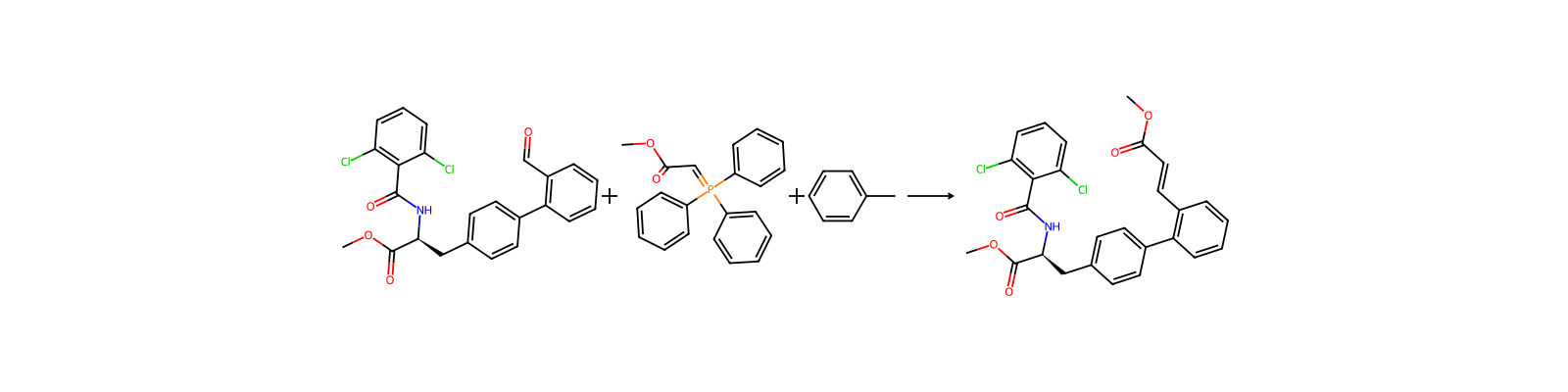
Uses(Methoxycarbonylmethylene)triphenylphosphorane is used in olefination reactions. Further, it undergoes the Wittig reaction with aldehydes to give substituted methyl acrylates. It is used in the preparation of (triphenylphosphoranylidene)-ketene.
UsesWittig reagent for the two-carbon homologation of aldehydes to α,β-unsaturated esters. Also used in an efficient synthesis of pyrazoles via reaction with methyl diazoacetate in the presence of triethylamine.
Uses(Methoxycarbonylmethylene)triphenylphosphorane is used in olefination reactions. Wittig reagent for the two-carbon homologation of aldehydes to α,β-unsaturated esters. it undergoes the Wittig reaction with aldehydes to give substituted methyl acrylates. used in an efficient synthesis of pyrazoles via reaction with methyl diazoacetate in the presence of triethylamine. It is used in the preparation of (triphenylphosphoranylidene)-ketene. The Wittig reaction we performed in class involved the reaction of 2-nitrobenzaldehyde (1) with methyl (triphenylphosphoranylidene) acetate (2) to produce methyl (2E)-3-(2-nitrophenyl) acrylate (3) with a triphenylphosphine oxide (4) side product, and took place in a silica gel matrix to ensure even product dispersion for chromatography.


2605-67-6DTXSID6062549CHEMBL1715161