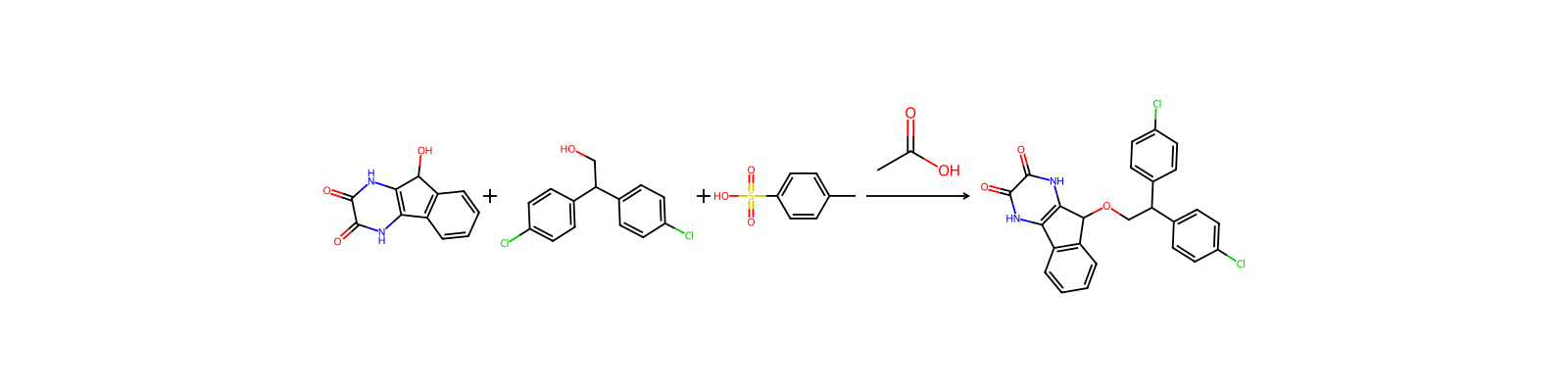
HRID 45504As reactant

2642-82-2OCC(c1ccc(Cl)cc1)c1ccc(Cl)cc1ZVIDYKRNLNAXFT-UHFFFAOYSA-N2,2-bis(4-chlorophenyl)ethanol is a organochlorine compound that is 4,4'-dichlorodiphenylmethane in which one of the methylene hydrogens is replaced by a hydroxymethyl group. It has a role as a xenobiotic metabolite. It is a primary alcohol and a member of monochlorobenzenes. It is functionally related to a 4,4'-dichlorodiphenylmethane.
2642-82-2DTXSID5041308CHEMBL3182945CHEBI:28410Safety information is for reference only and does not replace the supplier’s Safety Data Sheet (SDS), applicable regulations, or professional assessment.
Warning
H302 (100%): Harmful if swallowed [Warning Acute toxicity, oral]
P261, P264, P264+P265, P270, P271, P280, P301+P317, P302+P352, P304+P340, P305+P351+P338, P317, P319, P321, P330, P332+P317, P337+P317, P362+P364, P403+P233, P405, and P501 (click each P-code to see the statement)
Aggregated GHS information provided per 39 reports by companies from 2 notifications to the ECHA C&L Inventory. Each notification may be associated with multiple companies.
UsesDDOH is a metabolite of DDT and forms conjugates with palmitic acid in DDT-treated female rats.
General DescriptionDDOH is a metabolite of DDT and forms conjugates with palmitic acid in DDT-treated female rats.
DefinitionChEBI: 2,2-bis(4-chlorophenyl)ethanol is a organochlorine compound that is 4,4'-dichlorodiphenylmethane in which one of the methylene hydrogens is replaced by a hydroxymethyl group. It has a role as a xenobiotic metabolite. It is a primary alcohol and a member of monochlorobenzenes. It is functionally related to a 4,4'-dichlorodiphenylmethane.