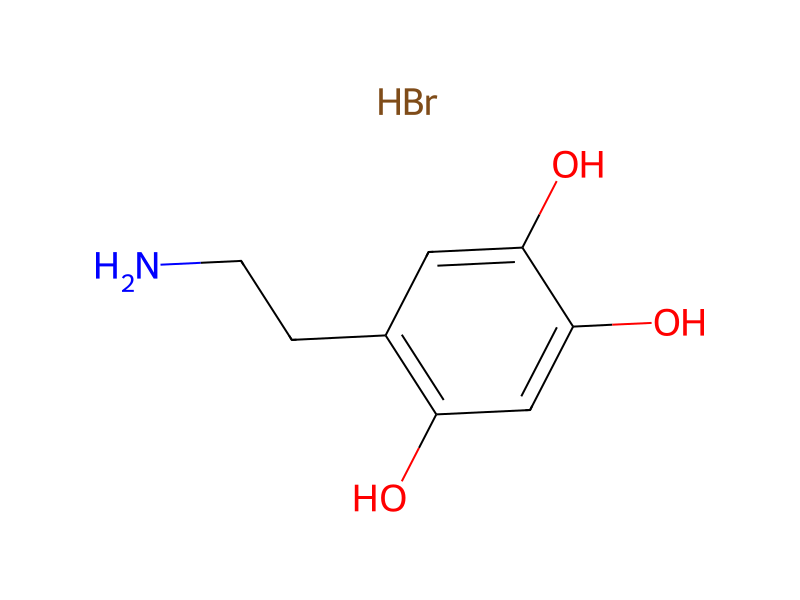
Basic information
- CAS
636-00-0- Standard SMILES
Br.NCCc1cc(O)c(O)cc1O- InChIKey
MLACDGUOKDOLGC-UHFFFAOYSA-N- Molecular formula
- C8H12BrNO3
- Average molar mass
- 250.09 g/mol
- Monoisotopic mass
- 249.00005534
Overview
See also: 6-Hydroxydopamine (annotation moved to); Hydroxydopamine (annotation moved to).
Names & identifiers
- Preferred name
- 1,2,4-Benzenetriol, 5-(2-aminoethyl)-, hydrobromide (1:1)
- IUPAC
- 5-(2-aminoethyl)benzene-1,2,4-triol;hydrobromide
- English name
- 6-HYDROXYDOPAMINE HYDROBROMIDE
- Molecular formula
- C8H12BrNO3
- Molecular weight
- 250.09
Names & synonyms
Show more names
Database identifiers
- CAS
636-00-0- PubChem CID
- 176170
- DTXSID
DTXSID30212972- ChEMBL
CHEMBL1718398- UNII
- TWC1D4W0WB
- EC Number
- 211-247-0
Properties
Computed structural properties
- Topological polar surface area
- 86.7 Ų
- Hydrogen bond donors
- 5
- Hydrogen bond acceptors
- 4
- Rotatable bonds
- 2
- Heavy atoms
- 13
- Formal charge
- 0
- Complexity
- 142
Physicochemical properties
- Melting point
- 216 · 216-220 °C(lit.)
- storage temp.
- -20 °C · -20°C
- solubility
- DMSO (Slightly), Methanol (Slightly), Water (Slightly)
- form
- solid
- color
- tan to brown
- BRN
- 3713280 · 3713280
- Stability
- Hygroscopic, Light Sensitive
- InChI
- InChI=1S/C8H11NO3.BrH/c9-2-1-5-3-7(11)8(12)4-6(5)10;/h3-4,10-12H,1-2,9H2;1H
- InChIKey
- MLACDGUOKDOLGC-UHFFFAOYSA-N
- SMILES
- C(C1C=C(O)C(O)=CC=1O)CN.Br
- CAS DataBase Reference
- 636 · 636-00-0(CAS DataBase Reference)
- FDA UNII
- 1 D4W0WB · TWC1D4W0WB
- UNSPSC Code
- 12352200 · 12352200
- NACRES
- 77 · NA.77
- Symbol(GHS)
- 7 · GHS07
- Signal word
- Warning
- Hazard statements
- 315 · H315-H319-H335
- Precautionary statements
- 261 · P261-P264-P271-P280-P302+P352-P305+P351+P338
- target organs
- Respiratory system
- PPE
- 95 · dust mask type N95 (US), Eyeshields, Gloves
- Hazard Codes
- Xi
- Risk Statements
- 36 · 36/37/38
- Safety Statements
- 26 · 26-36
- WGK Germany
- 3 · 3
- RTECS
- 4600000 · DC4600000
- F
- 3 · 3-10
- Storage Class
- 11 · 11 - Combustible Solids
- Hazard Classifications
- 2 Skin · Eye Irrit. 2Skin Irrit. 2STOT SE 3
Safety & regulation
GHS classification
GHS Classification
Warning
H315 (100%): Causes skin irritation [Warning Skin corrosion/irritation]
P261, P264, P264+P265, P271, P280, P302+P352, P304+P340, P305+P351+P338, P319, P321, P332+P317, P337+P317, P362+P364, P403+P233, P405, and P501 (click each P-code to see the statement)
Aggregated GHS information provided per 40 reports by companies from 3 notifications to the ECHA C&L Inventory. Each notification may be associated with multiple companies.
Hazard information
Safety data
- F
- 3-10
- PPE
- dust mask type N95 (US), Eyeshields, Gloves
- wgk
- 3
- rtecs
- DC4600000
- risk_code
- 36/37/38
- Signal word
- Warning
- Symbol(GHS)
- GHS07
- hazard_code
- Xi
- safety_code
- 26-36
- Storage Class
- 11 - Combustible Solids
- target organs
- Respiratory system
- Hazard statements
- H315-H319-H335
- Hazard Classifications
- Eye Irrit. 2Skin Irrit. 2STOT SE 3
- Precautionary statements
- P261-P264-P271-P280-P302+P352-P305+P351+P338
Chemistry & industry
Pharmacology
MeSH Pharmacological Classification
Drugs that inhibit the actions of the sympathetic nervous system by any mechanism. The most common of these are the ADRENERGIC ANTAGONISTS and drugs that deplete norepinephrine or reduce the release of transmitters from adrenergic postganglionic terminals (see ADRENERGIC AGENTS). Drugs that act in the central nervous system to reduce sympathetic activity (e.g., centrally acting alpha-2 adrenergic agonists, see ADRENERGIC ALPHA-AGONISTS) are included here.
Drugs that act on adrenergic receptors or affect the life cycle of adrenergic transmitters. Included here are adrenergic agonists and antagonists and agents that affect the synthesis, storage, uptake, metabolism, or release of adrenergic transmitters.
Applications
Description6-OHDA is a catecholaminergic neurotoxin that has been used to induce dopaminergic lesions and parkinsonian symptoms as a model of Parkinson''s disease in rodents. It induces locomotor impairment in mice and loss of tyrosine hydroxylase-reactive neurons in mouse brain when administered into the substantia nigra, medial forebrain bundle (MFB), or striatum at doses of 9, 6, and 18 μg, respectively. Intracisternal administration of 6-OHDA (200 μg) decreases dopamine and norepinephrine levels in rat brain. It induces apoptosis in primary rat cortical cells and PC12 rat adrenal cells when used at a concentration of 50 μM. 6-OHDA (75 μM) activates caspase-3, -8, and -9 in a time-dependent manner and increases the level of intracellular reactive oxygen species (ROS) in PC12 cells and induces apoptosis in rat substantia nigra when stereotaxically injected into the right MFB.
Uses6-Hydroxydopamine is a selective catecholaminergic neurotoxin. Studies show that 6-Hydroxydopamine can be used to create an animal model of Parkinson''s disease as it causes almost complete destruction of nigral dopaminergic neurons and their striatal terminals when injected into the substantia nigra of rats. 6-Hydroxydopamine induces apoptosis in PC12 cells.
General DescriptionSolutions should be freshly prepared and protected from exposure to light.
Suppliers100 total
Related reactions
No reaction records under the current filter.
Compound notes
Loading…