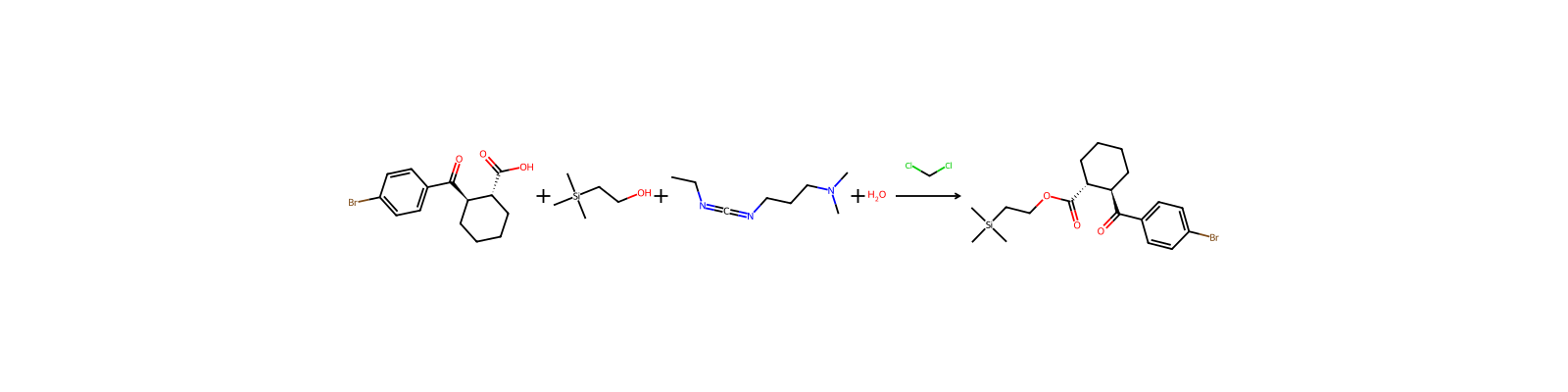
HRID 2712As reactant

2916-68-9C[Si](C)(C)CCOZNGINKJHQQQORD-UHFFFAOYSA-N2916-68-9DTXSID80183421CHEMBL25482Safety information is for reference only and does not replace the supplier’s Safety Data Sheet (SDS), applicable regulations, or professional assessment.
Warning
H226 (100%): Flammable liquid and vapor [Warning Flammable liquids]
P210, P233, P240, P241, P242, P243, P261, P264, P264+P265, P271, P280, P302+P352, P303+P361+P353, P304+P340, P305+P351+P338, P319, P321, P332+P317, P337+P317, P362+P364, P370+P378, P403+P233, P403+P235, P405, and P501 (click each P-code to see the statement)
Aggregated GHS information provided per 57 reports by companies from 7 notifications to the ECHA C&L Inventory. Each notification may be associated with multiple companies.
Uses2-(Trimethylsilyl)ethanol is a protecting reagent for carboxyl, phosphoryl, hydroxyl, and amino groups. It participates in the reactions of Phenol and Acid Protection, Alcohol Protection, Hemiacetal Protection, Amine Protection, Enol Ether Synthesis, Carbohydrate Chemistry etc.
Uses2-(Trimethylsilyl)ethanol is used as a protecting reagent for carboxyl, phosphoryl, hydroxyl and amino group in organic synthesis. It is used as a precursor to prepare trimethyl(2-phenoxyethyl)silanes by reacting with aromatic fluoride. It is also used in the synthesis of teoc-protected amines by using the corresponding isocyanates.
UsesUsed to synthesize Teoc-protected amines via alcoholysis of the corresponding isocyanates.
PreparationThree methods of preparation have been reported: (a) from the treatment of ethyl bromoacetate with zinc followed by the reaction with chlorotrimethylsilane1 and subsequent reduction of the resultant ethyl trimethylsilylacetate with lithium aluminum hydride2,3 or borane¨Ctetrahydrofuran(eq 1); (b) from the hydroboration/oxidation or oxymercuration/demercuration of vinyltrimethylsilane (eq 2); and (c)most conveniently, by the reaction of the Grignard reagent formed from (chloromethyl)trimethylsilane with paraformaldehyde (eq 3).