
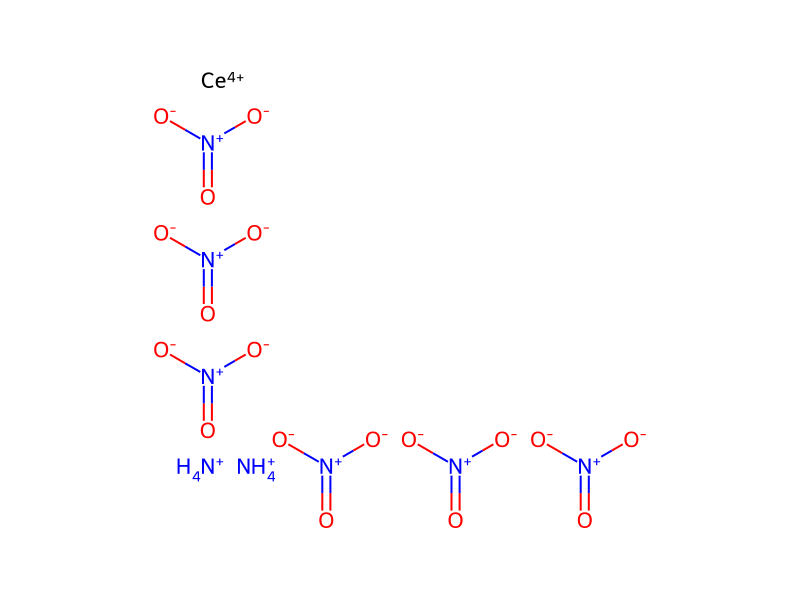
Basic information
- CAS
10139-51-2- Standard SMILES
O=[N+]([O-])[O-].O=[N+]([O-])[O-].O=[N+]([O-])[O-].O=[N+]([O-])[O-].O=[N+]([O-])[O-].O=[N+]([O-])[O-].[Ce+4].[NH4+].[NH4+]- InChIKey
XMPZTFVPEKAKFH-UHFFFAOYSA-P- Molecular formula
- CeH8N8O18
- Average molar mass
- 548.22 g/mol
- Monoisotopic mass
- 547.9011
Names & identifiers
- Preferred name
- Ceric ammonium nitrate
- IUPAC
- diazanium;cerium(4+);hexanitrate
- English name
- Cerium(IV) ammonium nitrate
- Molecular formula
- CeH4N2O3
- Molecular weight
- 220.16
Names & synonyms
Cerium ammonium nitrateDiammonium hexanitratocerate10139-51-2U99S55ED6BNSC-215187RefChem:124502lambda4-cerium(4+) ion bis(nitric acid) diamine tetranitrate240-827-6Ammonium cerium nitrateAmmonium hexanitratocerateAmmonium hexanitratocerate(IV)Cerate(2-), hexakis(nitrato-kappaO)-, ammonium (1:2), (OC-6-11)-
Show more names
Ceric ammonium nitrateCeric(IV) ammonium nitrateAmmonium cerium IV Nitratediazanium;cerium(4+);hexanitrateSCHEMBL313904cerium (IV) diammonium nitratediammonium cerium (IV) nitratedi-ammonium cerium (IV) nitrate
Database identifiers
- CAS
10139-51-2、16774-21-3- PubChem CID
- 180504
- UNII
- U99S55ED6B
- EC Number
- 240-827-6
Properties
Computed structural properties
- Topological polar surface area
- 379 Ų
- Hydrogen bond donors
- 2
- Hydrogen bond acceptors
- 18
- Rotatable bonds
- 0
- Heavy atoms
- 27
- Formal charge
- 0
- Complexity
- 18
Experimental & physicochemical properties
Physical DescriptionOrange solid, soluble in water; [Merck Index]
Physicochemical properties
- FDA UNII
- 99 S55ED6B · U99S55ED6B
Safety & regulation
GHS classification
GHS Classification
Danger
H272 (99.4%): May intensify fire; oxidizer [Danger Oxidizing liquids; Oxidizing solids];H302 (92.6%): Harmful if swallowed [Warning Acute toxicity, oral];H314 (67.4%): Causes severe skin burns and eye damage [Danger Skin corrosion/irritation];H315 (28%): Causes skin irritation [Warning Skin corrosion/irritation];H317 (66.3%): May cause an allergic skin reaction [Warning Sensitization, Skin];H318 (68%): Causes serious eye damage [Danger Serious eye damage/eye irritation];H319 (29.1%): Causes serious eye irritation [Warning Serious eye damage/eye irritation];H335 (26.9%): May cause respiratory irritation [Warning Specific target organ toxicity, single exposure; Respiratory tract irritation];H400 (65.1%): Very toxic to aquatic life [Warning Hazardous to the aquatic environment, acute hazard];H410 (65.7%): Very toxic to aquatic life with long lasting effects [Warning Hazardous to the aquatic environment, long-term hazard]
P210, P220, P260, P261, P264, P264+P265, P270, P271, P272, P273, P280, P301+P317, P301+P330+P331, P302+P352, P302+P361+P354, P304+P340, P305+P351+P338, P305+P354+P338, P316, P317, P319, P321, P330, P332+P317, P333+P317, P337+P317, P362+P364, P363, P370+P378, P391, P403+P233, P405, and P501 (click each P-code to see the statement)
Aggregated GHS information provided per 175 reports by companies from 19 notifications to the ECHA C&L Inventory. Each notification may be associated with multiple companies.;Information may vary between notifications depending on impurities, additives, and other factors. The percentage value in parenthesis indicates the notified classification ratio from companies that provide hazard codes. Only hazard codes with percentage values above 10% are shown. For more detailed information, please visit ECHA C&L website.
Hazard information
Regulatory InformationStatus: Active Update: 24-03-2022 https://echa.europa.eu/registration-dossier/-/registered-dossier/11355
Hazards SummarySee Cerium. See RARE EARTH METALS and linked occupational diseases.
Hazard Classes and CategoriesOx. Sol. 2 (99.4%);Acute Tox. 4 (92.6%);Skin Corr. 1B (67.4%);Skin Irrit. 2 (28%);Skin Sens. 1A (66.3%);Eye Dam. 1 (68%);Eye Irrit. 2 (29.1%);STOT SE 3 (26.9%);Aquatic Acute 1 (65.1%);Aquatic Chronic 1 (65.7%)
Safety & protection
Protective Action Criteria (PAC)
0.054 [mg/m3]
0.58 [mg/m3]
3.5 [mg/m3]
Toxicology
Treatment
Methemoglobinemia can be treated with supplemental oxygen and methylene blue 1% solution administered intravenously slowly over five minutes followed by IV flush with normal saline. Methylene blue restores the iron in hemoglobin to its normal (reduced) oxygen-carrying state. (L1613)
Health EffectsNitrate and nitrite poisoning causes methemoglobinemia. Nitrites may cause pregnancy complications and developmental effects. They may also be carcinogenic. (L1137)
Adverse EffectsFibrogenic - Inducing tissue injury and fibrosis (scarring).
Exposure RoutesOral (L1137) ; inhalation (L1137)
Toxicity Summary
Nitrate's toxicity is a result of it's conversion to nitrite once in the body. Nitrite causes the autocatalytic oxidation of oxyhemoglobin to hydrogen peroxide and methemoglobin. This elevation of methemoglobin levels is a condition known as methemoglobinemia, and is characterized by tissue hypoxia, as methemoglobin cannot bind oxygen. (A2450, L1613)
Signs and Symptoms
Nitrate and nitrite poisoning causes methemoglobinemia. Symptoms include cyanosis, cardiac dysrhythmias and circulatory failure, and progressive central nervous system (CNS) effects. CNS effects can range from mild dizziness and lethargy to coma and convulsions. (L1137)
Carcinogen ClassificationIngested nitrate or nitrite under conditions that result in endogenous nitrosation is probably carcinogenic to humans (Group 2A). (L135)
Regulatory information
Regulatory InformationStatus: Active Update: 24-03-2022 https://echa.europa.eu/registration-dossier/-/registered-dossier/11355
Chemistry & industry
Pharmacology
Metabolism/Metabolites
Intake of some amount of nitrates and nitrites is a normal part of the nitrogen cycle in humans. In vivo conversion of nitrates to nitrites can occur in the gastrointestional tract under the right conditions, significantly enhancing nitrates' toxic potency. The major metabolic pathway for nitrate is conversion to nitrite, and then to ammonia. Nitrites, nitrates, and their metabolites are excreted in the urine. (L1137)
Uses & manufacturing
UsesUsed as a standard in oxidimetry and an oxidant in redox reactions; Used in a solution of perchloric acid to etch printed circuits; [Merck Index]
General Manufacturing InformationCerate(2-), hexakis(nitrato-.kappa.O)-, ammonium (1:2), (OC-6-11)-: ACTIVE
Related reactions
301 records



Compound notes
Loading…