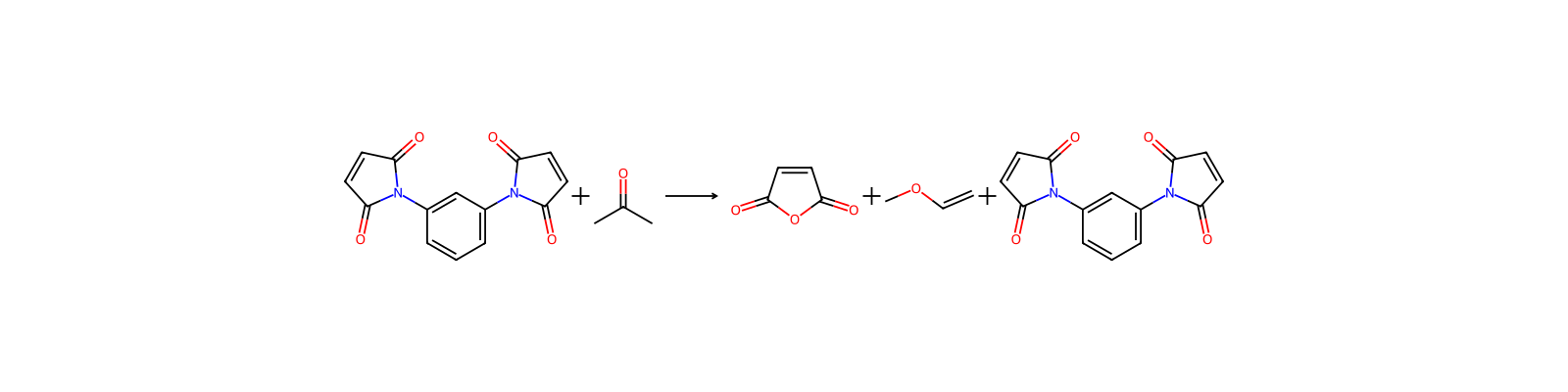
HRID 262415As reactant

3006-93-7O=C1C=CC(=O)N1c1cccc(N2C(=O)C=CC2=O)c1IPJGAEWUPXWFPL-UHFFFAOYSA-N3006-93-7DTXSID3044415CHEMBL573689Dry Powder; Wet Solid
Yellow powder; [Aldrich MSDS] Yellow to light brown odorless powder; [R.T. Vanderbilt MSDS]
Safety information is for reference only and does not replace the supplier’s Safety Data Sheet (SDS), applicable regulations, or professional assessment.
This chemical does not meet GHS hazard criteria for 0.8% (7 of 872) of reports.
Danger
H302 (88.5%): Harmful if swallowed [Warning Acute toxicity, oral]
P260, P261, P262, P264, P264+P265, P270, P271, P272, P280, P284, P301+P317, P302+P352, P304+P340, P305+P354+P338, P316, P317, P320, P321, P330, P333+P317, P361+P364, P362+P364, P403+P233, P405, and P501 (click each P-code to see the statement)
Aggregated GHS information provided per 872 reports by companies from 24 notifications to the ECHA C&L Inventory. Each notification may be associated with multiple companies.
Chemical: 1H-Pyrrole-2,5-dione, 1,1'-(1,3-phenylene)bis-
1H-Pyrrole-2,5-dione, 1,1'-(1,3-phenylene)bis- is listed on the EPA's Chemical Data Reporting (CDR) system. Manufacturers and importers of 1H-Pyrrole-2,5-dione, 1,1'-(1,3-phenylene)bis- are required to report information about their production and use of this chemical to the EPA under the Toxic Substances Control Act (TSCA). (40 eCFR Part 711)
REACH registered substance: 1,1'-(1,3-phenylene)bis-1H-pyrrole-2,5-dione (EC: 221-112-8)
1H-Pyrrole-2,5-dione, 1,1'-(1,3-phenylene)bis-: Does not have an individual approval but may be used as a component in a product covered by a group standard. It is not approved for use as a chemical in its own right.
May cause irritation; Harmful by ingestion; Highly toxic by inhalation; Toxic by skin absorption; [Aldrich MSDS] Dust may form combustible mixtures with air; A severe eye irritant (may have corrosive effects); May cause skin sensitization; May be fatal by inhalation; [R.T. Vanderbilt MSDS] May cause permanent eye injury; May cause skin sensitization; Inhalation may cause altered respiratory rate, delayed lung injury, or death; Contains less than 3% petroleum distillates that cause skin irritation; [DuPont Performance Elastomers MSDS]
Used as an elastomer curing adjuvant; [R.T. Vanderbilt MSDS]
Should not be used in medical applications that result in permanent implantation in the human body; [DuPont Performance Elastomers MSDS]
Plastic Composites Manufacturing [Category: Industry]
All Other Chemical Product and Preparation Manufacturing
1H-Pyrrole-2,5-dione, 1,1'-(1,3-phenylene)bis-: ACTIVE
Usesrubber vulcanizing agent; rubber crosslinkimg agent
UsesN,N'-1,3-Phenylene bismaleimide and sulfur coordination to prevent reversion to improve the heat resistance, reduce heat, anti-aging, improve adhesion of the rubber and tire cord and vulcanized rubber modulus.PDM is a non-sulfur vulcanizing agents solve copper wire and copper electrical contacts because of sulfur vulcanizing agent to generate black copper sulfide pollution problems.