HomeMCPWorkbenchSkills
HomeWorkbenchNotificationsMe
llms.txt · MCP GuidePrivacy Policy · Terms of Service · Supportv1.8.3
  1. Home
  2. /Compound

2,3-Dihydroxybenzoic Acid

HCID 19
New reaction
Print
Basic informationOverviewNames & identifiersPropertiesSafety & regulationChemistry & industryRelated reactionsCompound notes
Substructure searchFind similar structures

Basic information

CAS
27138-57-4
Standard SMILES
O=C(O)c1cccc(O)c1O
InChIKey
GLDQAMYCGOIJDV-UHFFFAOYSA-N
Molecular formula
C7H6O4
Average molar mass
154.12 g/mol
Monoisotopic mass
154.02660867

Overview

2,3-dihydroxybenzoic acid is a dihydroxybenzoic acid that is benzoic acid substituted by hydroxy groups at positions 2 and 3. It occurs naturally in Phyllanthus acidus and in the aquatic fern Salvinia molesta. It has a role as a plant metabolite and a human xenobiotic metabolite. It is functionally related to a benzoic acid. It is a conjugate acid of a 2,3-dihydroxybenzoate.

Names & identifiers

Preferred name
2,3-Dihydroxybenzoic Acid
IUPAC
2,3-dihydroxybenzoic acid
English name
2,3-Dihydroxybenzoic acid
Molecular formula
C7H6O4
Molecular weight
154.12

Names & synonyms

2,3-Dihydroxybenzoic acid303-38-8Pyrocatechuic acido-Pyrocatechuic acid3-Hydroxysalicylic acid2-Pyrocatechuic acidBenzoic acid, 2,3-dihydroxy-DHBACatecholcarboxylic acidDOBK2,3 DHB2,3-DIHYDROXY-BENZOIC ACID
Show more names
2,3-dihydroxybenzoate2,3-DihydroxybenzoicNSC 27435TIMTEC-BB SBB008367RARECHEM AL BE 00352-pyrocatechuicacid
2,3-dihydroxy benzoic acidCHEBI:1802670D5FBB392NSC-27435DTXSID708587122-carboxy-6-hydroxybenzen-1-olateRefChem:908646DTXCID60809455

Database identifiers

CAS
27138-57-4、303-38-8
PubChem CID
19
DTXSID
DTXSID70858712
ChEMBL
CHEMBL1432
ChEBI
CHEBI:18026
UNII
70D5FBB392
EC Number
206-139-5
Nikkaji
J79.590I

Properties

Computed structural properties

XLogP
1.2
Topological polar surface area
77.8 Ų
Hydrogen bond donors
3
Hydrogen bond acceptors
4
Rotatable bonds
1
Heavy atoms
11
Formal charge
0
Complexity
157

Experimental & physicochemical properties

Chemical ClassesOther Classes -> Benzoic Acid Derivatives
DrugsPharmaceuticals -> Listed in ZINC15
LogP · 2 items

1.20

1.2

Melting Point204.00 to 208.00 °C. @ 760.00 mm Hg
Vapor Pressure0.0000021 [mmHg]
Physical Description · 2 items

Beige powder; [Aldrich MSDS]

Solid

Dissociation Constants2.91 (at 25 °C)
Collision Cross Section · 2 items

118.42 Ų [M-H]- [CCS Type: DT; Method: single field calibrated with Agilent tune mix (Agilent)]

120.9 Ų [M-H]-

Physicochemical properties

Melting point
204 · 204-206 °C (lit.)
Boiling point
95 · 95-96/0.5mm
Density
1 · 1,542 g/cm3
refractive index
1.64 · 1.6400 (estimate)
storage temp.
Inert atmosphere,Room Temperature
solubility
50 mg/mL, · methanol: soluble50mg/mL, clear to faintly hazy, orange
pka
1 · pK1:2.98;pK2:10.14 (30°C)
form
Crystalline Powder
color
Beige to brown or pinkish-gray
Water Solubility
Soluble in water, methanol and dimethyl sulfoxide.
BRN
2209117 · 2209117
InChI
1S/C7H6O4/c8-5-3-1-2-4(6(5)9)7(10)11/h1-3,8-9H,(H,10,11)
InChIKey
GLDQAMYCGOIJDV-UHFFFAOYSA-N
SMILES
OC(=O)c1cccc(O)c1O
LogP
1.2 · 1.200
CAS DataBase Reference
303 · 303-38-8(CAS DataBase Reference)
FDA UNII
70 D5FBB392 · 70D5FBB392
NIST Chemistry Reference
2 · Benzoic acid, 2,3-dihydroxy-(303-38-8)
EPA Substance Registry System
2 · 2,3-Dihydroxybenzoic acid (303-38-8)
UNSPSC Code
12352106 · 12352106
NACRES
24 · NA.24
Symbol(GHS)
7 · GHS07
Signal word
Warning
Hazard statements
315 · H315-H319-H335
Precautionary statements
261 · P261-P264-P271-P280-P302+P352-P305+P351+P338
target organs
Respiratory system
PPE
95 · dust mask type N95 (US), Eyeshields, Gloves
Hazard Codes
Xi
Risk Statements
36 · 36/37/38
Safety Statements
26 · 26-36-37/39
WGK Germany
2 · 2
RTECS
8576490 · DG8576490
Hazard Note
Irritant
HS Code
2918290000 · 2918290000
Storage Class
11 · 11 - Combustible Solids
Hazard Classifications
2 Skin · Eye Irrit. 2Skin Irrit. 2STOT SE 3

Safety & regulation

Safety information is for reference only and does not replace the supplier’s Safety Data Sheet (SDS), applicable regulations, or professional assessment.

GHS classification

GHS Classification · 5 items

This chemical does not meet GHS hazard criteria for 2% (1 of 49) of reports.

Warning

H315 (98%): Causes skin irritation [Warning Skin corrosion/irritation]

P261, P264, P264+P265, P271, P280, P302+P352, P304+P340, P305+P351+P338, P319, P321, P332+P317, P337+P317, P362+P364, P403+P233, P405, and P501 (click each P-code to see the statement)

Aggregated GHS information provided per 49 reports by companies from 8 notifications to the ECHA C&L Inventory. Each notification may be associated with multiple companies.

Hazard information

Hazards Summary · 1 item

Causes other changes in kidney, ureter, and bladder, changes in kidney weight, and changes in blood serum composition in 7-day intermittent subcutaneous studies of rats; [RTECS] A skin and strong eye irritant; [Aldrich MSDS] See 4-Hydroxybenzoic acid.

Hazard Classes and CategoriesSkin Irrit. 2 (98%)

Safety data

PPE
dust mask type N95 (US), Eyeshields, Gloves
wgk
2
rtecs
DG8576490
hs_code
2918290000
risk_code
36/37/38
Signal word
Warning
Symbol(GHS)
GHS07
hazard_code
Xi
hazard_note
Irritant
safety_code
26-36-37/39
Storage Class
11 - Combustible Solids
target organs
Respiratory system
Hazard statements
H315-H319-H335
Hazard Classifications
Eye Irrit. 2Skin Irrit. 2STOT SE 3
Precautionary statements
P261-P264-P271-P280-P302+P352-P305+P351+P338

Chemistry & industry

Pharmacology

MeSH Pharmacological Classification · 1 item

Organic chemicals that form two or more coordination links with an iron ion. Once coordination has occurred, the complex formed is called a chelate. The iron-binding porphyrin group of hemoglobin is an example of a metal chelate found in biological systems.

Uses & manufacturing

Uses · 2 items

Synthetic Polymer MALDI Matrix Compounds

Synthetic Polymer MALDI Matrix Compounds

Applications · 2 items

Uses2,3-Dihydroxybenzoic Acid is a selected phenol as MMP (Matrix Metalloproteinase) inhibitor.

Uses2,3-Dihydroxybenzoic acid was used to study the complexes of manganese with aliphatic and aromatic polyhydroxy ligands in basic media by electrochemical, spectrophotometric and magnetic methods. It was used in isolation of new siderophore named vulnibactin from low iron cultures of Vibrio vulnificus, a human pathogen. It was used as cocrystal former to study the influence of position isomerism on the co-crystals formation and physicochemical properties of piracetam.

Upstream & downstream products

Downstream products

LY 294002 Hydrochloride1,3-Benzodioxole-4-carboxylic acid1,3-Benzodioxole-4-carbonyl chloride (9CI)2,3-Dibenzyl-5-broMobenzoic Acid Methyl Ester

Additional notes

DefinitionChEBI: A dihydroxybenzoic acid that is benzoic acid substituted by hydroxy groups at positions 2 and 3. It occurs naturally in Phyllanthus acidus and in the aquatic fern Salvinia molesta.

Related reactions

42 records
New reaction record
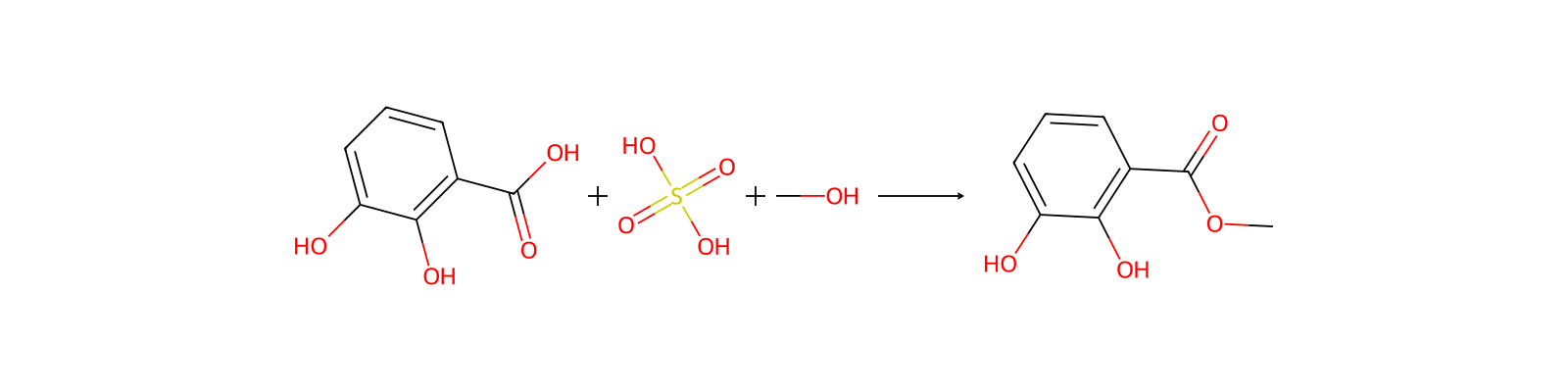
HRID 75069 reaction equation
HRID 75069As reactant
HRID 191199 reaction equation
HRID 191199As reactant
HRID 259845 reaction equation
HRID 259845As reactant
HRID 347423 reaction equation
HRID 347423As reactant
HRID 383904 reaction equation
HRID 383904As reactant
HRID 489141 reaction equation
HRID 489141As reactant
HRID 565198 reaction equation
HRID 565198As reactant
HRID 577560 reaction equation
HRID 577560As reactant
PreviousPage 1 of 6

Compound notes

On this pageBasic informationOverviewNames & identifiersPropertiesSafety & regulationChemistry & industryRelated reactionsCompound notes