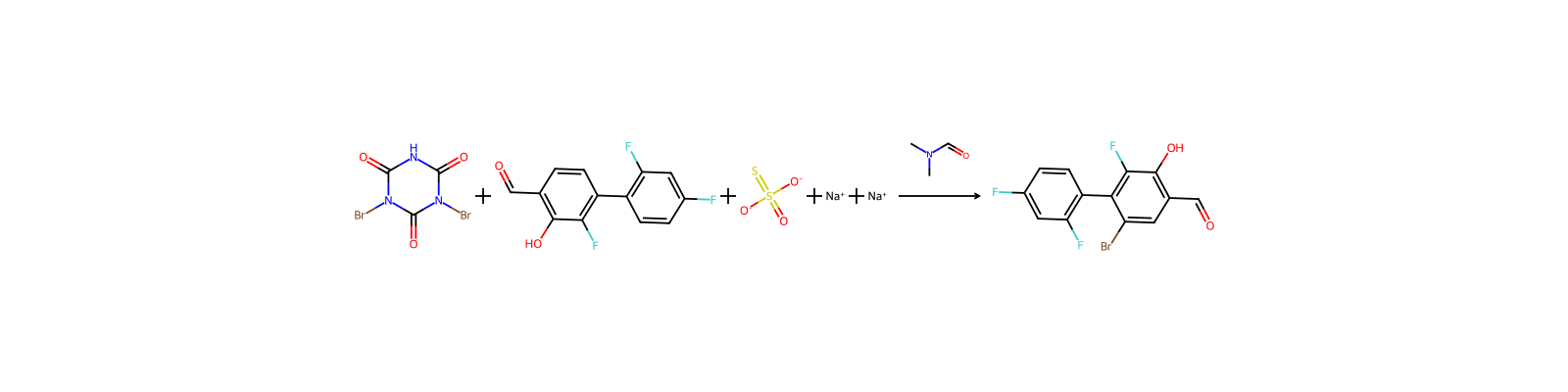
HRID 530984As reactant
Completing data — refresh the page later to see the latest

15114-43-9O=c1[nH]c(=O)n(Br)c(=O)n1BrHHBCEKAWSILOOP-UHFFFAOYSA-N15114-43-9DTXSID00164717Safety information is for reference only and does not replace the supplier’s Safety Data Sheet (SDS), applicable regulations, or professional assessment.
Danger
H272 (100%): May intensify fire; oxidizer [Danger Oxidizing liquids; Oxidizing solids]
P210, P220, P260, P264, P270, P280, P301+P317, P301+P330+P331, P302+P361+P354, P304+P340, P305+P354+P338, P316, P321, P330, P363, P370+P378, P405, and P501 (click each P-code to see the statement)
Aggregated GHS information provided per 41 reports by companies from 3 notifications to the ECHA C&L Inventory. Each notification may be associated with multiple companies.
UsesDibromoisocyanuric acid is a bromine compound with a superior bactericidal activity.
Uses1,3-Dibromoisocyanuric Acid (DBI) is used for electrophilic bromination of aromatic compounds, oximes.
PreparationDibromoisocyanuric acid has been prepared by treatment of isocyanuric acid (0.1 mol) and LiOH (0.2 mol) with Br2 (0.4 mol) in water (1 L) at 20 °C.[1] After vigorous stirring to effect dissolution of Br2, the mixture is cooled slowly in a refrigerator for 24 h. The product is collected by filtration, washed with ice-cold bromine water, and then dried in vacuo, first over KOH, then over P2O5 (88% yield).