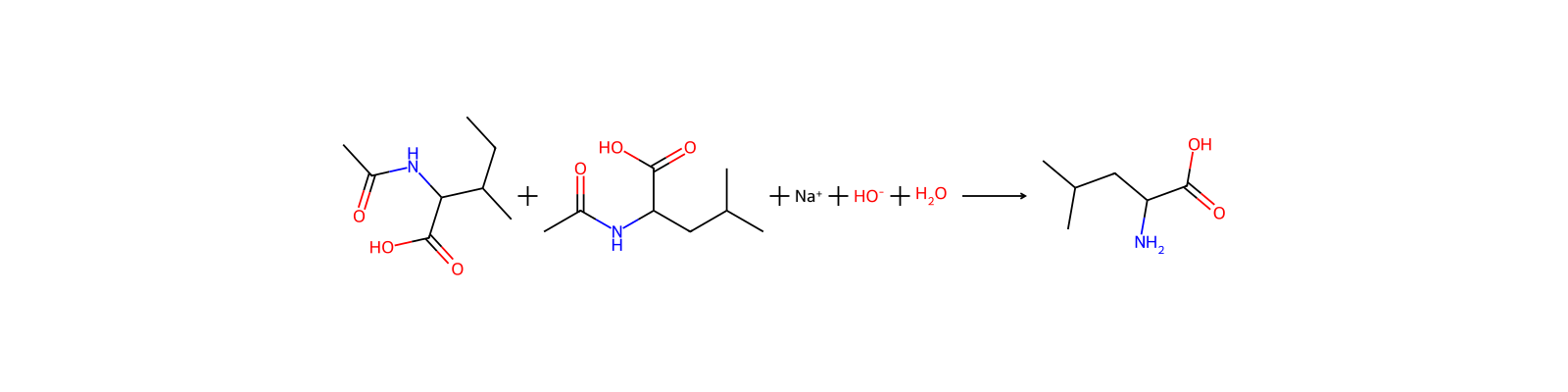
acetyl-DL-leucine
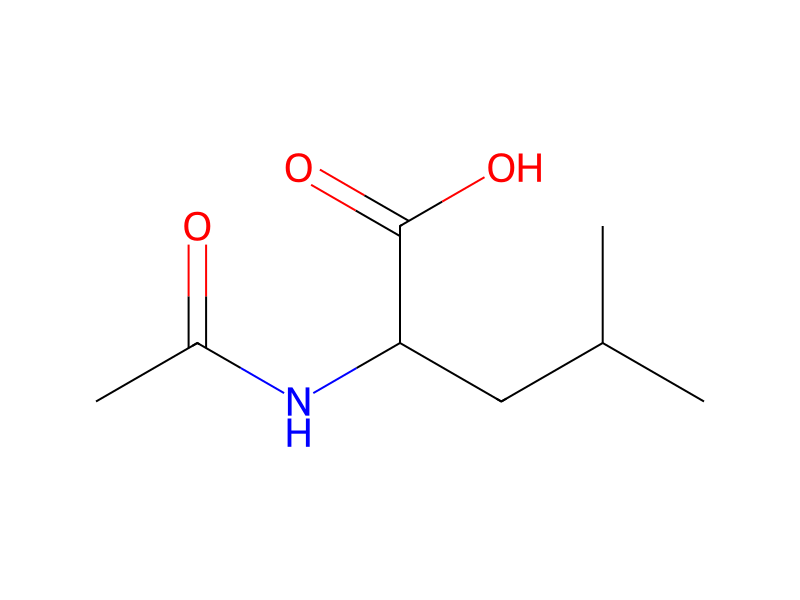
Basic information
- CAS
1188-21-2- Standard SMILES
CC(=O)NC(CC(C)C)C(=O)O- InChIKey
WXNXCEHXYPACJF-UHFFFAOYSA-N- Molecular formula
- C8H15NO3
- Average molar mass
- 173.21 g/mol
- Monoisotopic mass
- 173.10519334
Overview
N-acetyl-leucine is a N-acetyl-amino acid and a leucine derivative.
Names & identifiers
- Preferred name
- acetyl-DL-leucine
- IUPAC
- 2-acetamido-4-methylpentanoic acid
- English name
- N-Acetyl-L-leucine
- Molecular formula
- C8H15NO3
- Molecular weight
- 173.21
Names & synonyms
N-Acetyl-DL-leucineAcetylleucine99-15-02-acetamido-4-methylpentanoic acidAcetileucinaAcetyl-DL-leucineAcetylleucinumAcetylleucine, dl-NSC-122020K76S41V71XNSC-758152RefChem:109167
Show more names
AC-LEU-OHLevacetylleucineACETYL-L-LEUCINEN-Ac-L-Leu-OH(S)-2-AcetaMido-4-Methylpentanoic acidAc-L-Leu-OHn-acetyl-l-leucin(S)-N-Acetylleucine
N07CA04202-734-9Ac-DL-Leu-OHTanganilAcetylleucine [INN](R,S)-N-AcetylleucinAcetyl DL-leucineL-Leucine, N-acetyl-
Database identifiers
- CAS
1188-21-2、99-15-0- PubChem CID
- 1995
- DTXSID
DTXSID40859594- ChEMBL
CHEMBL1875805- ChEBI
CHEBI:166830- UNII
- K76S41V71X
- EC Number
- 202-734-9
- Nikkaji
- J23.190H
Properties
Computed structural properties
- XLogP
- 0.5
- Topological polar surface area
- 66.4 Ų
- Hydrogen bond donors
- 2
- Hydrogen bond acceptors
- 3
- Rotatable bonds
- 4
- Heavy atoms
- 12
- Formal charge
- 0
- Complexity
- 177
Physicochemical properties
- Melting point
- 187 · 187-190 °C(lit.)
- alpha
- -24.5 · -24.5 º (c=4, MeOH)
- Boiling point
- 303.86 °C · 303.86°C (rough estimate)
- Density
- 1.1599 · 1.1599 (rough estimate)
- refractive index
- -22 ° · -22 ° (C=5, EtOH)
- storage temp.
- Sealed in dry,Room Temperature
- solubility
- DMSO (Slightly), Ethanol (Slightly), Water (Slightly, Heated)
- form
- Crystalline Powder
- pka
- 3.67 · 3.67±0.10(Predicted)
- color
- White
- optical activity
- 25 · [α]25/D 23±3°, c = 2 in ethanol
- Water Solubility
- 0.81 g/100 · 0.81 g/100 mL (20 ºC)
- BRN
- 1724849 · 1724849
- Major Application
- peptide synthesis
- InChI
- 1S/C8H15NO3/c1-5(2)4-7(8(11)12)9-6(3)10/h5,7H,4H2,1-3H3,(H,9,10)(H,11,12)/t7-/m0/s1
Safety & regulation
Safety information is for reference only and does not replace the supplier’s Safety Data Sheet (SDS), applicable regulations, or professional assessment.
GHS classification
GHS Classification
This chemical does not meet GHS hazard criteria for 60% (3 of 5) of all reports.
Danger
H315 (20%): Causes skin irritation [Warning Skin corrosion/irritation]
P261, P264, P264+P265, P271, P280, P302+P352, P304+P340, P305+P351+P338, P305+P354+P338, P317, P319, P321, P332+P317, P337+P317, P362+P364, P403+P233, P405, and P501 (click each P-code to see the statement)
Aggregated GHS information provided per 5 reports by companies from 3 notifications to the ECHA C&L Inventory. Each notification may be associated with multiple companies.
Hazard information
Hazard Classes and CategoriesSkin Irrit. 2 (20%)
Safety data
- wgk
- 3
- tsca
- TSCA listed
- hs_code
- 29241900
- risk_code
- 36/37/38
- Signal word
- Warning
- Symbol(GHS)
- GHS07
- hazard_code
- Xi
- safety_code
- 24/25-36-26
- hazard_class
- IRRITANT
- Storage Class
- 11 - Combustible Solids
- Hazard statements
- H319-H315-H335
- Precautionary statements
- P271-P261-P280
Chemistry & industry
Pharmacology
ATC Code
N - Nervous system
QN - Nervous system
Applications
UsesN-Acetyl-L-(-)-leucine is used in the preparation of small molecule inhibitors of anti-apoptotic Bcl-2 family proteins. Also used in the preparation of amphiphilic copolymers involving hydrophobic amino acid and oligopeptide side chains for optical tumor imaging in vivo.
Preparation methods
PreparationAdd 2 mol of leucine, 3-3.5 mol of p-chloroacetanilide, and 3-4 mol of phenylacetyl to the reaction vessel. Raise the solution temperature to 60-65℃, reflux for 80-110 min, let stand for 2-3 h, lower the solution temperature to 10-15℃, cool and crystallize, filter the crystals, wash with potassium bromide solution, wash with triethylamine solution, wash with nitromethane solution, and dehydrate with a dehydrating agent to obtain the product N-acetyl-L-leucine.
Upstream & downstream products
Upstream raw materials
Additional notes
DefinitionChEBI: The N-acetyl derivative of L-leucine.
Related reactions
10 records



Compound notes
Loading…