
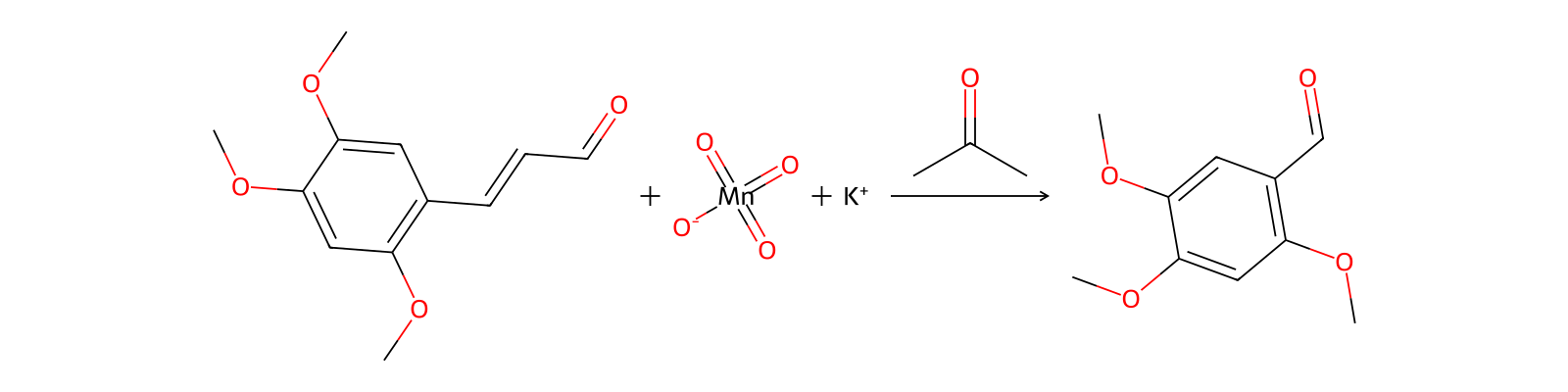
HRID 172098As reactant

4460-86-0COc1cc(OC)c(OC)cc1C=OIAJBQAYHSQIQRE-UHFFFAOYSA-N2,4,5-trimethoxybenzaldehyde is a beige powder. (NTP, 1992)
4460-86-0DTXSID1022217CHEMBL1164301CHEBI:113543less than 1 mg/mL at 72 °F (NTP, 1992)
Soluble in water, ethyl ether, chloroform, ligroin
234 to 237 °F (NTP, 1992)
114 °C
114 °C
2,4,5-trimethoxybenzaldehyde is a beige powder. (NTP, 1992)
Beige solid; [CAMEO] White to pale brown solid; [MSDSonline]
Solid
137.08 Ų [M+H]+ [CCS Type: TW; Method: calibrated with polyalanine and drug standards]
138.3 Ų [M+H]+ [CCS Type: TW; Method: calibrated with polyalanine and drug standards]
Safety information is for reference only and does not replace the supplier’s Safety Data Sheet (SDS), applicable regulations, or professional assessment.
Warning
H302 (100%): Harmful if swallowed [Warning Acute toxicity, oral]
P261, P264, P264+P265, P270, P271, P280, P301+P317, P302+P352, P304+P340, P305+P351+P338, P317, P319, P321, P330, P332+P317, P337+P317, P362+P364, P403+P233, P405, and P501 (click each P-code to see the statement)
Aggregated GHS information provided per 4 reports by companies from 4 notifications to the ECHA C&L Inventory. Each notification may be associated with multiple companies.
SYMPTOMS: Symptoms of exposure to related compounds are skin and gastrointestinal tract irritation, sensitization, blistering, nausea, vomiting, diarrhea, urinary tract irritation, initial excitement, convulsions and central nervous system depression. (NTP, 1992)
Used as an intermediate for pharmaceuticals and agrochemicals; [HSDB]
/Alkoxybenzaldehydes/, useful as intermediates for pharmaceuticals and agrochemicals
... Asarylaldehyde was attractive to male & female Mediterranean fruit flies & female oriental fruit flies.
/Alkoxybenzaldehydes/, useful as intermediates for pharmaceuticals and agrochemicals, are prepared by reaction of alkoxybenzenes with dialkylformamide in 1 or ... 2 solvents selected from benzene, alkylbenzenes, alkyl ethers, hydrocarbons or esters in the presence of ... 1 reagent deselected from phosgene, phosphorus ocychloride, and thionyl choride. ... 2,4,5-Trimethoxybenzaldehyde was prepared in 99.3% yield by the ... process.
Benzaldehyde, 2,4,5-trimethoxy-: ACTIVE
Asarylaldehyde was identified as an active component from the distillate of the essential oil of the root of Indian calamus. Asarylaldehyde was attractive to male & female Mediterranean fruit flies & female oriental fruit flies. Of the 3 positional isomers of asarylaldehyde only the 3,4,5-isomer showed activity.
UV (355 NM) irradiation of trans-isoasarone formed cis-isoasarone and asaronaldehyde.
In electrochemical substitution ... product of direct electrochemical oxidation using 3,4,5-trimethoxytoluene or 3,5-dimethoxy-4-hydroxypyridine
Description2,4,5-Trimethoxybenzaldehyde (2,4,5-TMBA) is a natural cyclooxygenase-2 (COX-2) activity inhibitor that is present in carrot seeds (Daucus carota L.) and can be synthesised using Indonesia Sweet Flag (Acorus calamus) as a raw material. 2,4,5-TMBA may serve as a synthetic intermediate component for various pharmaceuticals. In addition, 2,4,5-TMBA is also considered a candidate drug for oral non-steroidal anti-inflammatory drugs (NSAIDs)[1].[1] LERRICK R I. Synthesis of Nonsteroidal Anti-Inflammatory Drug (NSAID) 2,4,5-Trimethoxybenzaldehyde from Indonesian Calamus oil and Its In Silico Pharmacokinetic Study[J]. Canadian Journal of Chemistry, 2022, 20 1. DOI:10.1139/cjc-2022-0121.




EYES: First check the victim for contact lenses and remove if present. Flush victim's eyes with water or normal saline solution for 20 to 30 minutes while simultaneously calling a hospital or poison control center. Do not put any ointments, oils, or medication in the victim's eyes without specific instructions from a physician. IMMEDIATELY transport the victim after flushing eyes to a hospital even if no symptoms (such as redness or irritation) develop.
SMALL SPILLS AND LEAKAGE: If a spill of this chemical occurs, FIRST REMOVE ALL SOURCES OF IGNITION, then you should dampen the solid spill material with acetone and transfer the dampened material to a suitable container. Use absorbent paper dampened with acetone to pick up any remaining material. Seal your contaminated clothing and the absorbent paper in a vapor-tight plastic bag for eventual disposal. Solvent wash all contaminated surfaces with acetone followed by washing with a soap and water solution. Do not reenter the contaminated area until the Safety Officer (or other responsible person) has verified that the area has been properly cleaned.
SRP: The most favorable course of action is to use an alternative chemical product with less inherent propensity for occupational exposure or environmental contamination. Recycle any unused portion of the material for its approved use or return it to the manufacturer or supplier. Ultimate disposal of the chemical must consider: the material's impact on air quality; potential migration in soil or water; effects on animal, aquatic, and plant life; and conformance with environmental and public health regulations.
LC50 Pimephales promelas (Fathead minnow) at 80 mg/L for 24 hr /conditions of bioassay not specified/
LC50 Pimephales promelas (Fathead minnow, age 34 days) 49.5 mg/L for 96 hr (95% confidence limits: 45.5-53.8 mg/L); flow through, 24.5 °C, dissolved oxygen 7.0 mg/L, hardness 44.5 mg/L CaCO3, alkalinity 43.0 mg/L CaCO3, pH 7.70 /98% pure/
14: 101 (1981)] NINETEEN COMPOUNDS WERE FOUND IN SHIN-I DRUG OIL; ASARYLALDEHYDE WAS ISOLATED & IDENTIFIED.[KIKUCHI T ET AL; STUDIES ON THE CONSTITUENTS OF CRUDE DRUG "SHIN-I" (DRIED BUDS OF MAGNOLIA SALICIFOLIA MAXIM); WAKANYAKU SHINPOJUMU,
/GENOTOXICITY/ 2,4,5-Trimethoxy benzaldehyde (TMB) was tested for mutagenicity in the Salmonella/microsome preincubation assay using a protocol approved by the National Toxicology Program. TMB was tested at doses of 0, 100, 333, 1000, 3333, and 10,000 ug/plate in four Salmonella typhimurium strains (TA98, TA100, TA1535, and TA1537) in the presence and absence of Aroclor-induced rat and/or hamster liver S9. TMB was negative in these tests and the highest ineffective dose level tested (not causing formation of a precipitate) in any Salmonella tester strain was 3333 ug/plate.[Zeiger E et al; Environ Mutagen 9:1-110 (1987)]
/GENOTOXICITY/ 2,4,5-Trimethoxybenzaldehyde tested postive in the NTP's in vitro cytogenetics tests for chromosome aberrations and sister chromatid exchanges. It also tested positive in the mouse lymphoma assay, but was negative in the Ames Salmonella mutagenicity tests. /From table/[DHHS/NTP; Genotoxicity Studies of 2,4,5-TRIMETHOXYBENZALDEHYDE. Available from, as of February 22, 2007: http://ntp.niehs.nih.gov/index.cfm?objectid=6DE337DB-F1F6-975E-7701E15B968E0682]
/GENOTOXICITY/ Several aldehydes and peroxides were tested for mutagenicity using Salmonella typhimurium tester strains TA97a, TA100, TA102 and TA104, in the presence and absence of Aroclor-induced liver S9 mix from F344 rats and B6C3F1 mice, in either preincubation or vapour phase protocols. ... 2,4,5-Trimethoxybenzaldehyde was mutagenic only in strain TA1538 with rat liver S9. ...[Dillon D et al; Mutagenesis 13 (1): 19-26 (1998)]
Usesfly attractant
UsesA selective Cox-2 inhibitor.
Uses2,4,5-Trimethoxybenzaldehyde is used in the synthesis of stilbene and hydrostibene derivatives as potential anticancer agents, inhibiting tubulin. Also used in the synthesis of HIV-RT inhibitors.
General DescriptionBeige powder.
DefinitionChEBI: 2,4,5-trimethoxybenzaldehyde is a carbonyl compound.