

Basic information
- CAS
38936-60-6- Standard SMILES
Cl.NOCc1ccc(Cl)cc1- InChIKey
VIFDVZZLHVXUHV-UHFFFAOYSA-N- Molecular formula
- C7H9Cl2NO
- Average molar mass
- 194.06 g/mol
- Monoisotopic mass
- 193.00611927
Names & identifiers
- Preferred name
- Hydroxylamine, O-((4-chlorophenyl)methyl)-, hydrochloride (1:1)
- IUPAC
- O-[(4-chlorophenyl)methyl]hydroxylamine;hydrochloride
- English name
- 1-[(Ammoniooxy)methyl]-4-chlorobenzene chloride
- Molecular formula
- C7H9Cl2NO
- Molecular weight
- 194.06
Names & synonyms
38936-60-6RefChem:1087068Hydroxylamine, O-((4-chlorophenyl)methyl)-, hydrochloride (1:1)O-(4-Chlorobenzyl)hydroxylamine hydrochloride1-[(Ammoniooxy)methyl]-4-chlorobenzene chlorideMFCD01114589O-[(4-chlorophenyl)methyl]hydroxylamine hydrochlorideO-(p-Chlorobenzyl)hydroxylamine hydrochlorideO-[(4-chlorophenyl)methyl]hydroxylamine;hydrochloride1-[(Aminooxy)methyl]-4-chlorobenzene hydrochlorideCHEMBL37640234-chlorobenzyloxyamine hydrochloride
Show more names
O-(4-chlorobenzyl) hydroxylaMineo-(p-chlorobenzyl)-hydroxylaminhydrochloride1-[(aminooxy)methyl]-4-chlorobenzene hydrochloride (1:1)
Hydroxylamine, O-[(4-chlorophenyl)methyl]-, hydrochlorideHydroxylamine, O-(p-chlorobenzyl)-, hydrochlorideO-(4-Chlorobenzyl)hydroxylamine HClSCHEMBL1715739DTXSID10959772VIFDVZZLHVXUHV-UHFFFAOYSA-No-(4-chloro-benzyl)-hydroxylamineCS-B1210
Database identifiers
- CAS
38936-60-6- PubChem CID
- 217573
- DTXSID
DTXSID10959772- ChEMBL
CHEMBL3764023
Properties
Computed structural properties
- Topological polar surface area
- 35.3 Ų
- Hydrogen bond donors
- 2
- Hydrogen bond acceptors
- 2
- Rotatable bonds
- 2
- Heavy atoms
- 11
- Formal charge
- 0
- Complexity
- 91.6
Physicochemical properties
- Melting point
- 230 °C · 230°C
- storage temp.
- Store at room temperature
- form
- solid
- color
- White
- Symbol(GHS)
- 7 · GHS07
- Signal word
- Warning
- Hazard statements
- 302 · H302+H312+H332
- Precautionary statements
- 261 · P261-P264-P270-P271-P280-P301+P312+P330-P302+P352+P312-P304+P340+P312-P363-P501
- Hazard Codes
- Xi
- Risk Statements
- 36 · 36/37/38
- Safety Statements
- 26 · 26-36/37/39
- HazardClass
- IRRITANT
- HS Code
- 2921199990 · 2921199990
Safety & regulation
Safety data
- hs_code
- 2921199990
- risk_code
- 36/37/38
- Signal word
- Warning
- Symbol(GHS)
- GHS07
- hazard_code
- Xi
- safety_code
- 26-36/37/39
- hazard_class
- IRRITANT
- Hazard statements
- H302+H312+H332
- Precautionary statements
- P261-P264-P270-P271-P280-P301+P312+P330-P302+P352+P312-P304+P340+P312-P363-P501
Chemistry & industry
Preparation methods
PreparationTo a solution of 83.7 gm (1.5 moles) of potassium hydroxide in 560 ml of water is added in turn with stirring, 300 gm (0.985 mole) of dipotassium hydroxylaminedisulfonate and 161 gm (1.0 mole) of 4-chlorobenzyl chloride. The stirred mixture is heated on a steam bath for 1.75 hr. After cooling, the precipitate is filtered off and refluxed for 3 hr in 1000 ml of 1.5 Ν sulfuric acid. The reaction mixture is then cooled and made strongly alkaline with a 15% aqueous sodium hydroxide solution. The mixture is then extracted with ether repeatedly. The ether extracts are combined and evaporated to dryness. The solid residue (crude free base, 80 gm, i.e., 51.5% of theory, m.p. 35-38°C) is taken up in 1 liter of ether. Anhydrous hydrogen chloride is bubbled through this solution to precipitate the hydrochloride salt. The yield is 59 gm (31%, overall), m.p. 243-244°C (dec); the free base has b.p. 100°C/1 mm Hg. In this preparation, the hydrolysis of the alkylated dipotassium hydroxylaminedisulfonate with only 1 liter of 1.5 Ν sulfuric acid seems somewhat skimpy. We suggest that a higher level of sulfuric acid be considered at that stage of the reaction, if the alkylation has indeed gone to completion. Once the O-alkylhydroxylamine has been prepared by this reaction, it may be N-alkylated to produce an N,Ο-dialkylhydroxylamine. The preparation of O-phenylhydroxylamine has been a synthetic challenge for some time since it is quite unstable. Using hydroxylamine-O-sulfonic acid. A small quantity of this compound has been prepared [36]. Reaction conditions probably require further study to improve the yield. Extension of the reaction to the preparation of O-alkylhydroxylamines would be of interest.
Upstream & downstream products
Downstream products
Suppliers49 total
毕佳索(上海毕得医药科技股份有限公司)400-6005915 · [email protected]
江苏艾康生物医药研发有限公司025-58851090 19370895928 · [email protected]
上海毕得医药科技股份有限公司400-1647117 13681763483 · [email protected]
Dayang Chem (Hangzhou) Co.,Ltd.+86-0571-88938639 17705817739 · [email protected]
郑州鸿晟医药科技有限公司0371-55695890 15637198702 · [email protected]
Aladdin Scientific[email protected]
上海迈瑞尔生化科技有限公司4006356688 18621169109 · [email protected]
北京索莱宝科技有限公司010-50973130 17801761073 · [email protected]
武汉凯威斯科技有限公司86-027-67849912 · [email protected]
常州科化生物科技有限公司0519-68985668 13685222090 · [email protected]
宁波四明化工有限公司(宁波欧迅化学新材料技术有限公司)0574-86508062 18058587104 · [email protected]
孝感深远化工有限公司15527621225; 15527621225 · [email protected]
泰州志诚化工科技有限公司0523-82837785 13914525028 · [email protected]
广东元丰化学试剂有限公司0751-2829979 13376591640 · [email protected]
上海贤鼎生物科技有限公司4009209199 · [email protected]
台州南峰药物研究所[email protected] 18616377689 · [email protected]
PT CHEM GROUP LIMITED+86-85511178; +86-85511178 · [email protected]
上海石洋化工有限公司021-56795766 · [email protected]
上海寰川实业有限公司021-61478794 · [email protected]
北京六合宁远医药科技股份有限公司010-60400365-8001 15910885229 · [email protected]
郑州为易化工产品有限公司0371-88888888 qq272369594;2159423853qq · [email protected]
都创(上海)医药科技有限公司021-58099077 · [email protected]
南兴化工(江苏)有限公司0512-66387035 18662433356 · [email protected]
诺尔凯立科技有限公司86-(0)21-31261262 373522135 · [email protected]
武汉峰耀同辉化学制品有限公司027-87466205 15377579727 · [email protected]
厦门志信化学有限公司+86-5922680277 +86-13806087780 · [email protected]
嘉兴市浙嘉生物科技有限公司0573-85609002 · [email protected]
上海麦克林生化科技股份有限公司50706066 15221275939 · [email protected]
上海凌凯科技股份有限公司021-58950110 13124863828 · [email protected]
上海万千化工有限公司18796480002 18796480002 · [email protected]
杭州洁汉化工有限公司+86-571-86217390; +8618058761490 · [email protected]
武汉峰耀同辉化学制品有限公司027-87466105 15377573527 · [email protected]
career henan chemical co+86-0371-86658258 · [email protected]
聿锦(天津)科技有限公司13370351217 kungfu1217@1 · [email protected]
广东翁江化学试剂有限公司0751-2815688 13927872512 · [email protected]
上海皓鸿生物医药科技有限公司400-8210725 4008210725 · [email protected]
上海亿万化工有限公司00-18662433356 18662433356 · [email protected]
SHANGHAI KEAN TECHNOLOGY CO., LTD.+8613817748580 · [email protected]
上海瀚鸿科技股份有限公司021-54306202 18917919676 · [email protected]
SUZHOU SENFEIDA CHEMICAL CO.,LTD+86-0512-83500002 +86-15195660023 · [email protected]
上海祺弘医药科技有限公司13482681346 18117455885 · [email protected]
Mainchem Co., Ltd.+86-86-05926210733 · [email protected]
重庆卡兰医药有限公司[email protected]
北京百灵威科技有限公司18210857532 18210857532 · [email protected]
上海锐谱医药科技有限公司15895968936 · [email protected]
Hefei TNJ Chemical Industry Co.,Ltd.+86-0551-65418671 +86-189 4982 3763 · [email protected]
合肥钼凯医药科技有限公司18001872185; 18001872185 · [email protected]
都创(上海)医药科技股份有限公司021-58099077-8041 18601625411 · [email protected]
Henan Fengda Chemical Co., Ltd+86-371-86557731 +86-13613820652 · [email protected]
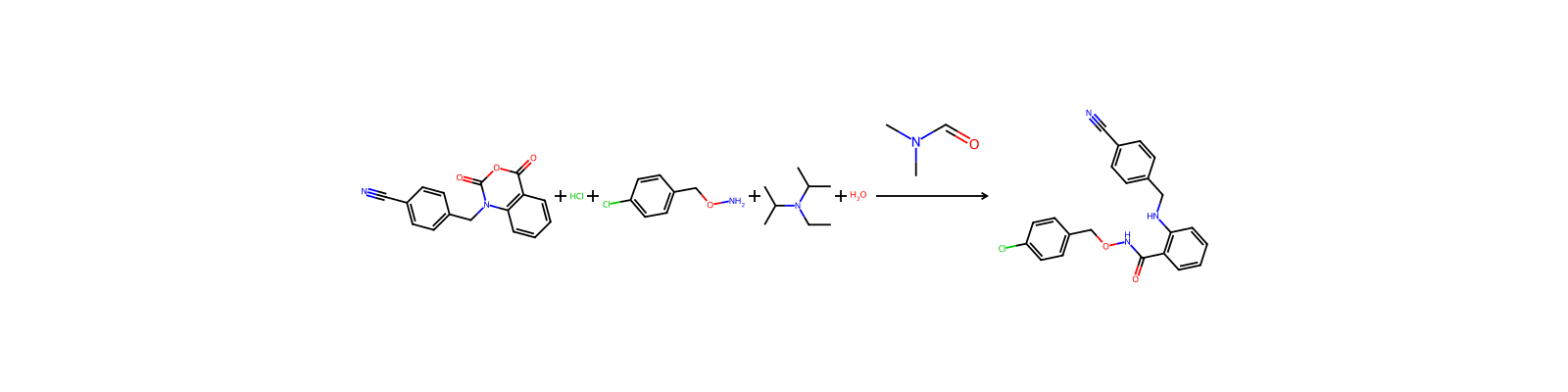
Related reactions
6 records


Compound notes
Loading…