9-Anthracenecarboxylic acid
9-ANTHRACENECARBOXYLIC ACID · 9-AC · 9-ANTHROIC ACID · ANTHRACENE-9-CARBOXYLIC ACID · Anthra · AKOS MSC-0134 · 9-anthroicaci · 9-Anthroate acid
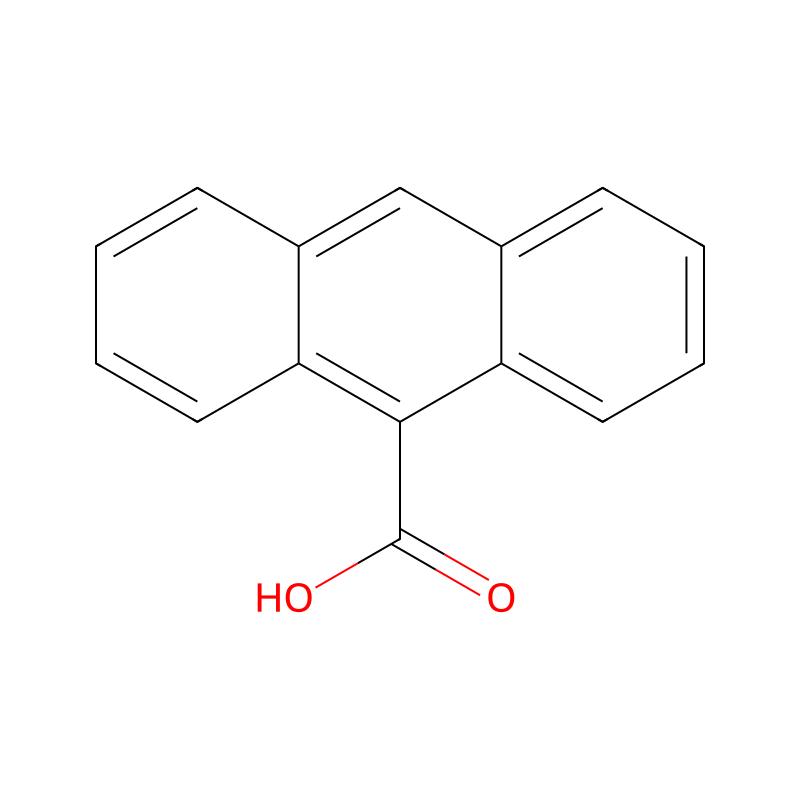
Identifiers & Physical Properties
| CAS No. | 723-62-6 |
|---|---|
| Molecular formula | C15H10O2 |
| Average molar mass | 222.24 g/mol |
| Monoisotopic mass | 222.06807956 g/mol |
| SMILES | O=C(O)c1c2ccccc2cc2ccccc12 |
| InChIKey | XGWFJBFNAQHLEF-UHFFFAOYSA-N |
| PubChem CID | 2201 |
| ChEMBL | CHEMBL1513985 |
| ChEBI | CHEBI:34507 |
| EC No. | 211-964-9 |
| DTXSID | DTXSID7049427 |
Chemical & Physical Properties
| XLogP | 3.8 |
|---|---|
| Topological polar surface area | 37.3 |
| Hydrogen bond donors | 1 |
| Hydrogen bond acceptors | 2 |
| Rotatable bonds | 1 |
| Heavy atoms | 17 |
| Formal charge | 0 |
| Complexity | 277 |
| Vapor pressure | 0.00000022 [mmHg] |
| Physical Description | Yellow powder[Alfa Aesar MSDS] |
| Melting point | 213-217 °C (lit.) |
| Boiling point | 323.41°C (rough estimate) |
| Density | 1.1404 (rough estimate) |
| Refractive index | 1.6600 (estimate) |
| Storage conditions | Sealed in dry,Room Temperature |
| Solubility | H2O: solubleinsoluble |
| Physical state | Solid |
| pKa (acidity coefficient) | pK1: 3.65 (25°C) |
| Color | Yellow |
| λmax | 254 nm at 0.1% in ethanol |
| BRN | 1875336 |
| InChI | 1S/C15H10O2/c16-15(17)14-12-7-3-1-5-10(12)9-11-6-2-4-8-13(11)14/h1-9H,(H,16,17) |
| InChIKey | XGWFJBFNAQHLEF-UHFFFAOYSA-N |
| SMILES | OC(=O)c1c2ccccc2cc3ccccc13 |
| CAS DataBase Reference | 723-62-6(CAS DataBase Reference) |
| EWG's Food Scores | 1 |
| FDA UNII | 7VK69492FV |
| NIST Chemistry Reference | 9-Anthroic acid(723-62-6) |
| EPA Substance Registry System | 9-Anthracenecarboxylic acid (723-62-6) |
| UNSPSC Code | 12352100 |
| NACRES | NA.22 |
| GHS pictogram | GHS07 |
| Signal word | Warning |
| GHS hazard statements | H315-H319-H335 |
| GHS precautionary statements | P264-P280-P302+P352+P332+P313+P362+P364-P305+P351+P338+P337+P313-P261-P280a-P304+P340-P305+P351+P338-P405-P501a |
| Personal protective equipment (PPE) | Eyeshields, Gloves, type N95 (US) |
| Hazard symbols | Xi,C,Xn |
| Risk statements (R) | 36/37/38-20/21/22 |
| Safety statements (S) | 37/39-26-36-24/25 |
| Water hazard class (WGK) | 3 |
| RTECS number | CB8764000 |
| Hazard Note | Corrosive |
| TSCA inventory status | TSCA listed |
| Customs code | 29163900 |
| Storage class | 11 - Combustible Solids |
| Toxicity | pic-esc 127 mg/well MUREAV 260,349,91 |
| REACH registrations | Active |
Safety & Regulations
| GHS classification | This chemical does not meet GHS hazard criteria for 30% (3 of 10) of reports.DangerH301 (10%): Toxic if swallowed [Danger Acute toxicity, oral]H315 (60%): Causes skin irritation [Warning Skin corrosion/irritation]H319 (60%): Causes serious eye irritation [Warning Serious eye damage/eye irritation]H335 (50%): May cause respiratory irritation [Warning Specific target organ toxicity, single exposureRespiratory tract irritation]P261, P264, P264+P265, P270, P271, P280, P301+P316, P302+P352, P304+P340, P305+P351+P338, P319, P321, P330, P332+P317, P337+P317, P362+P364, P403+P233, P405, and P501 (click each P-code to see the statement)Aggregated GHS information provided per 10 reports by companies from 5 notifications to the ECHA C&L Inventory. Each notification may be associated with multiple companies.Reported as not meeting GHS hazard criteria per 3 of 10 reports by companies.There are 4 notifications provided by 7 of 10 reports by companies with hazard statement code(s).Information may vary between notifications depending on impurities, additives, and other factors. The percentage value in parenthesis indicates the notified classification ratio from companies that provide hazard codes. Only hazard codes with percentage values above 10% are shown. For more detailed information, please visit ECHA C&L website. |
|---|---|
| Regulatory information | Chemical: 9-Anthracenecarboxylic acidStatus: Active Update: 25-09-2019 https://echa.europa.eu/registration-dossier/-/registered-dossier/299539-Anthracenecarboxylic acid: Does not have an individual approval but may be used under an appropriate group standard |
| Hazards summary | Causes muscle contraction or spasticity in intraperitoneal lethal-dose studies of mice (LD50 = 750 mg/kg)[RTECS] A skin and strong eye irritant[Alfa Aesar MSDS] See POLYCYCLIC AROMATIC HYDROCARBONS. |
| Hazard Classes and Categories | Acute Tox. 3 (10%)Skin Irrit. 2 (60%)Eye Irrit. 2 (60%)STOT SE 3 (50%) |
| Personal protective equipment (PPE) | Eyeshields, Gloves, type N95 (US) |
| Water hazard class (WGK) | 3 |
| TSCA inventory status | TSCA listed |
| RTECS number | CB8764000 |
| Customs code | 29163900 |
| Toxicity | pic-esc 127 mg/well MUREAV 260,349,91 |
| Risk statements (R) | 36/37/38-20/21/22 |
| Signal word | Warning |
| GHS pictogram | GHS07 |
| Hazard symbols | Xi,C,Xn |
| hazard_note | Corrosive |
| Safety statements (S) | 37/39-26-36-24/25 |
| Storage class | 11 - Combustible Solids |
| GHS hazard statements | H315-H319-H335 |
| REACH registrations | Active |
| GHS precautionary statements | P264-P280-P302+P352+P332+P313+P362+P364-P305+P351+P338+P337+P313-P261-P280a-P304+P340-P305+P351+P338-P405-P501a |
Applications & Uses
Description
9-Anthracenecarboxylic acid (9-AC) is a yellow powder with excellent light stability and fluorescence properties, which can be used as a dye intermediate. The binding constant for fluorescein and 9-AC is 982 M−1, while it is only 81 M−1 for the eosin ester and 9-AC. The fluorescence spectrum of 9-AC in ethanol exhibits strong concentration dependence. At concentrations below 10-5 mol/l, the spectrum displays an anthracene-like structure, whereas above 10-3 mol/l, the spectrum shifts towards the red region, transforming into a broad, structureless band. Furthermore, 9-AC may serve as an electron-transfer ligand for applications in semiconductor or OLED fields.
Uses
Anthracene-9-carboxylic acid is a Cl- transport inhibitor with a moderate to strong inhibitory action on PKA activated cardiac IcI.