HomeMCPWorkbenchSkills
HomeWorkbenchNotificationsMe
llms.txt · MCP GuidePrivacy Policy · Terms of Service · Supportv1.8.3
  1. Home
  2. /Compound

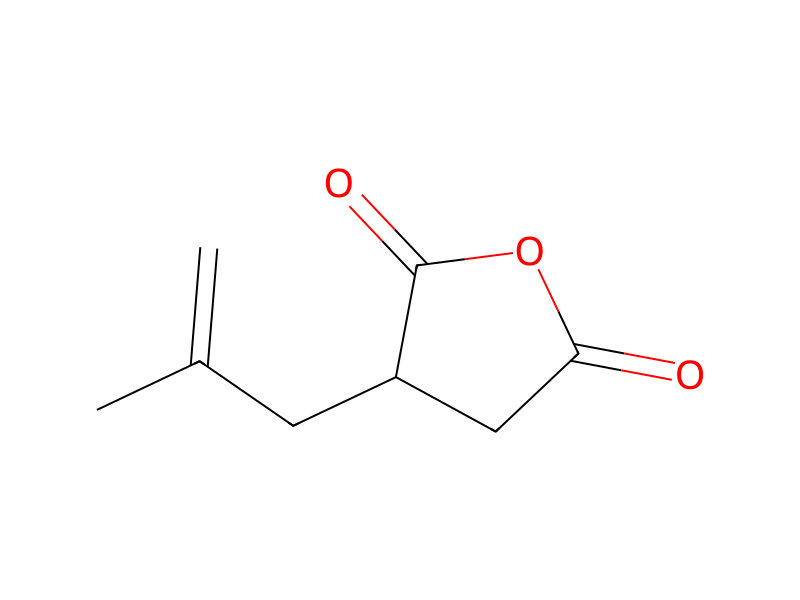
(2-Methyl-2-propenyl)succinic Anhydride

HCID 225375
New reaction
Print
Basic informationNames & identifiersPropertiesSafety & regulationChemistry & industryRelated reactionsCompound notes
Substructure searchFind similar structures

Basic information

CAS
18908-20-8
Standard SMILES
C=C(C)CC1CC(=O)OC1=O
InChIKey
ANPMHDUGFOMMJJ-UHFFFAOYSA-N
Molecular formula
C8H10O3
Average molar mass
154.16 g/mol
Monoisotopic mass
154.06299418

Names & identifiers

Preferred name
(2-Methyl-2-propenyl)succinic Anhydride
IUPAC
3-(2-methylprop-2-enyl)oxolane-2,5-dione
English name
2,5-Furandione, dihydro-, monopolyisobutylene derivs.
Molecular weight
0

Names & synonyms

(2-Methyl-2-propenyl)succinic AnhydrideRefChem:396068672-646-718908-20-83-(2-Methylallyl)dihydrofuran-2,5-dione(2-METHYL-2-PROPEN-1-YL)SUCCINIC ANHYDRIDEMFCD000754773-(2-methylprop-2-enyl)oxolane-2,5-dione3-(2-METHYLPROP-2-EN-1-YL)OXOLANE-2,5-DIONEIsobutenylsuccinic anhydride2,5-Furandione, dihydro-3-(2-methyl-2-propen-1-yl)-(beta-Methallyl)succinic Anhydride
Show more names
Polyisobutylene succinic anhydridePolyisobutenylsuccinic anhydridePolyisobutylene Succinic Anhydride PIBSA5-Furandione, dihydro-, 3-(polyisobutenyl)-23-(2-Methylprop-2-en-1-yl)dihydrofuran-2,5-dione5-furandione, dihydro- monopolyisobutylene derivs.2,5-Furandione, dihydro-, monopolyisobutylene derivs.Dihydro-2,5-furandione mono polyisobutylene derivative
NSC146784-Methyl-4-pentene-1,2-dicarboxylic Anhydride2-Methallylsuccinic anhydridebeta-methallylsuccinic anhydrideSCHEMBL1653285DTXSID30873542NSC-14678AKOS024319645

Database identifiers

CAS
18908-20-8、67762-77-0
PubChem CID
225375
DTXSID
DTXSID30873542
EC Number
104-573-9、672-646-7
Nikkaji
J534.127B

Properties

Computed structural properties

XLogP
1.3
Topological polar surface area
43.4 Ų
Hydrogen bond donors
0
Hydrogen bond acceptors
3
Rotatable bonds
2
Heavy atoms
11
Formal charge
0
Complexity
217

Physicochemical properties

Density
0.92 g/cm3 · 0.92 g/cm3
refractive index
1.469 · 1.469
Flash point
200 °C · 200 °C
form
viscous liquid
color
Light amber to dark brown
Odor
Mild, pleasant odor
Indirect Additives used in Food Contact Substances
POLY(ISOBUTENE)/MALEIC ANHYDRIDE ADDUCT
FDA 21 CFR
176.17 · 176.170
EPA Substance Registry System
2 · 2,5-Furandione, dihydro-, monopolyisobutylene derivs. (67762-77-0)
TSCA
TSCA listed

Safety & regulation

Safety information is for reference only and does not replace the supplier’s Safety Data Sheet (SDS), applicable regulations, or professional assessment.

GHS classification

GHS Classification · 4 items

Warning

H315 (100%): Causes skin irritation [Warning Skin corrosion/irritation]

P261, P264, P264+P265, P271, P280, P302+P352, P304+P340, P305+P351+P338, P319, P321, P332+P317, P337+P317, P362+P364, P403+P233, P405, and P501 (click each P-code to see the statement)

Aggregated GHS information provided per 39 reports by companies from 2 notifications to the ECHA C&L Inventory. Each notification may be associated with multiple companies.

Hazard information

Hazard Classes and CategoriesSkin Irrit. 2 (100%)

Safety data

tsca
TSCA listed

Chemistry & industry

Applications

UsesPolyisobutylene Succinic Anhydride (PIBSA) is a versatile chemical compound with various industrial applications due to its properties as a dispersant, emulsifier, and lubricant additive.

Related reactions

11 records
New reaction record
HRID 443187 reaction equation
HRID 443187As product
HRID 443188 reaction equation
HRID 443188As reactant
HRID 443189 reaction equation
HRID 443189As product
HRID 964966 reaction equation
HRID 964966As product
HRID 964967 reaction equation
HRID 964967As reactant
HRID 1253138 reaction equation
HRID 1253138As reactant
HRID 1253142 reaction equation
HRID 1253142As product
HRID 1253144 reaction equation
HRID 1253144As reactant
PreviousPage 1 of 2

Compound notes

On this pageBasic informationNames & identifiersPropertiesSafety & regulationChemistry & industryRelated reactionsCompound notes