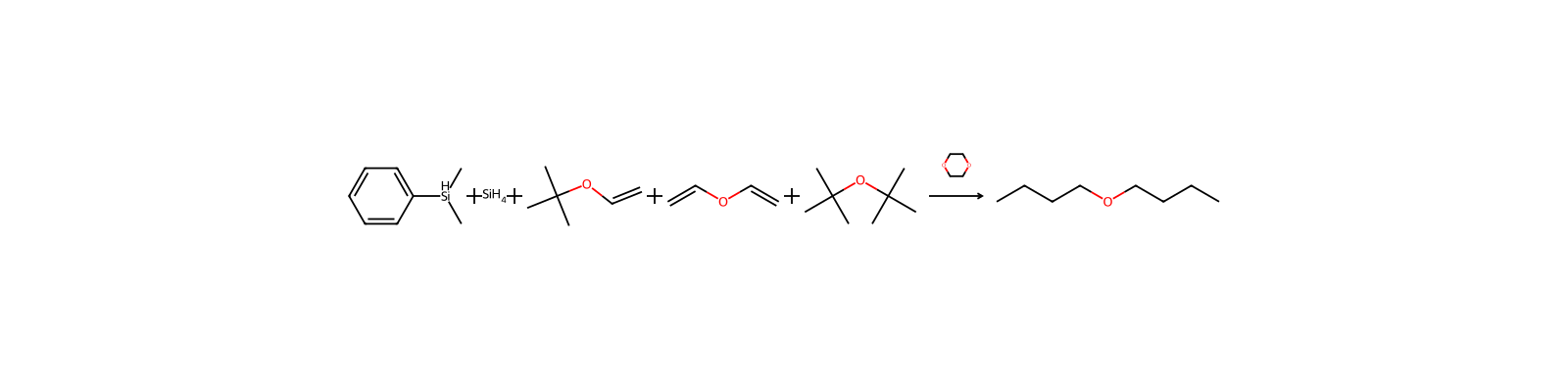

Basic information
- CAS
6163-66-2- Standard SMILES
CC(C)(C)OC(C)(C)C- InChIKey
AQEFLFZSWDEAIP-UHFFFAOYSA-N- Molecular formula
- C8H18O
- Average molar mass
- 130.23 g/mol
- Monoisotopic mass
- 130.13576519
Names & identifiers
- Preferred name
- Di-tert-butyl ether
- IUPAC
- 2-methyl-2-[(2-methylpropan-2-yl)oxy]propane
- English name
- Di-tert-butyl ether
- Molecular formula
- C8H18O
- Molecular weight
- 130.23
Names & synonyms
Di-tert-butyl ethertert-Butyl etherPropane, 2,2'-oxybis[2-methyl-(tert-C4H9)2OUNII-C3A9UPP65HC3A9UPP65HBIS(TERT-BUTYL)ETHER2-(1,1-Dimethylethoxy)-2-methylpropane2,2'-Oxybis-2-methyl-propaneDTXSID80210645DI-TERT-BUTYL ETHER [MI]1,1'-Oxybis(1,1-dimethylethane)
Show more names
Acedoben Impurity 8Ditertiary butyl etherBis1,1-dimethylethyletherBis(1,1-dimethylethyl)etherDi(1,1-dimethylethyl) ether2-tert-Butoxy-2-methylpropane
PROPANE, 2-(1,1-DIMETHYLETHOXY)-2-METHYL-Propane, 2,2'-oxybis(2-methyl-RefChem:132517DTXCID10133136672-143-2AQEFLFZSWDEAIP-UHFFFAOYSA-NInChI=1/C8H18O/c1-7(2,3)9-8(4,5)6/h1-6H6163-66-2
Database identifiers
- CAS
6163-66-2- PubChem CID
- 22541
- DTXSID
DTXSID80210645- UNII
- C3A9UPP65H
- EC Number
- 672-143-2
- Nikkaji
- J44.185F
Properties
Computed structural properties
- XLogP
- 2
- Topological polar surface area
- 9.2 Ų
- Hydrogen bond donors
- 0
- Hydrogen bond acceptors
- 1
- Rotatable bonds
- 2
- Heavy atoms
- 9
- Formal charge
- 0
- Complexity
- 69
Physicochemical properties
- Melting point
- -78.15 °C · -78.15°C
- Boiling point
- 106 °C · 106°C
- Density
- 420 · d420 0.7658
- refractive index
- 20 · nD20 1.3949
- storage temp.
- Sealed in dry,Room Temperature
- solubility
- Chloroform (Sparingly), Methanol (Slightly)
- form
- Liquid
- color
- Colourless
- Specific Heat Capacity
- 2.12 J/ · Cp(liquid): 2.12 J/(g·K), at 25℃
- Henry's Law Constant
- 2.1 · 2.1×10-3 mol/(m3Pa) at 25℃, Yaws (2003)
- Dielectric constant
- 3.05 · 3.0499999999999998
- Stability
- Volatile
- FDA UNII
- 3 A9UPP65H · C3A9UPP65H
- Symbol(GHS)
- 2 · GHS02
- Signal word
- Danger
- Hazard statements
- 226 · H226
- Risk Statements
- 10 · 10-36/37/38
- Safety Statements
- 16 · 16-26-36
- RIDADR
- 3271 · 3271
Safety & regulation
GHS classification
GHS Classification
Warning
H226 (66.7%): Flammable liquid and vapor [Warning Flammable liquids];H315 (66.7%): Causes skin irritation [Warning Skin corrosion/irritation];H319 (66.7%): Causes serious eye irritation [Warning Serious eye damage/eye irritation];H335 (66.7%): May cause respiratory irritation [Warning Specific target organ toxicity, single exposure; Respiratory tract irritation]
P210, P233, P240, P241, P242, P243, P261, P264, P264+P265, P271, P280, P302+P352, P303+P361+P353, P304+P340, P305+P351+P338, P319, P321, P332+P317, P337+P317, P362+P364, P370+P378, P403+P233, P403+P235, P405, and P501 (click each P-code to see the statement)
Aggregated GHS information provided per 3 reports by companies from 3 notifications to the ECHA C&L Inventory. Each notification may be associated with multiple companies.;Information may vary between notifications depending on impurities, additives, and other factors. The percentage value in parenthesis indicates the notified classification ratio from companies that provide hazard codes. Only hazard codes with percentage values above 10% are shown. For more detailed information, please visit ECHA C&L website.
Hazard information
Peroxide Forming Chemical
t-Butyl ether
B*: Compounds that form peroxides on concentration (distillation/evaporation)
Moderate peroxides found in new commerically available containers
Bretherick's
An explosion occured druing distillation despite a negative test result for peroxides. See Bretherick's.
Bowen, R. D. et al., J. Chem. Soc. Perk. 2, 1990, 147
Hazard Classes and CategoriesFlam. Liq. 3 (66.7%);Skin Irrit. 2 (66.7%);Eye Irrit. 2 (66.7%);STOT SE 3 (66.7%)
Safety data
- ridadr
- 3271
- risk_code
- 10-36/37/38
- Signal word
- Danger
- Symbol(GHS)
- GHS02
- safety_code
- 16-26-36
- Hazard statements
- H226
Chemistry & industry
Applications
UsesGasoline additive.
Upstream & downstream products
Downstream products
Suppliers33 total
武汉英诺医药科技有限公司+86-027-59232304 15387063101 · [email protected]
合肥翰刚医药科技有限公司+8618062405514 · [email protected]
南京世洲生物科技有限公司025-025-85560043 17301488900 · [email protected]
上海迈瑞尔生化科技有限公司4006356688 18621169109 · [email protected]
Hangzhou Sage Chemical Co., Ltd.+86057186818502 13588463833 · [email protected]
烟台正信新材料科技有限公司13854547682 13854547682 · [email protected]
佛山宝诺生物科技有限公司0757-85921206 18520245316 · [email protected]
HONG KONG IPURE BIOLOGY CO.,LIMITED86 18062405514 18062405514 · [email protected]
湖北扬信医药科技有限公司15347293736 · [email protected]
南京世洲生物科技有限公司13675144456 · [email protected]
四川省维克奇生物科技有限公司028-81700200 18116577057 · [email protected]
天津安浩生物科技有限公司[email protected]
上海麦克林生化科技股份有限公司15221275939 15221275939 · [email protected]
江苏艾康生物医药研发有限公司025-66028182 17714375163 · [email protected]
陕西缔都医药化工有限公司029-81024372 17792795018 · [email protected]
Alfa Chemistry1-516-6625404 · [email protected]
BOC Sciences16314854226; +8616314854226 · [email protected]
Alfa Chemistry+1-5166625404 · [email protected]
艾吉析科技(上海)有限公司17721401538;17717235263 17721401538 · [email protected]
武汉多普乐生物医药有限公司+86-02787215551 19945035818 · [email protected]
安泰精细化工技术有限公司18503026267 · [email protected]
金锦乐(湖南)化学有限公司18001959627(微信同号) 18001959627 · [email protected]
Shanghai Acmec Biochemical Technology Co., Ltd.+86-18621343501 · [email protected]
上海吉至生化科技有限公司021-4009004166/18616739031 18616739031 · [email protected]
广东翁江化学试剂有限公司0751-2815688 13927872512 · [email protected]
SHANGHAI KEAN TECHNOLOGY CO., LTD.+8613817748580 · [email protected]
山东千帆顺化工有限公司15610119970 · [email protected]
DAYANG CHEM (HANGZHOU) CO.,LTD+86-88938639 +86-17705817739 · [email protected]
ShangHai IKSChem Technology Co.,LTD+86-18337276608 · [email protected]
上海锐谱医药科技有限公司15895968936 · [email protected]
山东彬睿特新材料有限公司0533-2866658 15615638350 · [email protected]
湖北清北云研医药科技有限责任公司18162595016; 18162595016 · [email protected]
兰州金诚楷摩医药科技有限公司13361936468 · [email protected]
Related reactions
31 records


Compound notes
Loading…