
Azosemide
Completing data — refresh the page later to see the latest
Basic information
- CAS
27589-33-9- Standard SMILES
NS(=O)(=O)c1cc(-c2nn[nH]n2)c(NCc2cccs2)cc1Cl- InChIKey
HMEDEBAJARCKCT-UHFFFAOYSA-N- Molecular formula
- C12H11ClN6O2S2
- Average molar mass
- 370.8 g/mol
- Monoisotopic mass
- 370.00734327
Overview
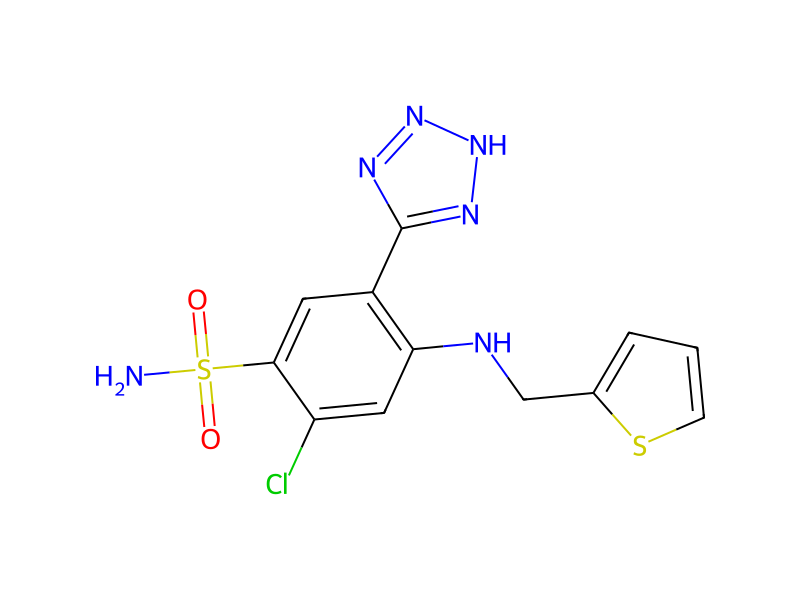
Azosemide is a sulfonamide that is benzenesulfonamide which is substituted at positions 2, 4, and 5 by chlorine, (2-thienylmethyl)amino and 1H-tetrazol-5-yl groups, respectively. It is a diuretic that has been used in the management of oedema and hypertension. It has a role as a loop diuretic. It is a member of thiophenes, a sulfonamide, a member of tetrazoles and a member of monochlorobenzenes.
Names & identifiers
- Preferred name
- Azosemide
- IUPAC
- 2-chloro-5-(2H-tetrazol-5-yl)-4-(thiophen-2-ylmethylamino)benzenesulfonamide
- English name
- Azosemide
- Molecular formula
- C12H11ClN6O2S2
- Molecular weight
- 370.84
Names & synonyms
azosemide27589-33-9AzosemidDiartAzosemidaAzosemidumLuretDTXSID7046910MR40VT1L8Z2-Chloro-5-(1H-tetrazol-5-yl)-N(sup 4)-2-thenylsulfanilamideBenzenesulfonamide, 2-chloro-5-(1H-tetrazol-5-yl)-4-((2-thienylmethyl)amino)-5-(4'-chloro-5'-sulfamoyl-2'-thenylaminophenyl)tetrazole
Show more names
SK-110ple1053DiurapidAZOSEMIDE HPLCAzosemide USP/EP/BP
DTXCID5026910CHEBI:312482-chloro-5-(2H-1,2,3,4-tetrazol-5-yl)-4-((thiophen-2-ylmethyl)amino)benzene-1-sulfonamide2-chloro-5-(2H-1,2,3,4-tetrazol-5-yl)-4-[(thiophen-2-ylmethyl)amino]benzene-1-sulfonamide5-(4-chloro-5-sulfamyl-2-thienylaminophenyl)tetrazoleRefChem:5606092-Chloro-5-(1H-tetrazol-5-yl)-4-((thien-2-ylmethyl)amino)benzenesulfonamide248-549-7
Database identifiers
- CAS
27589-33-9- PubChem CID
- 2273
- DTXSID
DTXSID7046910
Properties
Computed structural propertiesFilling in
- XLogP
- 1.5
- Topological polar surface area
- 163 Ų
- Hydrogen bond donors
- 3
- Hydrogen bond acceptors
- 8
- Rotatable bonds
- 5
- Heavy atoms
- 23
- Formal charge
- 0
- Complexity
- 504
Experimental & physicochemical properties
DrugsPharmaceuticals -> Listed in ZINC15
Melting Point219.5 °C
Physical DescriptionSolid
Physicochemical properties
- Melting point
- 218 · 218-221°
- Boiling point
- 221 °C · 221°C (rough estimate)
- Density
- 1.6843 · 1.6843 (rough estimate)
- refractive index
- 1.61 · 1.6100 (estimate)
- storage temp.
- 2 · under inert gas (nitrogen or Argon) at 2–8 °C
- solubility
- DMSO (Slightly), Methanol (Slightly, Heated)
- form
- Solid
- pka
- 3.58 · 3.58±0.10(Predicted)
- color
- Crystals
- InChI
- InChI=1S/C12H11ClN6O2S2/c13-9-5-10(15-6-7-2-1-3-22-7)8(12-16-18-19-17-12)4-11(9)23(14,20)21/h1-5,15H,6H2,(H2,14,20,21)(H,16,17,18,19)
Safety & regulation
Safety information is for reference only and does not replace the supplier’s Safety Data Sheet (SDS), applicable regulations, or professional assessment.
Safety data
- Toxicity
- LD50 orl-rat: 2545 mg/kg IYKEDH 18,666,87
- Signal word
- Warning
- Symbol(GHS)
- GHS07
- Hazard statements
- H302+H312+H332-H315-H319-H227
- Precautionary statements
- P501-P261-P270-P210-P271-P264-P280-P370+P378-P337+P313-P305+P351+P338-P362+P364-P332+P313-P301+P312+P330-P302+P352+P312-P304+P340+P312-P403+P235
Chemistry & industry
Pharmacology
Protein Binding> 95% 4% protein binding to 4% human serum albumin at azosemide concentrations of 10-100ug/ml, using equilibrium dialysis.
PharmacodynamicsDiuretic affects upon oral administration match those of furosemide. However, upon intravenous administration azosemide displays 5.5 to 8 times greater effect.
Mechanism of ActionExact mechanism of action is unclear. However, it acts primarily on the loop of Henle, in both the medullary and cortical segments of the thick ascending limb.
Biological Half-LifeTerminal half life 2-3 hours.
Metabolism/MetabolitesConsiderable first pass metabolism which makes parentral administration more effective than oral administration. Eleven metabolites of azosemide were found in rats, but only azosemide and its glucuronide were detected in humans.
MeSH Pharmacological ClassificationAgents that promote the excretion of urine through their effects on kidney function.
Absorption, Distribution and Excretion
Peak plasma concentrations are achieved in 3-4 hours when azosemide is administered to healthy humans in a fasting state. There is an absorption lag time of approximately 1 hour. Oral bioavailability estimated to be 20.4%
Total body clearance 112ml/min. Renal clearance 41.6ml/min. Actively secreted in the renal proximal tubule of humans. This may or may not involve a nonspecific organic acid secretory pathway. There is thus a potential for disease states and other organic acids such as NSAIDs which affect the organic acid transport pathway to affect the efficacy of azosemide.
Poor affinity for human tissue. Small apparent post-pseudodistribution Vd of 0.262 l/kg.
Cellular LocationsMembrane
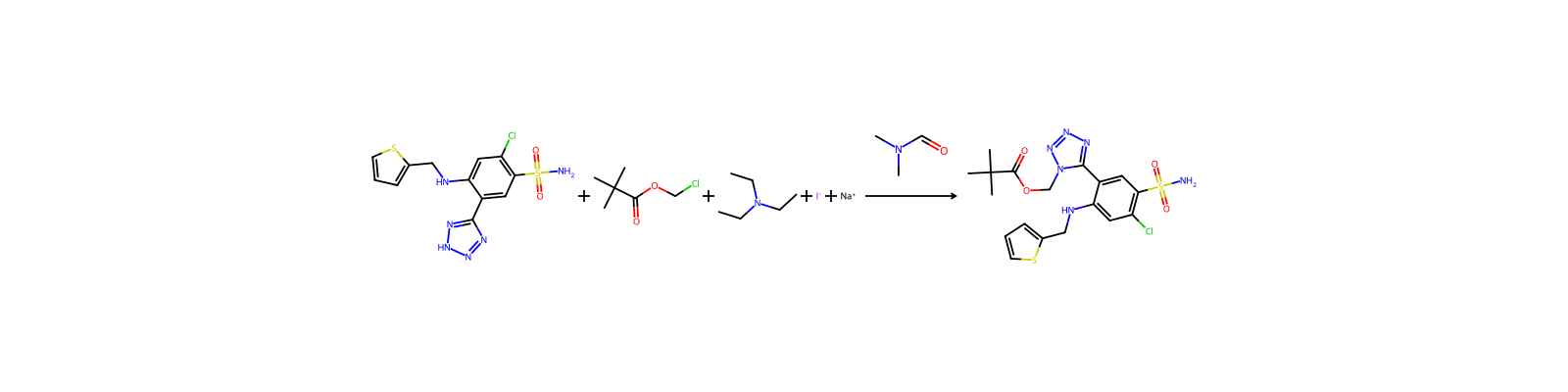
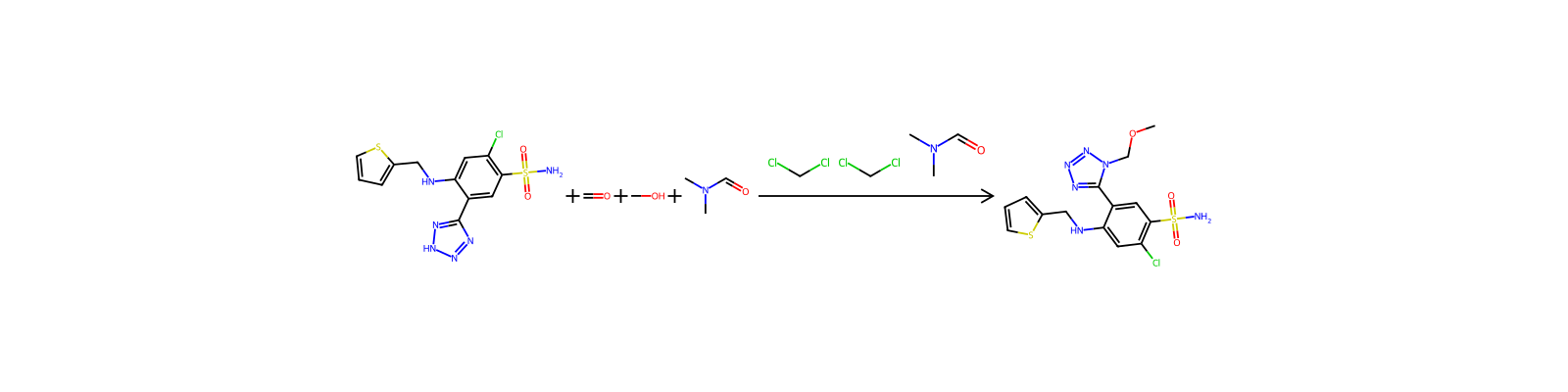
Related reactions
10 records





Compound notes
Loading…