
1,4-Dibromo-2,3-butanedione
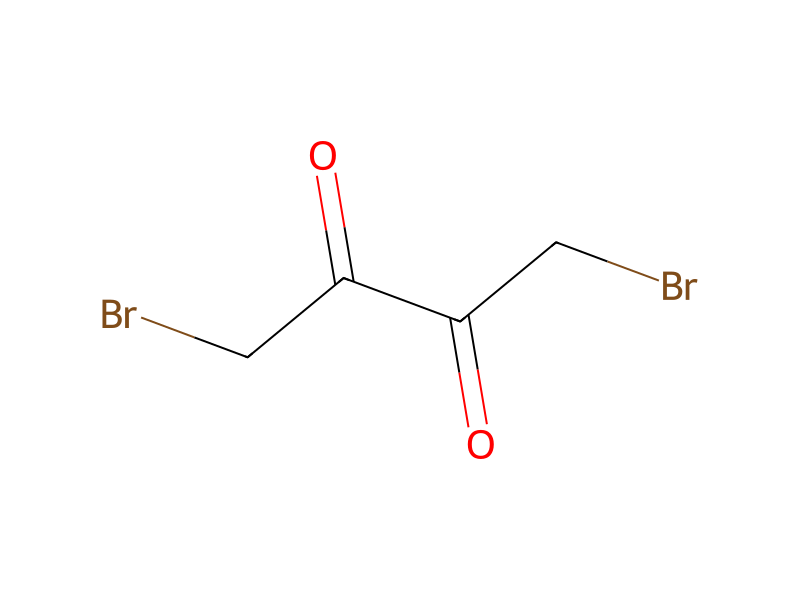
Basic information
- CAS
6305-43-7- Standard SMILES
O=C(CBr)C(=O)CBr- InChIKey
RZMOICJDRADLCT-UHFFFAOYSA-N- Molecular formula
- C4H4Br2O2
- Average molar mass
- 243.88 g/mol
- Monoisotopic mass
- 241.8578
Overview
1,4-Dibromodiacetyl is an alpha-diketone.
Names & identifiers
- Preferred name
- 1,4-Dibromo-2,3-butanedione
- IUPAC
- 1,4-dibromobutane-2,3-dione
- English name
- 1,4-Dibromo-2,3-butanedione
- Molecular formula
- C4H4Br2O2
- Molecular weight
- 243.88
Names & synonyms
1,4-Dibromo-2,3-butanedione6305-43-72,3-BUTANEDIONE, 1,4-DIBROMO-1,4-DibromobutanedioneNHZ2FG6JE3NSC-41130NSC-75722DTXSID9064219DBBDRefChem:416709DTXCID6043624228-615-1
Show more names
SKL239à,à'-dibromobiacetyl2,2’-dibromobiacetyl1,4-dibromo-3-butanedionealpha,alpha’-dibromobiacetyl
1,4-Dibromobutane-2,3-dione2,2'-Dibromobiacetylalpha,alpha'-DibromobiacetylS 671,4-DibromodiacetylEINECS 228-615-1sym-DibromodiacetylNSC 41130
Database identifiers
- CAS
6305-43-7- PubChem CID
- 22747
- DTXSID
DTXSID9064219- ChEBI
CHEBI:188852- UNII
- NHZ2FG6JE3
- EC Number
- 228-615-1
- Nikkaji
- J42.099I
Properties
Computed structural properties
- XLogP
- 1.2
- Topological polar surface area
- 34.1 Ų
- Hydrogen bond donors
- 0
- Hydrogen bond acceptors
- 2
- Rotatable bonds
- 3
- Heavy atoms
- 8
- Formal charge
- 0
- Complexity
- 96.6
Experimental & physicochemical properties
Chemical ClassesOther Classes -> Halogenated Ketones
Physical DescriptionLight yellow powder; [Aldrich MSDS] Irritating odor; [Alfa Aesar MSDS]
Physicochemical properties
- Melting point
- 117 · 117-119 °C (lit.)
- Boiling point
- 213 · 213.0±25.0 °C(Predicted)
- Density
- 2.0524 · 2.0524 (rough estimate)
- refractive index
- 1.522 · 1.5220 (estimate)
- storage temp.
- 2 · Storage temp. 2-8°C
- form
- powder
- Appearance
- Off-white to light yellow Solid
- Water Solubility
- Insoluble in water.
- BRN
- 970154 · 970154
- InChI
- InChI=1S/C4H4Br2O2/c5-1-3(7)4(8)2-6/h1-2H2
- InChIKey
- RZMOICJDRADLCT-UHFFFAOYSA-N
Safety & regulation
Safety information is for reference only and does not replace the supplier’s Safety Data Sheet (SDS), applicable regulations, or professional assessment.
GHS classification
GHS Classification
Warning
H315 (90.7%): Causes skin irritation [Warning Skin corrosion/irritation]
P261, P264, P264+P265, P271, P280, P302+P352, P304+P340, P305+P351+P338, P319, P321, P332+P317, P337+P317, P362+P364, P403+P233, P405, and P501 (click each P-code to see the statement)
Aggregated GHS information provided per 43 reports by companies from 3 notifications to the ECHA C&L Inventory. Each notification may be associated with multiple companies.
Hazard information
Hazards Summary
Causes acute pulmonary edema and diffuse hepatitis in intravenous lethal-dose studies of dogs; [RTECS] A skin and strong eye irritant; [Aldrich MSDS] Causes burns; Inhalation may cause corrosive injuries to upper respiratory tract and lungs; Harmful by ingestion; [Alfa Aesar MSDS]
Hazard Classes and CategoriesSkin Irrit. 2 (90.7%)
Toxicology
Adverse EffectsOccupational hepatotoxin - Secondary hepatotoxins: the potential for toxic effect in the occupational setting is based on cases of poisoning by human ingestion or animal experimentation.
Safety data
- PPE
- dust mask type N95 (US), Eyeshields, Gloves
- wgk
- 3
- tsca
- TSCA listed
- rtecs
- EK2850000
- ridadr
- 1759
- risk_code
- 36/37/38
Chemistry & industry
Uses & manufacturing
UsesReacts covalently with pyruvate kinase from rabbit muscle to cause inactivation of the enzyme. [ChemIDplus]
General Manufacturing Information2,3-Butanedione, 1,4-dibromo-: INACTIVE
Applications
UsesCatalyst-Free Multicomponent Cyclopolymerizations: A novel approach utilizing 1,4-Dibromo-2,3-butanedione in catalyst-free multicomponent cyclopolymerizations to synthesize functional polyiminofurans containing bromomethyl groups was developed. This method enhances the utility of 1,4-Dibromo-2,3-butanedione in producing advanced materials with potential applications in chemical and pharmaceutical industries (Zhu et al., 2021).
Upstream & downstream products
Downstream products
Additional notes
DefinitionChEBI: 1,4-Dibromodiacetyl is an alpha-diketone.
Related reactions
8 records


Compound notes
Loading…