Butyl cyanoacrylate
HCID 23087
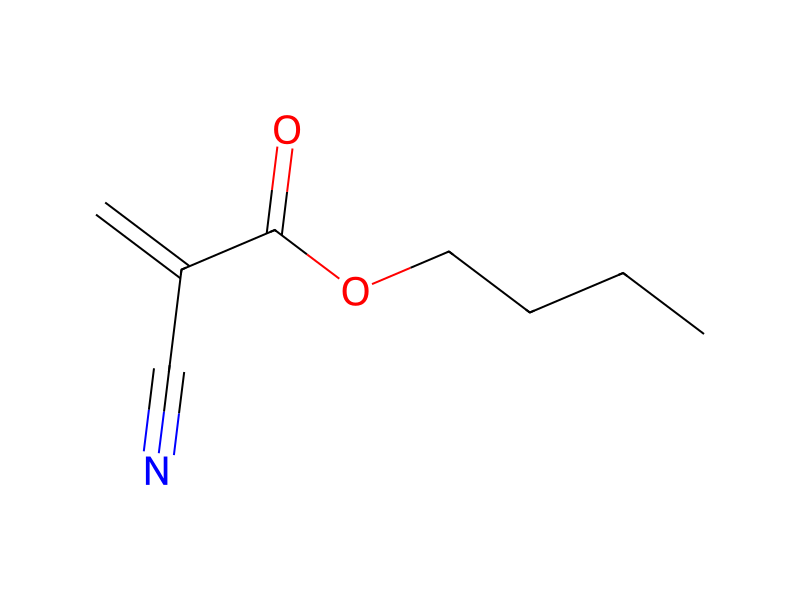
Basic information
- CAS
25154-80-7- Standard SMILES
C=C(C#N)C(=O)OCCCC- InChIKey
JJJFUHOGVZWXNQ-UHFFFAOYSA-N- Molecular formula
- C8H11NO2
- Average molar mass
- 153.18 g/mol
- Monoisotopic mass
- 153.07897859
Overview
Enbucrilate is a nitrile and an alpha,beta-unsaturated monocarboxylic acid.
Names & identifiers
- Preferred name
- Butyl cyanoacrylate
- IUPAC
- butyl 2-cyanoprop-2-enoate
- English name
- enbucrilate
- Molecular formula
- C8H11NO2
- Molecular weight
- 153.18
Names & synonyms
ENBUCRILATEButyl 2-cyanoacrylate6606-65-1BUTYL CYANOACRYLATEHistoacrylbutyl 2-cyanoprop-2-enoateEnbucrilatumEnbucrilatoGlustitchMedibondMedicrylPeriacryl
Show more names
n-Butyl CyanoacrylateBUTYLCYANOACRYLATEn-Butyl 2-CyanoacrylateNBCA n-butyl cyanoacrylate tissue adhesiveIndermilTisuacrylIntegusealHystoacrylGlubranh 1
Vetbond2-Propenoic acid, 2-cyano-, butyl esterF8CEP82QNPButyl 2-cyano-2-propenoateDTXSID5064417EnbucrilatesEnbucrylateEnbucrylates
Database identifiers
- CAS
25154-80-7、6606-65-1- PubChem CID
- 23087
- DTXSID
DTXSID5064417- ChEMBL
CHEMBL2104251- ChEBI
CHEBI:134778- UNII
- F8CEP82QNP
- EC Number
- 229-552-2
- Nikkaji
- J8.426C
Properties
Computed structural properties
- XLogP
- 2.4
- Topological polar surface area
- 50.1 Ų
- Hydrogen bond donors
- 0
- Hydrogen bond acceptors
- 3
- Rotatable bonds
- 5
- Heavy atoms
- 11
- Formal charge
- 0
- Complexity
- 199
Experimental & physicochemical properties
Drugs
Pharmaceuticals -> Listed in ZINC15
Pharmaceuticals
Physicochemical properties
- Boiling point
- 1.8 · bp1.8 68°
- Density
- 20 · d20 0.989
- vapor pressure
- 1.3 hPa · 1.3hPa at 20℃
- refractive index
- 20 D · n20D 1.4424; nD25 1.4410
- Flash point
- 176 °F · closed cup: >176°F (>80°C)
- storage temp.
- 2 · under inert gas (nitrogen or Argon) at 2-8°C
- solubility
- Chloroform (Sparingly), Ethyl Acetate (Slightly)
- form
- Oil
- color
- Colourless
- InChI
- InChI=1S/C8H11NO2/c1-3-4-5-11-8(10)7(2)6-9/h2-5H2,1H3
- InChIKey
- JJJFUHOGVZWXNQ-UHFFFAOYSA-N
- SMILES
- C(OCCCC)(=O)C(C#N)=C
Safety & regulation
Safety information is for reference only and does not replace the supplier’s Safety Data Sheet (SDS), applicable regulations, or professional assessment.
GHS classification
GHS Classification
This chemical does not meet GHS hazard criteria for 100% (19 of 19) of all reports.
Not Classified
Aggregated GHS information provided per 19 reports by companies from 2 notifications to the ECHA C&L Inventory.
Hazard information
Regulatory Information
Chemical: 2-Propenoic acid, 2-cyano-, butyl ester
REACH registered substance: Enbucrilate (EC: 229-552-2)
n-Butyl cyanoacrylate: Does not have an individual approval but may be used as a component in a product covered by a group standard. It is not approved for use as a chemical in its own right.
Hazard Classes and CategoriesNot Classified
Toxicology
Treatment
Antidotes to cyanide poisoning include hydroxocobalamin and sodium nitrite, which release the cyanide from the cytochrome system, and rhodanase, which is an enzyme occurring naturally in mammals that combines serum cyanide with thiosulfate, producing comparatively harmless thiocyanate. Oxygen therapy can also be administered. (L97)
Health Effects
Exposure to high levels of cyanide for a short time harms the brain and heart and can even cause coma, seizures, apnea, cardiac arrest and death. Chronic inhalation of cyanide causes breathing difficulties, chest pain, vomiting, blood changes, headaches, and enlargement of the thyroid gland. Skin contact with cyanide salts can irritate and produce sores. (L96, L97)
Exposure Routes
Chemistry & industry
Pharmacology
Metabolism/Metabolites
Organic nitriles are converted into cyanide ions through the action of cytochrome P450 enzymes in the liver. Cyanide is rapidly absorbed and distributed throughout the body. Cyanide is mainly metabolized into thiocyanate by either rhodanese or 3-mercaptopyruvate sulfur transferase. Cyanide metabolites are excreted in the urine. (L96)
Uses & manufacturing
Uses
Use (kg; approx.) in Germany (2009): >10
Butyl cyanoacrylate is the main component of medical cyanoacrylate glues, which are used as adhesives for lacerations of the skin, and in the treatment of bleeding from vascular structures. (L595)
Household ProductsInformation on 3 consumer products that contain Butyl 2-cyano-2-propenoate in the following categories is provided:
General Manufacturing Information2-Propenoic acid, 2-cyano-, butyl ester: ACTIVE
Applications
UsesEnbucrilate is bacteriostatic and its use is usually painless. It is used as an adhesive for lacerations of the skin, and in the treatment of bleeding from vascular structures.
Upstream & downstream products
Upstream raw materials
Related reactions
0 records
No related reactions yet