
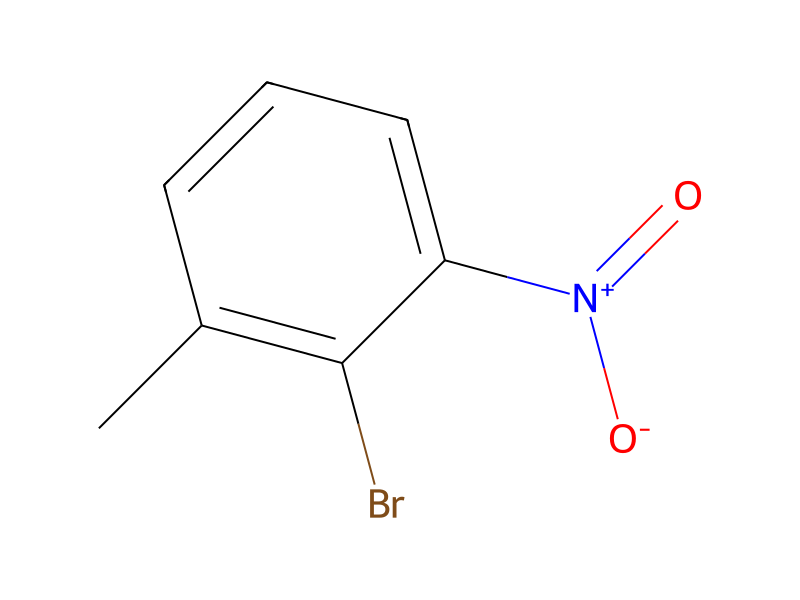
Basic information
- Standard SMILES
Cc1cccc([N+](=O)[O-])c1Br- InChIKey
GCAAVRIWNMTOKB-UHFFFAOYSA-N- Molecular formula
- C7H6BrNO2
- Average molar mass
- 216.03 g/mol
- Monoisotopic mass
- 214.95819053
Names & identifiers
- Preferred name
- 2-Bromo-3-nitrotoluene
- IUPAC
- 2-bromo-1-methyl-3-nitrobenzene
- English name
- 2-Bromo-3-nitrotoluene
- Molecular formula
- C7H6BrNO2
- Molecular weight
- 216.03
Names & synonyms
2-Bromo-3-nitrotolueneDTXSID30282877RefChem:466349DTXCID80234028628-326-441085-43-22-Bromo-1-methyl-3-nitrobenzeneMFCD00134555Benzene, 2-bromo-1-methyl-3-nitro-NSC285842-Bromo-3-nitrotoluene, 99%STR06977
Show more names
2-Bromo-3-nitrotoL2-Chloro-3-nitrotoluenem2-Bromo-3-nitrotoluene >2-Bromo-3-nitrotoluene,98%2-Bromo-3-methylnitrobenzene2-BroMo-3-nitrotoluene, 95+%2 - broMine - 3 - nitrotoluene1-Bromo-2-methyl-6-nitrobenzene
2-Bromo-1-methyl-3-nitrobenzene #AKOS005145632CS-W002413AC-9442BP-12606B3712EN300-180441AJ-797/43492802
Database identifiers
- CAS
41085-43-2- PubChem CID
- 231828
- DTXSID
DTXSID30282877- EC Number
- 628-326-4
- Nikkaji
- J1.257.062G
Properties
Computed structural properties
- XLogP
- 2.8
- Topological polar surface area
- 45.8 Ų
- Hydrogen bond donors
- 0
- Hydrogen bond acceptors
- 2
- Rotatable bonds
- 0
- Heavy atoms
- 11
- Formal charge
- 0
- Complexity
- 157
Physicochemical properties
- Melting point
- 38 · 38-41 °C (lit.)
- Boiling point
- 135 · 135-136 °C/8 mmHg (lit.)
- Density
- 0.803 g/mL · 0.803 g/mL at 25 °C (lit.)
- refractive index
- 1.612 · 1.6120 (estimate)
- Flash point
- 230 °F · >230 °F
- storage temp.
- Sealed in dry,Room Temperature
- solubility
- soluble in Methanol
- form
- Low Melting Solid
- color
- Pale yellow
- InChI
- 1S/C7H6BrNO2/c1-5-3-2-4-6(7(5)8)9(10)11/h2-4H,1H3
- InChIKey
- GCAAVRIWNMTOKB-UHFFFAOYSA-N
- SMILES
- Cc1cccc(c1Br)[N+]([O-])=O
- CAS DataBase Reference
- 41085 · 41085-43-2(CAS DataBase Reference)
- UNSPSC Code
- 12352100 · 12352100
- NACRES
- 22 · NA.22
- Symbol(GHS)
- 7 · GHS07
- Signal word
- Warning
- Hazard statements
- 302 · H302+H312+H332-H302-H312-H315-H319-H332-H335
- Precautionary statements
- 264 · P264-P270-P271-P301+P312+P330-P302+P352+P312+P362+P364-P304+P340+P312-P305+P351+P338+P337+P313-P501-P261-P280-P305+P351+P338
- target organs
- Respiratory system
- PPE
- 95 · dust mask type N95 (US), Eyeshields, Gloves
- Hazard Codes
- Xn
- Risk Statements
- 20 · 20/21/22-36/37/38
- Safety Statements
- 26 · 26-36
- WGK Germany
- 3 · 3
- HS Code
- 29049090 · 29049090
- Storage Class
- 11 · 11 - Combustible Solids
- Hazard Classifications
- 4 OralEye · Acute Tox. 4 OralEye Irrit. 2Skin Irrit. 2STOT SE 3
Safety & regulation
GHS classification
GHS Classification
Warning
H302 (95.5%): Harmful if swallowed [Warning Acute toxicity, oral]
P261, P264, P264+P265, P270, P271, P280, P301+P317, P302+P352, P304+P340, P305+P351+P338, P317, P319, P321, P330, P332+P317, P337+P317, P362+P364, P403+P233, P405, and P501 (click each P-code to see the statement)
Aggregated GHS information provided per 44 reports by companies from 6 notifications to the ECHA C&L Inventory. Each notification may be associated with multiple companies.
Hazard information
Hazard Classes and CategoriesAcute Tox. 4 (95.5%)
Safety data
- PPE
- dust mask type N95 (US), Eyeshields, Gloves
- wgk
- 3
- hs_code
- 29049090
- risk_code
- 20/21/22-36/37/38
- Signal word
- Warning
- Symbol(GHS)
- GHS07
- hazard_code
- Xn
- safety_code
- 26-36
- Storage Class
- 11 - Combustible Solids
- target organs
- Respiratory system
- Hazard statements
- H302+H312+H332-H302-H312-H315-H319-H332-H335
- Hazard Classifications
- Acute Tox. 4 OralEye Irrit. 2Skin Irrit. 2STOT SE 3
- Precautionary statements
- P264-P270-P271-P301+P312+P330-P302+P352+P312+P362+P364-P304+P340+P312-P305+P351+P338+P337+P313-P501-P261-P280-P305+P351+P338
Chemistry & industry
Applications
Uses2-Bromo-3-nitrotoluene may be used in the preparation of unsymmetrical dimethyl dinitro biphenyl, via Ullmann reaction. It may be used as starting material in the synthesis of 10-methylfluoranthene.
General DescriptionCrystal structure of 2-bromo-3-nitrotoluene has been studied and the dihedral angle between the nitro group and the phenyl ring is reported to be 54.1(4)°.
Upstream & downstream products
Upstream raw materials
Downstream products
Suppliers50 total
梯希爱(上海)化成工业发展有限公司021-67121386 · [email protected]
上海阿拉丁生化科技股份有限公司400-6206333 13167063860 · [email protected]
上海策嵘生物科技有限公司[email protected]
温州共赢化学有限公司+86-0086-577-64498589 +86-15355981851 · [email protected]
T&W GROUP021-61551611 13296011611 · [email protected]
Dayang Chem (Hangzhou) Co.,Ltd.+86-0571-88938639 17705817739 · [email protected]
韶远科技(上海)有限公司021-50795510 4000665055 · [email protected]
上海迈瑞尔生化科技有限公司4006356688 18621169109 · [email protected]
Wuhan EnTai Technology Development Co,.Ltd86-27-82330560 · [email protected]
武汉易泰科技有限公司上海分公司18930552037 · [email protected]
安耐吉化学&3A(安徽泽升科技股份有限公司)400-0056266 · [email protected]
武汉凯威斯科技有限公司86-027-67849912 · [email protected]
Allfluoro Pharmaceutical Company Limited+86-400-0216110 +86-15958047586 · [email protected]
浙江雅辰药物科技股份有限公司13674959855 13674959855 · [email protected]
上海瀚鸿科技股份有限公司021-54306202 13764082696 · [email protected]
上海相辉医药科技有限公司13761987713 · [email protected]
上海景颜化工科技有限公司13817811078 · [email protected]
嘉兴市艾森化工有限公司0573-85285100 18627885956 · [email protected]
郑州药领医药科技有限公司13526569071 · [email protected]
上海泰坦科技股份有限公司400-6009262 15618770481 · [email protected]
上海隆盛化工有限公司58099637 13585536065 · [email protected]
杭州东帆化学有限公司86-0571-85151182
常州四渡化工有限公司0519-81291281 18015082300
天津希恩思生化科技有限公司400 638 7771 · [email protected]
南京维奥化工有限公司Please Send Email 18652950785 · [email protected]
广州科瑞生物技术有限公司20-66003216 18666003216 · [email protected]
苏州岚云医药科技有限公司2332782371 · [email protected]
上海思域化工科技有限公司86-21-34053660 · [email protected]
赛默飞世尔科技(中国)有限公司800-810-5118 · [email protected]
TCI AMERICA800-4238616 · [email protected]
TOKYO CHEMICAL INDUSTRY CO., LTD.03-36680489 · [email protected]
TCI Europe320-37350700 · [email protected]
武汉凯美克化学科技有限公司027-87342388 18086026008 · [email protected]
越林试剂021-62960152 · [email protected]
上海睿升化工科技有限公司+86-021-50935922
上海湄水化工科技有限公司021-60549325 18616193163
上海将来实业股份有限公司400-0066400 13621662912 · [email protected]
上海将来实业股份有限公司021-61552785 · [email protected]
HBCChem, Inc.+1-510-219-6317 · [email protected]
南京大唐医药科技有限公司025-84341491 13951930983 · [email protected]
上海石洋化工有限公司021-56795766 · [email protected]
天津安浩生物科技有限公司[email protected]
南京多隆生物科技有限公司18905173768 · [email protected]
上海洽凡生化科技有限公司+86-021-61654350 · [email protected]
上海嵩爰化工科技有限公司010-1234567 18521000990 · [email protected]
江苏艾康生物医药研发有限公司025-66028182 17714375163 · [email protected]
上海缘启生物科技有限公司+86-2332782371 +86-18120098618 · [email protected]
Sigma-Aldrich西格玛奥德里奇(上海)贸易有限公司021-61415566 800-8193336 · [email protected]
AN PharmaTech Co Ltd86(21)68097365 · [email protected]
北京六合宁远医药科技股份有限公司010-60400365-8001 15910885229 · [email protected]
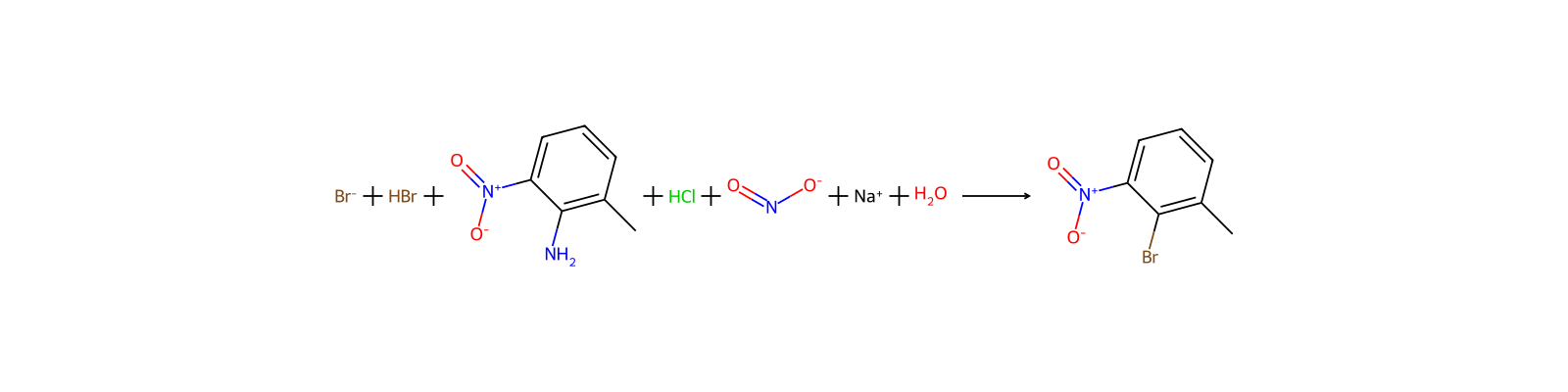
Related reactions
31 records




Linked notes
Loading…