HomeMCPWorkbenchSkills
HomeWorkbenchNotificationsMe
llms.txt · MCP GuidePrivacy Policy · Terms of Service · Supportv1.8.0
  1. Home
  2. /Compound

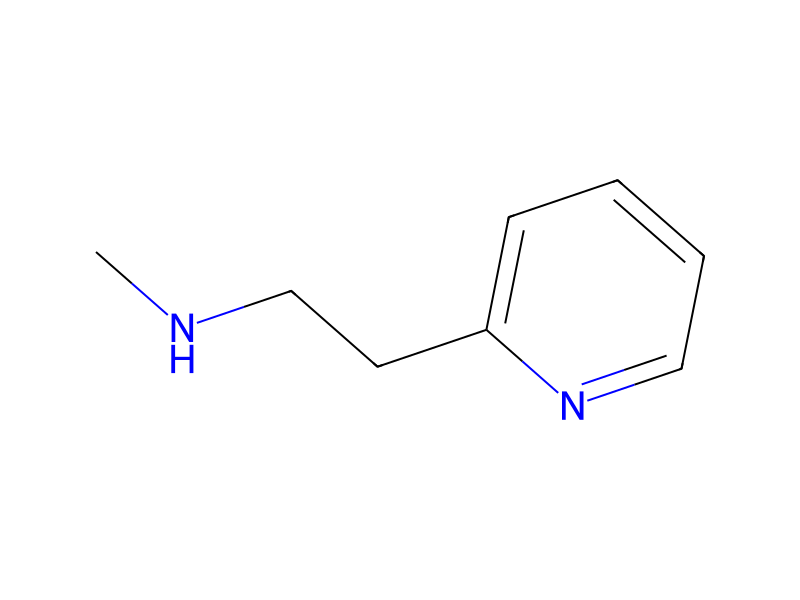
Betahistine

HCID 2366
New noteNew reactionRequest quotes
Print preview
Basic informationOverviewNames & identifiersPropertiesSafety & regulationChemistry & industryRelated reactionsCompound notes
Substructure searchFind similar structures

Basic information

CAS
5638-76-6
Standard SMILES
CNCCc1ccccn1
InChIKey
UUQMNUMQCIQDMZ-UHFFFAOYSA-N
Molecular formula
C8H12N2
Average molar mass
136.19 g/mol
Monoisotopic mass
136.10004839

Overview

Betahistine is an aminoalkylpyridine that is pyridine substituted by a 2-(methylamino)ethyl group at position 2. It acts as a histamine agonist and a vasodilator, and is thought to improve the microcirculation of the labyrinth, resulting in reduced endolymphatic pressure. It is used (generally as the hydrochloride or mesylate salt) to reduce the symptoms of vertigo, tinnitus, and hearing loss associated with Mnire's disease. It has a role as a vasodilator agent and a H1-receptor agonist. It is an aminoalkylpyridine and a secondary amino compound.

Names & identifiers

Preferred name
Betahistine
IUPAC
N-methyl-2-pyridin-2-ylethanamine
English name
Betahistine
Molecular formula
C8H12N2
Molecular weight
136.19

Names & synonyms

betahistine5638-76-6N-Methyl-2-pyridineethanamineVasomotal2-Pyridineethanamine, N-methyl-Betahistina2-[2-(Methylamino)ethyl]pyridineN-methyl-2-pyridin-2-ylethanamineBetahistinummethyl[2-(pyridin-2-yl)ethyl]amineBetaistina2-(2-(Methylamino)ethyl)pyridine
Show more names
n-methyl-2-(pyridin-2-yl)ethan-1-amineY-G 14-d3PT 9 baseSerc baseβ-HistineNSC 42617-d3AKOS BBS-00002883Sinmenier (free base)
Vestibo(2-(2-Pyridyl)ethyl)methylamine[2-(2-Pyridyl)ethyl]methylamine2-(beta-Methylaminoethyl)pyridineHISTALEANX32KK4201DN-Methyl-2-(2-pyridinyl)ethanamineNSC-42617

Database identifiers

CAS
5638-76-6
PubChem CID
2366
DTXSID

Properties

Computed structural properties

XLogP
0.4
Topological polar surface area
24.9 Ų
Hydrogen bond donors
1
Hydrogen bond acceptors
2
Rotatable bonds
3
Heavy atoms
10
Formal charge
0
Complexity
83.3

Experimental & physicochemical properties

Drugs · 3 items

Pharmaceuticals -> Listed in ZINC15

Pharmaceuticals

Pharmaceuticals -> Used in Switzerland

LogP0.68
Boiling Point210.9±15.0 °C
Melting Point150-144
Physical DescriptionSolid
Dissociation Constants3.5, 9.7
Collision Cross Section132.35 Ų [M+K]+ [CCS Type: TW; Method: calibrated with polyalanine and drug standards]

Physicochemical properties

Boiling point
113 · 113-114 °C30 mm Hg(lit.)
Density
0.984 g/mL · 0.984 g/mL at 25 °C(lit.)
vapor pressure
17.7 Pa · 17.7Pa at 25℃

Safety & regulation

Safety information is for reference only and does not replace the supplier’s Safety Data Sheet (SDS), applicable regulations, or professional assessment.

GHS classification

GHS Classification · 4 items

Warning

H315 (100%): Causes skin irritation [Warning Skin corrosion/irritation]

P261, P264, P264+P265, P271, P280, P302+P352, P304+P340, P305+P351+P338, P319, P321, P332+P317, P337+P317, P362+P364, P403+P233, P405, and P501 (click each P-code to see the statement)

Aggregated GHS information provided per 47 reports by companies from 5 notifications to the ECHA C&L Inventory. Each notification may be associated with multiple companies.

Hazard information

Regulatory InformationREACH registered substance: Betahistine (EC: 227-086-4)
Hazard Classes and CategoriesSkin Irrit. 2 (100%)

Toxicology

Drug Induced Liver Injury · 5 items

Drug-Induced Liver Injury Severity and Toxicity (DILIst)

betahistine

DILI Positive

Oral

DOI:10.1016/j.drudis.2019.09.022

Safety data

PPE
Eyeshields, Gloves, type ABEK (EN14387) respirator filter
wgk
2
tsca
TSCA listed
rtecs
UT5552000
hs_code
2933399990
risk_code
36/37/38
Signal word
Warning
Symbol(GHS)
GHS07

Chemistry & industry

Pharmacology

ATC Code · 3 items

N07CA01

N - Nervous system

QN - Nervous system

Protein BindingThe plasma protein binding of betahistine is reported to be less than 5%.
PharmacodynamicsThrough its actions on the histamine receptors, betahistine provides relief from vertigo associated with Ménière's disease.
Mechanism of Action · 2 items

OBE101 is a H1 receptor agonist and partial H3 receptor antagonist. Because inhibition of H1 receptors increases feeding, agonism of H1 receptors by OBE101 should reduce feeding. By also partially antagonizing H3, OBE101 impedes a negative feedback loop that essentially prolongs stimulation of the H1 receptors.

Vertigo is a disturbing sensation of movement caused by dysfunction of the labyrinth (inner ear), vestibular nerve, cerebellum, brainstem, or Central Nervous System (CNS). Vestibular forms of vertigo are often accompanied by auditory dysfunctions such as hyperacusis, hearing loss, and tinnitus. In most cases, adaptive mechanisms of the CNS lead to functional recovery after episodes of vertigo, however, syndromes such as Ménière's disease tend to cause the recurrence of vertigo symptoms. This significantly impacts the quality of life and the ability to carry out daily activities. **H1-receptor activity** The mechanism of action of betahistine is multifactorial. Ménière's disease is thought to result from a disruption of endolymphatic fluid homeostasis in the ear. Betahistine mainly acts as a histamine H1-receptor agonist. The stimulation of H1-receptors in the inner ear causes a vasodilatory effect leading to increased permeability of blood vessels and a reduction in endolymphatic pressure; this action prevents the rupture of the labyrinth, which can contribute to the hearing loss associated with Ménière's disease. Betahistine is also purported to act by reducing the asymmetrical functioning of sensory vestibular organs and increasing vestibulocochlear blood flow, relieving symptoms of vertigo. **H3-receptor activity** In addition to the above mechanisms, betahistine also acts as a histamine H3-receptor antagonist, increasing the turnover of histamine from postsynaptic histaminergic nerve receptors, subsequently leading to an increase in H1-agonist activity. H3-receptor antagonism elevates levels of neurotransmitters including serotonin in the brainstem, inhibiting the activity of vestibular nuclei, thus restoring proper balance and decreasing vertigo symptoms.

Related reactions

64 records
New reaction record
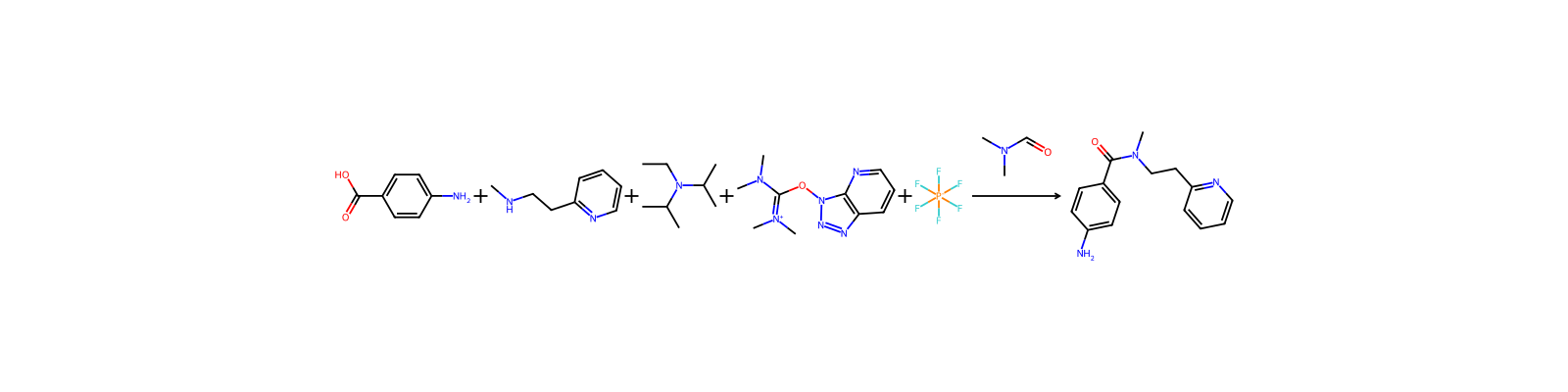
HRID 14638 reaction equation
HRID 14638As reactantuspto-grants-2010_06
HRID 14687 reaction equation
HRID 14687As reactantuspto-grants-2010_06
HRID 17829 reaction equation
HRID 17829As reactantuspto-grants-2010_06
HRID 17833 reaction equation
HRID 17833As reactantuspto-grants-2010_06
HRID 33721 reaction equation
HRID 33721As reactantuspto-grants-2008_09
HRID 154598 reaction equation
HRID 154598As reactantTraining data from https://doi.org/10.1039/C8SC04228D (9/10)
HRID 187445 reaction equation
HRID 187445As reactantTraining data from https://doi.org/10.1039/C8SC04228D (6/10)
HRID 211212 reaction equation
HRID 211212As reactantTraining data from https://doi.org/10.1039/C8SC04228D (6/10)
Page 1 of 8

Compound notes

Loading…

On this pageBasic informationOverviewNames & identifiersPropertiesSafety & regulationChemistry & industryRelated reactionsCompound notes
More actions
New noteNew reactionRequest quotes
DTXSID3022665
ChEMBL
CHEMBL24441
ChEBI
CHEBI:35677
UNII
X32KK4201D
EC Number
227-086-4
Nikkaji
J8.042J
refractive index
20 · n20/D 1.518(lit.)
Flash point
206 °F · 206 °F
storage temp.
Keep in dark place,Inert atmosphere,Room temperature
solubility
Chloroform (Slightly), DMSO (Sparingly), Ethyl Acetate (Slightly), Methanol (Slightly)
pka
3.46 · pKa 3.46 (Uncertain)
form
Oil
color
Light Yellow to Yellow
Water Solubility
1000 g/L · 1000g/L at 25℃
Merck
13 · 13,1181
InChI
1S/C8H12N2/c1-9-7-5-8-4-2-3-6-10-8/h2-4,6,9H,5,7H2,1H3
InChIKey
UUQMNUMQCIQDMZ-UHFFFAOYSA-N
SMILES
CNCCc1ccccn1
LogP
0.68 · 0.68
CAS DataBase Reference
5638 · 5638-76-6(CAS DataBase Reference)
FDA UNII
32 KK4201D · X32KK4201D
ATC code
7 CA01 · N07CA01
EPA Substance Registry System
2 · 2-Pyridineethanamine, N-methyl- (5638-76-6)
UNSPSC Code
12352100 · 12352100
NACRES
22 · NA.22
Symbol(GHS)
7 · GHS07
Signal word
Warning
Hazard statements
315 · H315-H319-H335
Precautionary statements
261 · P261-P264-P271-P280-P302+P352-P305+P351+P338
target organs
Respiratory system
PPE
Eyeshields, Gloves, type ABEK (EN14387) respirator filter
Hazard Codes
Xi,C
Risk Statements
36 · 36/37/38
Safety Statements
26 · 26-37/39
WGK Germany
2 · 2
RTECS
5552000 · UT5552000
Hazard Note
Corrosive
TSCA
TSCA listed
HS Code
2933399990 · 2933399990
Storage Class
10 · 10 - Combustible liquids
Hazard Classifications
2 Skin · Eye Irrit. 2Skin Irrit. 2STOT SE 3
REACH Registrations
Active
hazard_code
Xi,C
hazard_note
Corrosive
safety_code
26-37/39
Storage Class
10 - Combustible liquids
target organs
Respiratory system
Hazard statements
H315-H319-H335
REACH Registrations
Active
Hazard Classifications
Eye Irrit. 2Skin Irrit. 2STOT SE 3
Precautionary statements
P261-P264-P271-P280-P302+P352-P305+P351+P338
Biological Half-LifeThe half-life of betahistine is 3-4 hours.
Metabolism/MetabolitesBetahistine is metabolized primarily into the inactive metabolite 2-pyridylacetic acid. There is both clinical and in vitro evidence that monoamine oxidase enzymes are responsible for the metabolism of betahistine.
MeSH Pharmacological Classification · 2 items

Drugs used to cause dilation of the blood vessels.

Drugs that bind to and activate histamine receptors. Although they have been suggested for a variety of clinical applications histamine agonists have so far been more widely used in research than therapeutically.

Absorption, Distribution and Excretion · 3 items

When given orally, betahistine is rapidly and almost completely absorbed from the gastrointestinal tract. In the fasted state, Cmax is achieved within 1 hour of administration; in the fed state, Cmax is delayed, but the total drug absorption is similar. Food, therefore, has little effect on the absorption of betahistine.[A220563,16388]

Betahistine is mainly excreted in the urine; with approximately 85-91% being detected in urine samples within 24 hours of administration.

In a pharmacokinetic study of rats, betahistine was found to be distributed throughout the body. Human data for betahistine's volume of distribution is not readily available.

Cellular LocationsMembrane
Metabolite PathwaysBetahistine H1-Antihistamine Action

Uses & manufacturing

UsesUse (kg; approx.) in Germany (2009): >1000
General Manufacturing Information2-Pyridineethanamine, N-methyl-: INACTIVE
Applications · 3 items

DescriptionBetahistine is an analogue of histamine with weak agonist properties at histamine H1 receptors and more potent antagonistic effects at histamine H3 receptors.This drug is broadly used worldwide, except for the USA, since it has not been approved by the US Food and Drug Administration. Betahistine is a structural analog of histamine that acts as a weak partial postsynaptic histamine H1 receptor agonist and presynaptic H3 receptor antagonist, with no effect on postsynaptic H2 receptors (Gbahou et al, 2010). The mechanism of action of the drug appears to depend mainly on its action on H3 receptors mediated by two metabolites, aminoethylpyridine and hydroxyethylpyridine (Bertich et al, 2014).

UsesBetahistine is a vasodilator, a mild H1 histamine agonist, and a potent H3 histamine antagonist. The mechanism of action in Meniere's disease is unknown, but theories include reducing the endolymphatic pressure through improved circulation in the stria vascularis or inhibiting activity in the vestibular nuclei. It has been found to be a safe drug with a very low side effect profile. Betahistine was FDA approved for Meniere's disease in the US market for a short period of time in the 1970s, but approval was then rescinded due to lack of evidence supporting its efficacy. However, based on clinical experience and several observational studies, it is still widely used elsewhere in the world.

UsesAnti - Vertigo/Anti-Nauseants/Antiemetics

Upstream & downstream products

Upstream raw materials

2-Picoline2-(2-Hydroxyethyl)pyridine2-VinylpyridineMethylamine hydrochlorideHydrochloric acidAcetic acid

Downstream products

N-Methyl-N,N-bis(2-pyridylethyl)amineBetahistine dihydrochloride
Additional notes · 1 item

DefinitionChEBI: Betahistine is an aminoalkylpyridine that is pyridine substituted by a 2-(methylamino)ethyl group at position 2. It acts as a histamine agonist and a vasodilator, and is thought to improve the microcirculation of the labyrinth, resulting in reduced endolymphatic pressure. It is used (generally as the hydrochloride or mesylate salt) to reduce the symptoms of vertigo, tinnitus, and hearing loss associated with Meniere's disease. It has a role as a vasodilator agent and a H1-receptor agonist. It is an aminoalkylpyridine and a secondary amino compound.