Potassium Lactate
PURASAL(R)P/HQ 60 · POTASSIUM LACTATE · Lactate (potassium) · POTASSIUM DL-LACTATE · MONOPOTASSIUMLACTATE · Potassium lactate 50% · Lactic acid (potassium) · potassium lactate solution
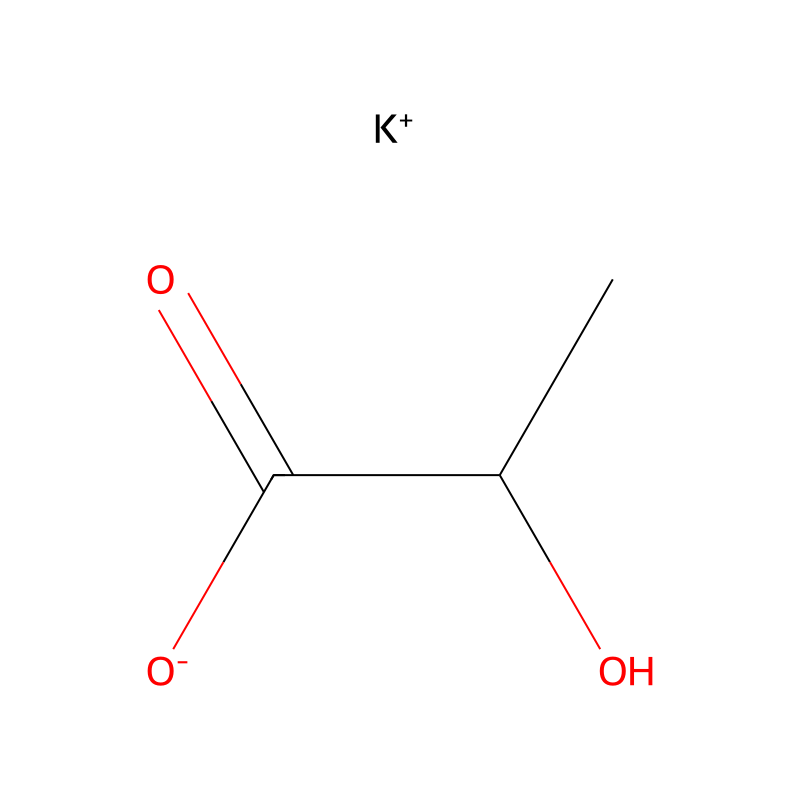
Identifiers & Physical Properties
| CAS No. | 996-31-6 |
|---|---|
| Molecular formula | C3H5KO3 |
| Average molar mass | 128.17 g/mol |
| Monoisotopic mass | 127.9875757 g/mol |
| SMILES | CC(O)C(=O)[O-].[K+] |
| InChIKey | PHZLMBHDXVLRIX-UHFFFAOYSA-M |
| PubChem CID | 23671663 |
| ChEMBL | CHEMBL1200664 |
| EC No. | 213-631-3 |
| DTXSID | DTXSID80883631 |
Chemical & Physical Properties
| Topological polar surface area | 60.4 |
|---|---|
| Hydrogen bond donors | 1 |
| Hydrogen bond acceptors | 3 |
| Rotatable bonds | 1 |
| Heavy atoms | 7 |
| Formal charge | 0 |
| Complexity | 63.2 |
| Chemical classes | Metals -> Organic Acids, Metal Salts |
| Cosmetics | Cosmetic ingredients (Potassium Lactate) -> CIR (Cosmetic Ingredient Review)Antimicrobial |
| Food additives | FLAVOR ENHANCER -> FDA Substance added to food |
| Human Drugs | FDA approved drugs -> Active ingredient |
| Physical Description | Liquid |
| Boiling point | 115 °C |
| Density | 1.32 g/cm3 |
| Storage conditions | 2-8°C, sealed storage, away from moisture |
| Physical state | syrupy liquid |
| Color | Clear, colorless, or slightly yellowish |
| pH | 7.45(1 mM solution)7.89(10 mM solution)8.3(100 mM solution)8.62(1000 mM solution) |
| Odor | at 100.00%. odorless |
| Cosmetics Ingredients Functions | SKIN CONDITIONINGBUFFERINGHUMECTANT |
| InChI | InChI=1S/C3H6O3.K.H/c1-2(4)3(5)6/h2,4H,1H3,(H,5,6) |
| InChIKey | LVFFNGBHDOMRED-UHFFFAOYSA-N |
| SMILES | C(O)(C)C(=O)O.[KH] |
| CAS DataBase Reference | 996-31-6(CAS DataBase Reference) |
| Substances Added to Food (formerly EAFUS) | POTASSIUM LACTATE |
| FDA 21 CFR | 184.1639 |
| EWG's Food Scores | 1-4 |
| FDA UNII | 87V1KMK4QV |
| ATC code | B05XA15 |
| EPA Substance Registry System | Potassium lactate (996-31-6) |
| GHS pictogram | GHS06 |
| Signal word | Danger |
| GHS hazard statements | H331-H319 |
| GHS precautionary statements | P261-P271-P304+P340-P311-P321-P403+P233-P405-P501-P264-P280-P305+P351+P338-P337+P313P |
| Water hazard class (WGK) | - |
| TSCA inventory status | TSCA listed |
Safety & Regulations
| GHS classification | This chemical does not meet GHS hazard criteria for 19.9% (29 of 146) of reports.WarningH319 (79.5%): Causes serious eye irritation [Warning Serious eye damage/eye irritation]P264+P265, P280, P305+P351+P338, and P337+P317 (click each P-code to see the statement)Aggregated GHS information provided per 146 reports by companies from 4 notifications to the ECHA C&L Inventory. |
|---|---|
| Regulatory information | Chemical: Propanoic acid, 2-hydroxy-, monopotassium saltPropanoic acid, 2-hydroxy-, potassium salt (1:1) is listed on the EPA's Chemical Data Reporting (CDR) system. Manufacturers and importers of Propanoic acid, 2-hydroxy-, potassium salt (1:1) are required to report information about their production and use of this chemical to the EPA under the Toxic Substances Control Act (TSCA). (40 eCFR Part 711)Propanoic acid, 2-hydroxy-, monopotassium salt: Does not have an individual approval but may be used under an appropriate group standard |
| Other safety information | IMAP assessments - Propanoic acid, 2-hydroxy-, monopotassium salt: Human health tier I assessment |
| Hazards summary | A mild eye irritant[RTECS] See Sodium lactate. See Lactic acid. |
| EPA Safer Chemical | Chemical: Potassium lactate |
| Hazard Classes and Categories | Eye Irrit. 2 (79.5%) |
| Toxicity summary | Based on the available information included in this report, the CIR Expert Panel concludes that Glycolic and Lactic Acid, their common salts and their simple esters, are safe for use in cosmetic products at concentrations less than or equal to 10%, at final formulation pH greater than or equal to 3.5, when formulated to avoid increasing sun sensitivity or when directions for use include the daily use of sun protection. These ingredients are safe for use in salon products at concentrations less than or equal to 30%, at final formulation pH greater than or equal to 3.0, in products designed for brief, discontinuous use followed by thorough rinsing from the skin, when applied by trained professionals, and when application is accompanied by directions for the daily use of sun protection...Potassium Lactate...Safe for use in cosmetics, with qualifications |
| Water hazard class (WGK) | - |
| TSCA inventory status | TSCA listed |
| Signal word | Danger |
| GHS pictogram | GHS06 |
| GHS hazard statements | H331-H319 |
| GHS precautionary statements | P261-P271-P304+P340-P311-P321-P403+P233-P405-P501-P264-P280-P305+P351+P338-P337+P313P |
Applications & Uses
Description
Potassium lactate is a compound with formula KC3H5O3, or H3C-CHOH-COOK. It is the potassium salt of lactic acid. It is produced by neutralizing lactic acid which is fermented from a sugar source. It has E number "E326". Potassium lactate is a liquid product that is usually 60% solids but is available at up to 78 % solids. Potassium lactate is commonly used in meat and poultry products to extend shelf life and increase food safety as it has a broad antimicrobial action and is effective at inhibiting most spoilage and pathogenic bacteria. Potassium lactate is also used as an extinguishing media in the First Alert Tundra fire extinguishers.
Uses
Potassium DL- Lactate is used in preparation of high solids and high protein lactose-free aseptic milk concentration and milk powders with forward osmosis.
Uses
Potassium Lactate is a flavor enhancer that is the potassium salt of lactic acid. it is a hygroscopic, white, odorless solid and is prepared commercially by the neutralization of lactic acid with potassium hydroxide. it is used as a flavoring agent and enhancer in some meat and poultry products, a humectant, and a ph control agent.