
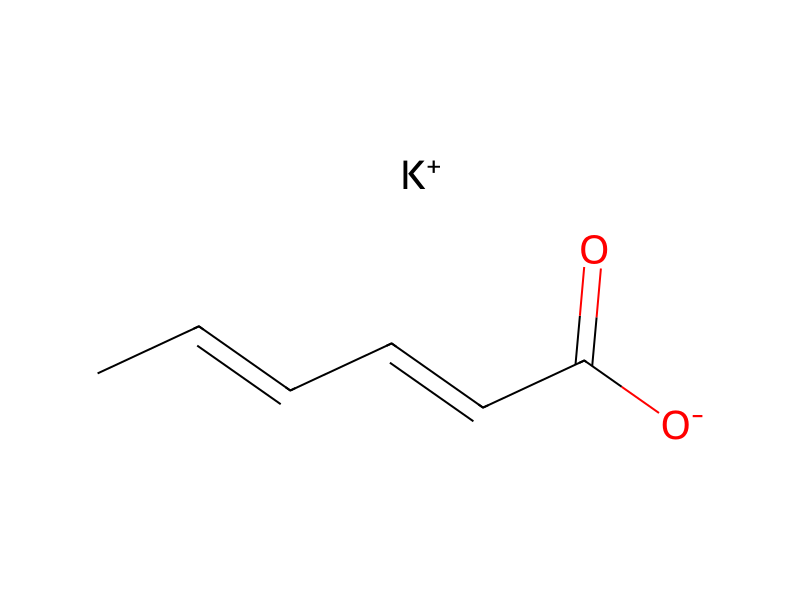
Basic information
- Standard SMILES
C/C=C/C=C/C(=O)[O-].[K+]- InChIKey
CHHHXKFHOYLYRE-STWYSWDKSA-M- Molecular formula
- C6H7KO2
- Average molar mass
- 150.22 g/mol
- Monoisotopic mass
- 150.00831095
Names & identifiers
- Preferred name
- Potassium Sorbate
- IUPAC
- potassium (2E,4E)-hexa-2,4-dienoate
- English name
- Potassium sorbate
- Molecular formula
- C6H7KO2
- Molecular weight
- 151.23
Names & synonyms
POTASSIUM SORBATE24634-61-5Sorbistat potassiumSorbic acid potassium saltBB PowderSorbic acid, potassium saltSorbistat-potassiumpotassium (2E,4E)-hexa-2,4-dienoateSorbistat kFEMA No. 2921Potassium (E,E)-hexa-2,4-dienoate1VPU26JZZ4
Show more names
e202POTASSIUM SARBATEPOTASSIUM SORBATE GRANULES(E,E)-hexadienoic acid, potassium saltsuanjiaFEMA 2921trans-trans-SoPotassium otassium sorbate
Potassium (E,E)-2,4-hexadienoateDTXSID7027835Ins no.202Potassium (e,e')-sorbateIns-202Potassium sorbate (e 202)2,4-Hexadienoic acid, potassium salt, (2E,4E)-DTXCID207835
Database identifiers
- CAS
24634-61-5、590-00-1- PubChem CID
- 23676745
- DTXSID
DTXSID7027835- ChEMBL
CHEMBL2106930- ChEBI
CHEBI:77868- UNII
- 1VPU26JZZ4
- EC Number
- 246-376-1、611-771-3、680-685-6
- Nikkaji
- J1.006E、J837K
Properties
Computed structural properties
- Topological polar surface area
- 40.1 Ų
- Hydrogen bond donors
- 0
- Hydrogen bond acceptors
- 2
- Rotatable bonds
- 2
- Heavy atoms
- 9
- Formal charge
- 0
- Complexity
- 127
Experimental & physicochemical properties
OdorCharacteristic odor
Density1.363 at 25 °C/20 °C
Color/Form
White powder
Crystals
White crystals or powder
Solubility
Solubility in water at 20 °C: 58.2%; in alcohol: 6.5%
Very soluble in water
Soluble in water at 25 °C
58.5 g in 100 cc water at 25 °C
For more Solubility (Complete) data for POTASSIUM SORBATE (6 total), please visit the HSDB record page.
DecompositionWhen heated to decomposition it emits toxic fumes of K2O.
Melting Point
for sorbic acidMelting range of sorbic acid isolated by acidification and not recrystallised 133 °C to 135 °C after vacuum drying in a sulphuric acid desiccator
>270 °C (decomposes)
Physical Description
Liquid; CBI; Dry Powder
Liquid; Other Solid; Dry Powder
White crystalline powder showing no change in colour after heating for 90 minutes at 105 °C
White solid; [HSDB]
Other Experimental Properties
Crystalline solid; odorless. Density: 1.36 at 23.5 °C; VP: 0.001 PA at 20 °C; Water solubility: 1.95-543 g/L at 20 °C and pH 4-7; solubility in methanol: 78.2-80.1 mg/L; Surface Tension: 72.6 mN/m at 1 g/L and 20 °C; Dissociation constant: 4.69 at 20 °C; Dissipation half-life (phototransformation in air): 5.16-5.232 hours
Physicochemical properties
- Melting point
- 270 °C · 270 °C
- Density
- 1 · 1,361 g/cm3
- vapor pressure
- 1 Pa · <1 Pa (20 °C)
- FEMA
- 2921 · 2921 | POTASSIUM SORBATE
- storage temp.
- 2 · 2-8°C
- solubility
- 2 O: · H2O: 1 M at 20 °C, clear, colorless to faintly yellow
- form
- Powder
- pka
- 4.69 · 4.69[at 20 ℃]
- color
- White to light cream
- Odor
- Odorless
- PH Range
- 8 · 8 - 11 at 580 g/l at 20 °C
- PH
- 7.8 · 7.8 (H2O, 20.1℃)
- Water Solubility
- 58.2 g/100 · 58.2 g/100 mL (20 ºC)
- Merck
- 14 · 14,7671
- BRN
- 5357554 · 5357554
- Stability
- Stable. Incompatible with strong oxidizing agents.
- Major Application
- cleaning productscosmeticsfood and beveragespersonal care
- Cosmetics Ingredients Functions
- FRAGRANCEPRESERVATIVE
- InChI
- 1S/C6H8O2.K/c1-2-3-4-5-6(7)8;/h2-5H,1H3,(H,7,8);/q;+1/p-1/b3-2+,5-4+;
- InChIKey
- CHHHXKFHOYLYRE-STWYSWDKSA-M
- SMILES
- [K+].C\C=C\C=C\C([O-])=O
- LogP
- -1.72 at · -1.72 at 20℃
- SCOGS (Select Committee on GRAS Substances)
- Potassium sorbate
- Substances Added to Food (formerly EAFUS)
- POTASSIUM SORBATE
- FDA 21 CFR
- 182.364 · 182.3640; 182.90; 582.3640
- CAS DataBase Reference
- 24634 · 24634-61-5(CAS DataBase Reference)
- FDA UNII
- 1 VPU26JZZ4 · 1VPU26JZZ4
- EPA Substance Registry System
- Potassium sorbate (24634-61-5)
- UNSPSC Code
- 41116107 · 41116107
- NACRES
- 24 · NA.24
- Symbol(GHS)
- 7 · GHS07
- Signal word
- Warning
- Hazard statements
- 319 · H319
- Precautionary statements
- 305 · P305+P351+P338
- PPE
- 95 · dust mask type N95 (US), Eyeshields, Gloves
- Hazard Codes
- Xi,C,T,F
- Risk Statements
- 36 · 36/37/38-35-22
- Safety Statements
- 26 · 26-36-45-36/37/39
- WGK Germany
- 1 · 1
- RTECS
- 2170000 · WG2170000
- Autoignition Temperature
- 150 °C · >150 °C
- TSCA
- TSCA listed
- HS Code
- 2916 · 2916 19 95
- Storage Class
- 11 · 11 - Combustible Solids
- Hazard Classifications
- 2 · Eye Irrit. 2
- Toxicity
- 50 orally · LD50 orally in Rabbit: 3800 mg/kg
- REACH Registrations
- Active
Safety & regulation
GHS classification
GHS Classification
Warning
H319: Causes serious eye irritation [Warning Serious eye damage/eye irritation]
P264+P265, P280, P305+P351+P338, and P337+P317 (click each P-code to see the statement)
This chemical does not meet GHS hazard criteria for 5.4% (90 of 1672) of reports.
Hazard information
Regulatory Information
Chemical: 2,4-Hexadienoic acid, potassium salt (1:1), (2E,4E)-
Regulation (EC) No 178/2002 (amended)
2,4-Hexadienoic acid, potassium salt (1:1), (2E,4E)- is listed on the EPA's Chemical Data Reporting (CDR) system. Manufacturers and importers of 2,4-Hexadienoic acid, potassium salt (1:1), (2E,4E)- are required to report information about their production and use of this chemical to the EPA under the Toxic Substances Control Act (TSCA). (40 eCFR Part 711)
2,4-Hexadienoic acid, potassium salt (1:1) is listed on the EPA's Chemical Data Reporting (CDR) system. Manufacturers and importers of 2,4-Hexadienoic acid, potassium salt (1:1) are required to report information about their production and use of this chemical to the EPA under the Toxic Substances Control Act (TSCA). (40 eCFR Part 711)
2004/129/EC, Reg. (EU) 2017/2068
Status: Active Update: 27-04-2023 https://echa.europa.eu/registration-dossier/-/registered-dossier/11008
Other Safety InformationIMAP assessments - 2,4-Hexadienoic acid, potassium salt, (E,E)-: Human health tier I assessment;IMAP assessments - 2,4-Hexadienoic acid, potassium salt, (E,E)-: Environment tier I assessment
Hazards SummaryAn eye irritant; Generally recognized as safe (GRAS) for use in foods; [HSDB] Oral LD50 (rat) = 4340 mg/kg; [ChemIDplus] May cause irritation; [MSDSonline]
FDA Requirements
Potassium sorbate used as a chemical preservative in food for human consumption is generally recognized as safe when used in accordance with good manufacturing practice.
Potassium sorbate used as a chemical preservative in animal drugs, feeds, and related products is generally recognized as safe when used in accordance with good manufacturing or feeding practice.
Substances migrating to food from paper and paperboard products used in food packaging that are generally recognized as safe for their intended use, within section 409 of the Act. Potassium sorbate is included on this list.
Special Reports
Cosmetic Ingredient Review; Final Report on the Safety Assessment of Sorbic Acid and Potassium Sorbate. J Am Col Toxicol 7 (6): 837-80 (1988)
Food & Drug Research Labs Inc; Scientific Literature Reviews on Generally Recognized as Safe (GRAS) Food Ingredients: Sorbic Acid Derivatives; US NTIS PB Report PBb-223 864: 92 pp (1973).
Cosmetic Ingredient Review; Annual Review of Cosmetic Ingredient Safety Assessments: 2005/2006. International Journal of Toxicology, 27(Suppl. 1): 77-142 (2008)
EPA Safer Chemical
Chemical: Potassium (E,E)-sorbate; Green circle - The chemical has been verified to be of low concern based on experimental and modeled data.
Chemical: Potassium sorbate; Green circle - The chemical has been verified to be of low concern based on experimental and modeled data.
FIFRA RequirementsAn exemption from the requirement of a tolerance is established for residues of potassium sorbate.
Toxic Combustion ProductsSpecial hazards arising from the substance or mixture: Carbon oxides, potassium oxides.
Hazard Classes and Categories
Skin Irrit. 2 (64.4%);Eye Irrit. 2 (94.1%);STOT SE 3 (35.4%)
Skin Irrit. 2 (44.3%);Eye Irrit. 2 (52.6%);STOT SE 3 (10%)
Not Classified
Eye irritation - category 2
Eye Irrit. 2
Hazardous Reactivities and IncompatibilitiesIncompatible materials: Strong oxidizing agents.
Safety & protection
Fire Fighting Procedures
Suitable extinguishing media: Use water spray, alcohol-resistant foam, dry chemical or carbon dioxide
Advice for firefighters: Wear self contained breathing apparatus for fire fighting if necessary.
Storage Conditions
Store in cool place. Keep container tightly closed in a dry and well-ventilated place.
...Potassium sorbate should be stored @ temp below 100 °F & should not be exposed to light or heat. Containers should be kept closed.
Cleanup Methods
ACCIDENTAL RELEASE MEASURES: Personal precautions, protective equipment and emergency procedures: Use personal protective equipment. Avoid dust formation. Avoid breathing vapors, mist or gas. Ensure adequate ventilation. Evacuate personnel to safe areas. Avoid breathing dust. Environmental precautions: Do not let product enter drains. Methods and materials for containment and cleaning up: Pick up and arrange disposal without creating dust. Sweep up and shovel. Keep in suitable, closed containers for disposal.
Disposal Methods
Product: Offer surplus and non-recyclable solutions to a licensed disposal company. Contact a licensed professional waste disposal service to dispose of this material. Dissolve or mix the material with a combustible solvent and burn in a chemical incinerator equipped with an afterburner and scrubber; Contaminated packaging: Dispose of as unused product.
SRP: Recycle any unused portion of the material for its approved use or return it to the manufacturer or supplier. Ultimate disposal of the chemical must consider: the material's impact on air quality; potential migration in air, soil or water; effects on animal, aquatic and plant life; and conformance with environmental and public health regulations. If it is possible or reasonable use an alternative chemical product with less inherent propensity for occupational harm/injury/toxicity or environmental contamination.
Preventive Measures
ACCIDENTAL RELEASE MEASURES: Personal precautions, protective equipment and emergency procedures: Use personal protective equipment. Avoid dust formation. Avoid breathing vapors, mist or gas. Ensure adequate ventilation. Evacuate personnel to safe areas. Avoid breathing dust. Environmental precautions: Do not let product enter drains.
Precautions for safe handling: Avoid contact with skin and eyes. Avoid formation of dust and aerosols. Provide appropriate exhaust ventilation at places where dust is formed. Normal measures for preventive fire protection.
Appropriate engineering controls: Handle in accordance with good industrial hygiene and safety practice. Wash hands before breaks and at the end of workday.
Gloves must be inspected prior to use. Use proper glove removal technique (without touching glove's outer surface) to avoid skin contact with this product. Dispose of contaminated gloves after use in accordance with applicable laws and good laboratory practices. Wash and dry hands.
Allowable TolerancesAn exemption from the requirement of a tolerance is established for residues of potassium sorbate.
Personal Protective Equipment (PPE)
Eye/face protection: Safety glasses with side-shields conforming to EN166. Use equipment for eye protection tested and approved under appropriate government standards such as NIOSH (US) or EN 166(EU).
Skin protection: Handle with gloves.
Body Protection: Impervious clothing. The type of protective equipment must be selected according to the concentration and amount of the dangerous substance at the specific workplace.
Respiratory protection: For nuisance exposures use type P95 (US) or type P1 (EU EN 143) particle respirator. For higher level protection use type OV/AG/P99 (US) or type ABEK-P2 (EU EN 143) respirator cartridges. Use respirators and components tested and approved under appropriate government standards such as NIOSH (US) or CEN (EU).
Toxicology
Interactions
The food additives sodium nitrite and potassium sorbate had cytostatic and cytotoxic effects on in vitro cultured V79 hamster cells and EUE human fibroblasts if administered in an acid environment (pH 4.95). The strong cytotoxic effect of sodium nitrite and that of the combined action of sodium nitrite and potassium sorbate was observed along the inhibition of macromolecular synthesis. In this respect, potassium sorbate was less effective. The decreased plating efficiency of the cells and the inhibition of de novo DNA synthesis induced by these substances aroused the question whether they also have genotoxic effects on V79 cells. Statistical analyses showed that sodium nitrite induced more 6-TG-resistant (6-TGr) mutants as compared to the untreated control. However, this elevation did not correspond to the level of inhibition of DNA synthesis determined during the followed period of time after the removal of the substance. Potassium sorbate and a combination thereof with sodium nitrite, in our experiments, had no mutagenic effects.
Although potassium sorbate (PS), ascorbic acid and ferric or ferrous salts (Fe-salts) are used widely in combination as food additives, the strong reactivity of PS and oxidative potency of ascorbic acid in the presence of Fe-salts might form toxic compounds in food during its deposit and distribution. In the present paper, the reaction mixture of PS, ascorbic acid and Fe-salts was evaluated for mutagenicity and DNA-damaging activity by means of the Ames test and rec-assay. Effective lethality was observed in the rec-assay. No mutagenicity was induced in either Salmonella typhimurium strains TA98 (with or without S-9 mix) or TA100 (with S-9 mix). In contrast, a dose-dependent mutagenic effect was obtained when applied to strain TA100 without S-9 mix. The mutagenic activity became stronger increasing with the reaction period. Furthermore, the reaction products obtained in a nitrogen atmosphere did not show any mutagenic and DNA-damaging activity. PS, ascorbic acid and Fe-salts were inactive when they were used separately. Omission of one component from the mixture of PS, ascorbic acid and Fe-salt turned the reaction system inactive. These results demonstrate that ascorbic acid and Fe-salt oxidized PS and the oxidative products caused mutagenicity and DNA-damaging activity.
Toxicity Summary
Safe in the present practices of use and concentration. Ingredient, concentration, and use information are available in documents discoverable at https://cir-reports.cir-safety.org
IDENTIFICATION AND USE: Potassium sorbate forms white crystals or powder with characteristic odor. It is used as preservative and antimicrobial agent for foods, cosmetics, and pharmaceuticals. It has been also used as medication. HUMAN EXPOSURE AND TOXICITY: Formulations containing up to 0.5% sorbic acid and/or potassium sorbate were not significant primary or cumulative irritants and not sensitizers at this test concentration. In humans, a few cases of idiosyncratic intolerances have been reported (non-immunological contact urticaria and pseudo-allergy). ANIMAL STUDIES: Potassium sorbate was practically nontoxic to rats and mice in acute oral toxicity studies. Potassium sorbate at concentrations up to 10% was practically nonirritating to the rabbit's eye. Potassium sorbate have been tested for mutagenic effects using the Ames test, genetic recombination tests, reversion assays, rec assays, tests for chromosomal aberrations, sister chromatid exchanges, and gene mutations. Results have been both positive and negative. Potassium sorbate at 0.1% in the diet or 0.3% in drinking water of rats for up to 100 weeks produced no neoplasms. No teratogenic effects have been observed in pregnant mice and rats administered potassium sorbate.
Human Toxicity Excerpts
/HUMAN EXPOSURE STUDIES/ In three repeat insult patch tests using a total of 478 subjects, sorbic acid had overall sensitization rates of 0, 0.33, and 0.8%. All the subjects sensitized were inducted with 20% sorbic acid and challenged with 5% sorbic acid. Formulations containing up to 0.5% sorbic acid or 0.15% potassium sorbate were not cumulative irritants or were very mild cumulative irritants. They were not primary irritants and were not sensitizers.
/HUMAN EXPOSURE STUDIES/ An RIPT was conducted using 56 panelists and a facial scrub containing 0.1% potassium sorbate. The formulation was diluted 1 :I00 by weight with distilled water for the study. Eight 24 hr semiocclusive induction patches were applied over a 2 week period to the lateral upper arm of each subject. Reactions were scored at patch removal. After an approximately 2 week rest period, a 24 hr semiocclusive challenge patch was applied to a previously untreated site. Reactions to the challenge patch were graded at patch removal and 24 and 48 hr later. Two slight, transient, questionable erythema reactions were observed during induction. No other reactions were observed during induction or challenge. The facial scrub did not induce dermal irritation or sensitization.
/HUMAN EXPOSURE STUDIES/ The skin irritation and sensitization potential of a facial scrub containing 0.1% potassium sorbate was evaluated in an RIPT with 47 panelists. The formulation was diluted 1 :I00 in distilled water. Eight 24 hr semiocclusive induction patches were applied to the lateral aspect of the upper arms of the subjects over a 2 week period, and reactions were scored on a scale of O-5 at patch removal. After a 2 week rest period, a 24 hr semiocclusive challenge patch was applied, and reactions were scored at patch removal and 24 and 48 hr later. No reactions greater than 2 (moderate erythema) were observed during the induction period, and no reactions at challenge were indicative of sensitization.
/CASE REPORTS/ Occupational contact dermatitis from potassium sorbate in milk transformation plant /described/.
For more Human Toxicity Excerpts (Complete) data for POTASSIUM SORBATE (8 total), please visit the HSDB record page.
Artificial Pollution SourcesPotassium sorbate's production and use as a bacteriostat and preservative in meats, sausage casings, wine(1) and cosmetics(2) may result in its release to the environment through various waste streams(SRC).
Carcinogen ClassificationNo indication of carcinogenicity to humans (not listed by IARC).
Non-Human Toxicity Excerpts
/LABORATORY ANIMALS: Acute Exposure/ Sorbic acid (in petrolatum) and potassium sorbate (as aqueous solution) at concentrations of 1, 5, and 10% were practically nonirritating and nonirritating, respectively, to the rabbit eye. Formulations containing 0.1% sorbic acid or 0.15% potassium sorbate were nonirritating to the rabbit eye.
/LABORATORY ANIMALS: Acute Exposure/ A 1% aqueous potassium sorbate solution was practically nonirritating to rabbit skin.
/LABORATORY ANIMALS: Subchronic or Prechronic Exposure/ The preservatives benzalkonium chloride (BZC) and potassium sorbate (PS) are widely used, not only for nasal drops, but also for eyedrops and cosmetics. However, there have been many case reports that consider lesions such as dermatitis or conjunctivitis to be the results of irritation induced by BZC or PS. We evaluated the histological changes after the long-term administration of BZC or PS on rat nasal respiratory mucosa. Forty rats were used for the BZC group and 40 rats for PS group. Animals in each group were divided into four subgroups The first subgroup received a low-concentration preservative solution that was commonly used for nasal sprays. The second subgroup received a high-concentration preservative solution that was reported to induce dermatitis in humans. The third and fourth subgroups received a steroid mixed preservative solution of low and high concentrations, respectively. The control group was administrated normal saline. After each group received 1, 2, and 4 weeks of topical administration, the symptomatic and histological changes on hemotoxylin and eosin (H&E) stain were observed. Sneezing and nasal rubbing with forelegs were observed in almost all subgroups by the seventh day of treatment. The preservatives induced nasal lesions, including intraepithelial glandular formation, inflammatory cell infiltration, vascular hyperplasia, and edematous change. The symptomatic and histological changes were pronounced with the prolonged duration of administration. Similar results were observed in the steroid mixed-solution groups. In the PS steroid mixed-solution group, however, symptoms and nasal lesions were reduced with the prolonged duration of administration. It is our finding that even a low-concentration solution of preservative can lead to nasal lesion. Hence there is a strong need to develop both a preservative that can be safely and widely used and a nasal spray without preservatives.
/LABORATORY ANIMALS: Chronic Exposure or Carcinogenicity/ The oral administration of potassium sorbate as 0.1% of the diet or 0.3% of the drinking water for up to 100 weeks produced no neoplasms in rats. No carcinogenic effect was demonstrated by sorbic acid in rats or mice fed diets containing up to 10% sorbic acid for periods of 2 years and 80 weeks, respectively. A diet containing up to 15% sorbic acid has been reported to have a carcinogenic effect in the liver of mice after 88 weeks' administration.
For more Non-Human Toxicity Excerpts (Complete) data for POTASSIUM SORBATE (15 total), please visit the HSDB record page.
Environmental Abiotic Degradation
The stability of potassium sorbate is strongly dependent on its water content, which must be kept below 0.5%. At room temperature about 140 g of potassium sorbate can be dissolved in 100 mL of water. ... Potassium sorbate is resistant to air oxidation ... although the stability in the solid state depends on purity.
Probable Routes of Human Exposure
According to the 2012 TSCA Inventory Update Reporting data, 23 reporting facilities estimate the number of persons reasonably likely to be exposed during the manufacturing, processing, or use of potassium sorbate in the United States may be considered as confidential business information (CBI) or unknown values(1).
Antidote and Emergency Treatment
/SRP:/ Immediate first aid: Ensure that adequate decontamination has been carried out. If patient is not breathing, start artificial respiration, preferably with a demand valve resuscitator, bag-valve-mask device, or pocket mask, as trained. Perform CPR if necessary. Immediately flush contaminated eyes with gently flowing water. Do not induce vomiting. If vomiting occurs, lean patient forward or place on the left side (head-down position, if possible) to maintain an open airway and prevent aspiration. Keep patient quiet and maintain normal body temperature. Obtain medical attention. /Poisons A and B/
/SRP:/ Basic treatment: Establish a patent airway (oropharyngeal or nasopharyngeal airway, if needed). Suction if necessary. Watch for signs of respiratory insufficiency and assist ventilations if needed. Administer oxygen by nonrebreather mask at 10 to 15 L/min. Monitor for pulmonary edema and treat if necessary ... . Monitor for shock and treat if necessary ... . Anticipate seizures and treat if necessary ... . For eye contamination, flush eyes immediately with water. Irrigate each eye continuously with 0.9% saline (NS) during transport ... . Do not use emetics. For ingestion, rinse mouth and administer 5 mL/kg up to 200 mL of water for dilution if the patient can swallow, has a strong gag reflex, and does not drool ... . Cover skin burns with dry sterile dressings after decontamination ... . /Poisons A and B/
/SRP:/ Advanced treatment: Consider orotracheal or nasotracheal intubation for airway control in the patient who is unconscious, has severe pulmonary edema, or is in severe respiratory distress. Positive-pressure ventilation techniques with a bag valve mask device may be beneficial. Consider drug therapy for pulmonary edema ... . Consider administering a beta agonist such as albuterol for severe bronchospasm ... . Monitor cardiac rhythm and treat arrhythmias as necessary ... . Start IV administration of D5W TKO /SRP: "To keep open", minimal flow rate/. Use 0.9% saline (NS) or lactated Ringer's (LR) if signs of hypovolemia are present. For hypotension with signs of hypovolemia, administer fluid cautiously. Watch for signs of fluid overload ... . Treat seizures with diazepam or lorazepam ... . Use proparacaine hydrochloride to assist eye irrigation ... . /Poisons A and B/
Non-Human Toxicity Values
LD50 Rats oral 4920 mg/kg
LD50 Mice ip 1300 mg/kg
Regulatory information
Regulatory Information
Chemical: 2,4-Hexadienoic acid, potassium salt (1:1), (2E,4E)-
Regulation (EC) No 178/2002 (amended)
2,4-Hexadienoic acid, potassium salt (1:1), (2E,4E)- is listed on the EPA's Chemical Data Reporting (CDR) system. Manufacturers and importers of 2,4-Hexadienoic acid, potassium salt (1:1), (2E,4E)- are required to report information about their production and use of this chemical to the EPA under the Toxic Substances Control Act (TSCA). (40 eCFR Part 711)
2,4-Hexadienoic acid, potassium salt (1:1) is listed on the EPA's Chemical Data Reporting (CDR) system. Manufacturers and importers of 2,4-Hexadienoic acid, potassium salt (1:1) are required to report information about their production and use of this chemical to the EPA under the Toxic Substances Control Act (TSCA). (40 eCFR Part 711)
2004/129/EC, Reg. (EU) 2017/2068
Status: Active Update: 27-04-2023 https://echa.europa.eu/registration-dossier/-/registered-dossier/11008
FDA Requirements
Potassium sorbate used as a chemical preservative in food for human consumption is generally recognized as safe when used in accordance with good manufacturing practice.
Potassium sorbate used as a chemical preservative in animal drugs, feeds, and related products is generally recognized as safe when used in accordance with good manufacturing or feeding practice.
Substances migrating to food from paper and paperboard products used in food packaging that are generally recognized as safe for their intended use, within section 409 of the Act. Potassium sorbate is included on this list.
FIFRA RequirementsAn exemption from the requirement of a tolerance is established for residues of potassium sorbate.
Safety data
- PPE
- dust mask type N95 (US), Eyeshields, Gloves
- wgk
- 1
- tsca
- TSCA listed
- rtecs
- WG2170000
- hs_code
- 2916 19 95
- Toxicity
- LD50 orally in Rabbit: 3800 mg/kg
- risk_code
- 36/37/38-35-22
- Signal word
- Warning
- Symbol(GHS)
- GHS07
- hazard_code
- Xi,C,T,F
- safety_code
- 26-36-45-36/37/39
- Storage Class
- 11 - Combustible Solids
- Hazard statements
- H319
- REACH Registrations
- Active
- Hazard Classifications
- Eye Irrit. 2
- Autoignition Temperature
- >150 °C
- Precautionary statements
- P305+P351+P338
Chemistry & industry
Pharmacology
Metabolism/Metabolites
The results of metabolic studies were that sorbic acid was qualitatively metabolized in the same manner as the saturated or singly unsaturated fatty acids of the same C-atom number. Under normal conditions, sorbic acid was almost completely oxidized to carbon dioxide and water. /Sorbic acid/
MeSH Pharmacological ClassificationSubstances capable of inhibiting, retarding or arresting the process of fermentation, acidification or other deterioration of foods.
Uses & manufacturing
Uses
CIR ingredient: Potassium Sorbate
Used as mold and yeast inhibitor and preservative/antioxidant for food; [HSDB]
For potassiuim sorbate (USEPA/OPP Pesticide Code: 075902) there are 0 labels match. /SRP: Not registered for current use in the U.S., but approved pesticide uses may change periodically and so federal, state and local authorities must be consulted for currently approved uses./
Reported uses (ppm):;Table: Reported uses (ppm): (Flavor and Extract Manufacturers' Association, 1994) [Table#3014]
Bacteriostat and preservative in meats, sausage casings, wine, etc.
Preservative and antimicrobial agent for foods, cosmetics, and pharmaceuticals. To improve the characteristics of drying oils. In alkyd type coatings to improve gloss. To improve milling characteristics of cold rubber. /Sorbic acid/
U.S. Production
2023: 1,000,000 - <2,500,000 lb;2022: 1,000,000 - <2,500,000 lb;2021: 1,000,000 - <2,500,000 lb;2020: 1,000,000 - <2,500,000 lb
2023: 422,385 lb;2022: 300,675 lb;2021: 283,845 lb;2020: 273,206 lb
Non-confidential 2012 Chemical Data Reporting (CDR) information on the production and use of chemicals manufactured or imported into the United States. Chemical: 2,4-Hexadienoic acid, potassium salt. National Production Volume: 100,000 - 500,000 lb/yr.
Consumer Uses
Preservative;Soil amendments (fertilizers);Not Known or Reasonably Ascertainable
Preservative;Not Known or Reasonably Ascertainable
Industry Uses
Soil amendments (fertilizers);Not Known or Reasonably Ascertainable;Preservative
Preservative;Not Known or Reasonably Ascertainable
Methods of Manufacturing
Preparation: O. Probst, H. Oehme, United States of America patent 3173948 (1965 to Hoechst).
Sorbic acid is reacted with an equimolar portion of KOH. The resulting potassium sorbate may be crystallized from aqueous ethanol.
Formulations/Preparations
It is sold commercially as a white powder and in granulated form.
Grades: Technical, FCC /Food Chemical Codex/
Household Products
Information on 39 consumer products that contain Potassium Sorbate [USAN] in the following categories is provided:;• Inside the Home;• Personal Care;• Pesticides;• Pet Care
Information on 241 consumer products that contain Potassium sorbate in the following categories is provided:;• Commercial / Institutional;• Inside the Home;• Personal Care;• Pesticides;• Pet Care
Use Classification
EPA Safer Chemical Functional Use Classes -> Preservatives and Antioxidants
Safer Chemical Classes -> Green circle - The chemical has been verified to be of low concern
EPA Safer Chemical Functional Use Classes -> Preservatives and Antioxidants
Safer Chemical Classes -> Green circle - The chemical has been verified to be of low concern
Food additives
Fragrance Ingredients
General Manufacturing Information
Not Known or Reasonably Ascertainable;Food, beverage, and tobacco product manufacturing;Pesticide, Fertilizer, and Other Agricultural Chemical Manufacturing;Wholesale and Retail Trade
Food, beverage, and tobacco product manufacturing;Not Known or Reasonably Ascertainable
2,4-Hexadienoic acid, potassium salt (1:1): ACTIVE
2,4-Hexadienoic acid, potassium salt (1:1), (2E,4E)-: ACTIVE
Because of their physiological inertness, their effectiveness even in the weakly acid pH range and their neutral taste, sorbic acid and its salts have become the leading preservatives in the food sector throughout the world over the past 30 years. The most commonly used products are sorbic acid itself (E200) and potassium sorbate (E202). In many countries sodium sorbate (E201) and calcium sorbate (E203) are also permitted. Sorbic acid is sparingly soluble in water, sodium sorbate has better solubility, and potassium sorbate is very freely soluble and can be used to produce 50% stock solutions. The soluble sorbates are preferred when it is desired to use the preservative in liquid form, or when aqueous systems are to be preserved. Sodium sorbate in solid form is unstable and very rapidly undergoes oxidation on exposure to atmospheric oxygen. It is therefore not produced on the industrial scale. Aqueous solutions of sodium sorbate remain stable for some time. Calcium sorbate is used in the manufacture of fungistatic wrappers because it is highly stable to oxidation, but this use is very limited. Sorbic acid and sorbates can be directly added into the product. The products can be dipped or sprayed with aqueous solutions of sorbates. Dusting of food with dry sorbic acid is also possible but less recommended because sorbic acid irritates the skin and mucous membranes. Sorbic acid and particularly calcium sorbate can be used as active substances in fungistatic wrappers.
Classified as "generally recognized as safe" (GRAS)
Applications
DescriptionPotassium sorbate is a white crystalline powder. It is a potassium salt of sorbic acid.It was originally discovered in the 1850’s, and was derived from the Mountain Ash Tree. Today, potassium sorbate is synthetically created.Potassium sorbate is a good food preservatives, fully degradable, similar to fatty acids found naturally in foods. It is used to slow the growth of molds and yeasts in foods. It is commonly found in margarine, wines, cheeses, yogurts, soft drinks, and baked goods. Potassium sorbate has been used has a food preservative for many years. There have been extensive long-term tests that have confirmed its safety and it is on the Center for Science in the Public Interest list of safe additives.
UsesSorbic acid and its potassium salt is commonly employed as food preservative in wide range of foodstuffs, such as cheese, pickles, sauces and wines. Potassium sorbate is a food grade preservative generally regarded as safe (GRAS) worldwide. It is the inactive salt of sorbic acid. It readily dissolves in water where it converts to sorbic acid, its active form, at a low pH. Sorbic acid is very pH dependent. While it shows some activity up to pH 6 (about 6%), it is most active at pH 4.4 (70%). At pH 5.0 it is 37% active. As sorbic acid, it is considered to be active against mold, fair against yeast and poor against most bacteria. Sorbic acid is an unsaturated fatty acid and as such is subject to oxidation (use of an antioxidant like Mixed Tocopherols T50 is recommended). It is also sensitive to UV light and may turn yellow in solution. Gluconolactone is reported to stabilize potassium sorbate against discoloration and darkening in aqueous solutions and may be useful in stabilizing sorbic acid in the water phase of a product.
UsesAs mold and yeast inhibitor, like sorbic acid, especially where greater soly in water is desirable.
UsesPotassium sorbate is used to inhibit molds and yeasts in many foods, such as cheese, wine, yogurt, dried meats, apple cider, soft drinks and fruit drinks, and baked goods. It can also be found in the ingredients list of many dried fruit products. In addition, herbal dietary supplement products generally contain potassium sorbate, which acts to prevent mold and microbes and to increase shelf life, and is used in quantities at which there are no known adverse health effects, over short periods of time.Labeling of this preservative on ingredient statements reads as "potassium sorbate" and or "E202". Also, it is used in many personal care products to inhibit the development of microorganisms for shelf stability. Some manufacturers are using this preservative as a replacement for parabens. Also known as "wine stabilizer", potassium sorbate produces sorbic acid when added to wine. It serves two purposes. When active fermentation has ceased and the wine is racked for the final time after clearing, potassium sorbate will render any surviving yeast incapable of multiplying. Yeast living at that moment can continue fermenting any residual sugar into CO2 and alcohol, but when they die no new yeast will be present to cause future fermentation.
UsesSorbic acid is a naturally occurring polyunsaturated fat that has antimicrobial properties. That means that it helps to prevent the growth of molds, yeasts, and fungus. Potassium sorbate is found in many food products, especially those which are meant to be stored and eaten at room temperature. This helps to ward off particles such as mold or fungus that can cause foods to spoil or make people sick. Baked goods, processed fruits and vegetables or dairy products frequently contain this product. When brewing wine, yeast is used to convert sugar to alcohol. This process is called fermentation. When the wine reaches the desired flavour and body, you want to stop the yeast from growing. Potassium sorbate is added to inhibit yeast growth.
General DescriptionSorbates have been reported to be less toxic than benzoate and have been classified as “Generally Recognized as Safe” (GRAS) additives by the U.S. Food and Drug Administration (FDA).Sorbic acid is metabolised to mainly to carbon dioxide. While the minor amounts are converted to trans,trans-muconic acid (ttMA), which is excreted unchanged into the urine. Urinary ttMA is a biomarker for the occupational and environmental exposure to benzene. Ability of trans,trans-2,4-Hexadienoic acid potassium salt (Sorbic acid potassium salt, Potassium sorbate) to induce chromosome aberrations, sister chromatid exchanges (SCE) and gene mutations in cultured Chinese hamster V79 cells has been examined.Potassium sorbate is reported to be less genotoxic than the sodium salt analog.
Preparation methods
PreparationPotassium sorbate is prepared by reacting potassium hydroxide with sorbic acid, followed by evaporation and crystallization:CH3CH=CHCH=CHCOOH + KOH →CH3CH=CHCH=CHCOOK + H2O.
Upstream & downstream products
Upstream raw materials
Downstream products
Suppliers50 total
国药集团化学试剂有限公司86-21-63210123 · [email protected]
梯希爱(上海)化成工业发展有限公司021-67121386 · [email protected]
上海阿拉丁生化科技股份有限公司400-6206333 13167063860 · [email protected]
山东艾斯曼新材料有限公司13698626386 13698626386
上海如吉生物科技发展有限公司+86-21-65211385-8001 36031160 · [email protected]
Syntechem Co.,Ltd[email protected]
上海迈瑞尔生化科技有限公司4006356688 18621169109 · [email protected]
武汉易泰科技有限公司上海分公司18930552037 · [email protected]
大连美仑生物技术有限公司0411-62910999 13889544652 · [email protected]
阿法埃莎(中国)化学有限公司400-6106006 · [email protected]
太原市瑞和丰科贸有限公司+86 351 7031519 · [email protected]
安耐吉化学&3A(安徽泽升科技股份有限公司)400-0056266 · [email protected]
北京绿百草科技发展有限公司010-61136123 · [email protected]
上海瀚鸿科技股份有限公司021-54306202 13764082696 · [email protected]
合肥天健化工有限公司551-65418679 15856988503;15837135945 · [email protected]
Beckmann-Kenko GmbH+49 4241 9308 88 · [email protected]
山东西亚化学有限公司13355009207 13355009207 · [email protected]
玛雅试剂+86 (573) 82222445 (0)18006601000 452520369 · [email protected]
天津希恩思生化科技有限公司400 638 7771 · [email protected]
湖南汇百侍生物科技有限公司0731-85526065 13308475853 · [email protected]
Connect Chemicals GmbH+49 2102 2077 19 · [email protected]
斯百全化学(上海)有限公司021-021-021-67601398-809-809-809 15221380277 · [email protected]
上海源叶生物科技有限公司13636370518 · [email protected]
艾科试剂4008-755-333 18080918076 · [email protected]
青岛保税区鲁联国际贸易有限公司0532-83893697 18561902820 · [email protected]
上海思域化工科技有限公司86-21-34053660 · [email protected]
苏州思变化学技术有限公司0512-65617459 18915409046 · [email protected]
西安康培基生物科技有限公司86-029-85456576 · [email protected]
赛默飞世尔科技(中国)有限公司800-810-5118 · [email protected]
北京伊诺凯科技有限公司400-810-7969 010-59572699 · [email protected]
江苏艾康生物医药研发有限公司025-66113011 13913916777 · [email protected]
TOKYO CHEMICAL INDUSTRY CO., LTD.03-36680489 · [email protected]
潍坊沃腾进出口有限公司0536-2456718
上海倍卓生物科技有限公司021-61119791,13386096464 · [email protected]
上海将来实业股份有限公司400-0066400 13621662912 · [email protected]
安徽科迪达化工有限公司0554-2106669 · [email protected]
HBCChem, Inc.+1-510-219-6317 · [email protected]
日照力德士化工有限公司010-51268198 · [email protected]
美岚实业(上海)有限公司021-58958189 · [email protected]
大连瑞闻科技有限公司86-0411-62789512 · [email protected]
上海爱蝶实业有限公司021-58957966 18930537195 · [email protected]
广拓化学(上海)有限公司021-60899189-8001 18918189673 · [email protected]
上海麦克林生化科技股份有限公司15221275939 15221275939 · [email protected]
杭州杰恒化工有限公司0571-87396432 · [email protected]
北京欣赛维化学科技有限公司010-56218822 13717722232 · [email protected]
成都润泽本土化工有限公司13096311329 028-88469284 616445927 · [email protected]
北京华扬致成科技有限公司13716033033 · [email protected]
湖北巨胜科技有限公司027-59599241 18871490274 · [email protected]
池州凯隆进出口贸易有限公司[email protected]
Sigma-Aldrich西格玛奥德里奇(上海)贸易有限公司021-61415566 800-8193336 · [email protected]
Additional notes
DefinitionChEBI: A potassium salt having sorbate as the counterion.
Related reactions
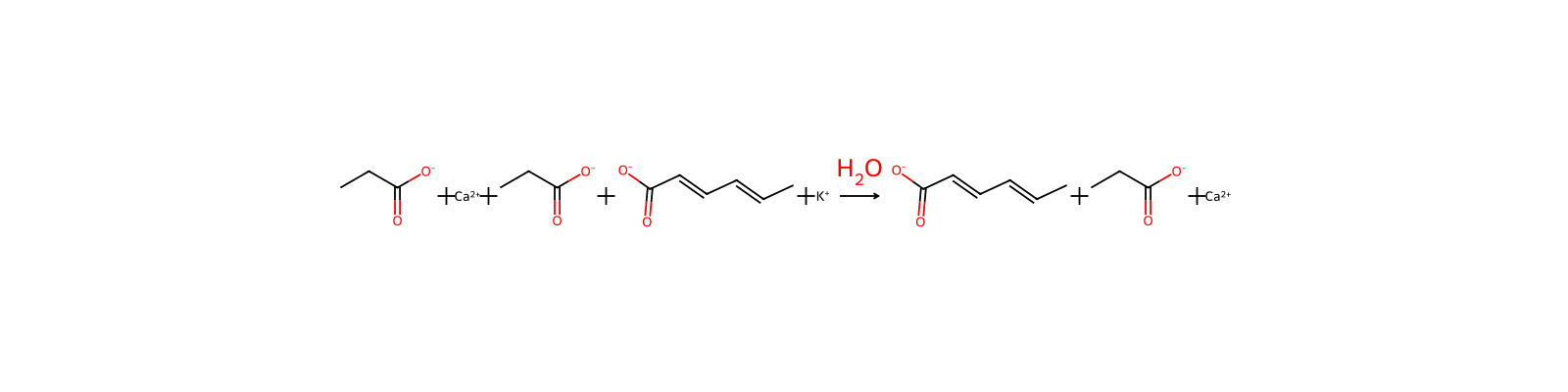
5 records



Linked notes
Loading…