HomeMCPWorkbenchSkills
HomeWorkbenchNotificationsMe
llms.txt · MCP GuidePrivacy Policy · Terms of Service · Supportv1.8.3
  1. Home
  2. /Compound

4-(2-Hydroxyethyl)-1-piperazineethanesulfonic acid

HCID 23831
New reaction
Print
Basic informationOverviewNames & identifiersPropertiesSafety & regulationChemistry & industryRelated reactionsCompound notes
Substructure searchFind similar structures

Basic information

CAS
7365-45-9
Standard SMILES
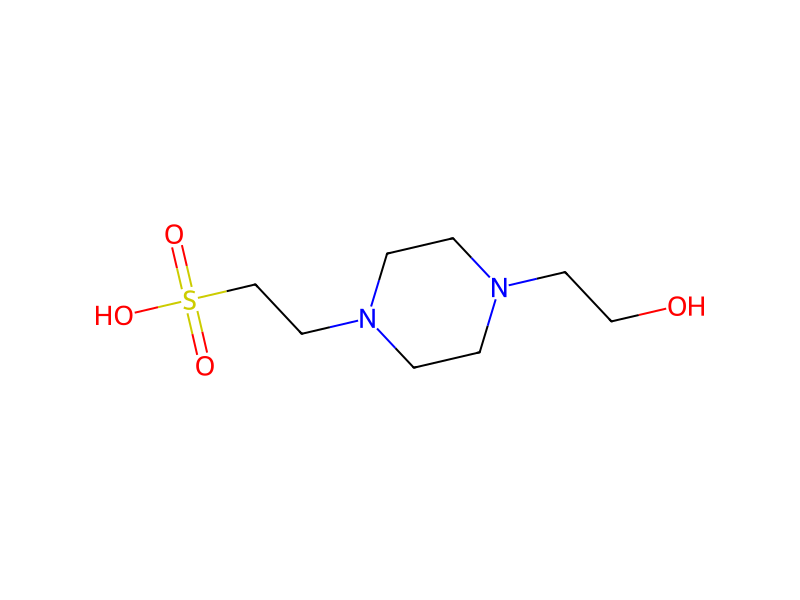
O=S(=O)(O)CCN1CCN(CCO)CC1
InChIKey
JKMHFZQWWAIEOD-UHFFFAOYSA-N
Molecular formula
C8H18N2O4S
Average molar mass
238.31 g/mol
Monoisotopic mass
238.09872823

Overview

2-[4-(2-hydroxyethyl)piperazin-1-yl]ethanesulfonic acid is a HEPES that is ethanesulfonic acid in which one of the methyl hydrogens is replaced by a 4-(2-hydroxyethyl)piperazin-1-yl group. A Good's buffer substance, pKa = 7.55 at 20 C. It is an organosulfonic acid and a HEPES. It is a conjugate acid of a 2-[4-(2-hydroxyethyl)piperazin-1-yl]ethanesulfonate. It is a tautomer of a 2-[4-(2-hydroxyethyl)piperazin-4-ium-1-yl]ethanesulfonate.

Names & identifiers

Preferred name
4-(2-Hydroxyethyl)-1-piperazineethanesulfonic acid
IUPAC
2-[4-(2-hydroxyethyl)piperazin-1-yl]ethanesulfonic acid
English name
HEPES
Molecular formula
C8H18N2O4S
Molecular weight
238.3

Names & synonyms

HEPES7365-45-94-(2-Hydroxyethyl)-1-piperazineethanesulfonic acid1-Piperazineethanesulfonic acid, 4-(2-hydroxyethyl)-Monosodium Salt, HEPESHEPES solutionSalt, HEPES Monosodiumhydroxyethylpiperazine ethane sulfonic acid4-(2-Hydroxyethyl)-1-piperazineethane sulfonic acidRWW266YE9ICHEBI:42334NSC-166663
Show more names
HEPES BUFFER4-(2-HYDROXYETHYL)PIPERAZINE-1-ETHANESULFONIC ACIDBiological BufferHEPES buffer SolutionEPES4-(2-hydroxyethyl)piperazin-1-ylethanesulphonic acid2-[4-(2-HYDROXYETHYL)-1-PIPERAZINYL]ETHANESULFONIC ACID
N 2 Hydroxyethylpiperazine N' 2' ethanesulfonic AcidNSC166663N-2-Hydroxyethylpiperazine-N'-2'-ethanesulfonic AcidHydroxyethyl Piperazine Ethanesulfonic Acid SolutionRefChem:783545CHEBI:46756230-907-92-(4-(2-Hydroxyethyl)piperazin-1-yl)ethanesulfonic acid

Database identifiers

Properties

Computed structural properties

XLogP
-4
Topological polar surface area
89.5 Ų
Hydrogen bond donors
2
Hydrogen bond acceptors
6
Rotatable bonds
5
Heavy atoms
15
Formal charge
0
Complexity
267

Experimental & physicochemical properties

Chemical ClassesOther Uses -> Biological Buffers
Physical Description · 2 items

Dry Powder; Liquid

Solid; [Merck Index] White powder; [Alfa Aesar MSDS]

Collision Cross Section151.1 Ų [M+H]+ [CCS Type: DT; Buffer gas: N2; Ionization: ESI+; Dataset: TOXCAST; Source Identifier: DTXSID4044458]

Physicochemical properties

Melting point
234 · 234-238 °C
Boiling point
408 ℃[at · 408℃[at 101 325 Pa]
bulk density
560 kg/m3 · 560kg/m3
Density
1.07 g/mL · 1.07 g/mL at 20 °C
vapor pressure
0 Pa · 0Pa at 25℃
refractive index
20 · n20/D 1.339
storage temp.
2 · 2-8°C
solubility
2 O: · H2O: 1 M at 20 °C, clear, colorless

Safety & regulation

Safety information is for reference only and does not replace the supplier’s Safety Data Sheet (SDS), applicable regulations, or professional assessment.

GHS classification

GHS Classification · 3 items

This chemical does not meet GHS hazard criteria for 95.6% (194 of 203) of all reports.

Not Classified

Aggregated GHS information provided per 203 reports by companies from 9 notifications to the ECHA C&L Inventory.

Hazard information

Regulatory Information · 4 items

Chemical: 1-Piperazineethanesulfonic acid, 4-(2-hydroxyethyl)-

1-Piperazineethanesulfonic acid, 4-(2-hydroxyethyl)- is listed on the EPA's Chemical Data Reporting (CDR) system. Manufacturers and importers of 1-Piperazineethanesulfonic acid, 4-(2-hydroxyethyl)- are required to report information about their production and use of this chemical to the EPA under the Toxic Substances Control Act (TSCA). (40 eCFR Part 711)

REACH registered substance: 4-(2-hydroxyethyl)piperazin-1-ylethanesulphonic acid (EC: 230-907-9)

Hydroxyethyl piperazineethanesulfonic acid: Does not have an individual approval but may be used under an appropriate group standard

Hazards SummaryMay cause irritation; [Alfa Aesar MSDS] See Piperazine and salts.
Hazard Classes and CategoriesNot Classified

Safety & protection

Protective Action Criteria (PAC) · 3 items

30 [mg/m3]

330 [mg/m3]

2000 [mg/m3]

Safety data

PPE
Eyeshields, Gloves, type N95 (US)

Chemistry & industry

Pharmacology

MeSH Pharmacological ClassificationA chemical system that functions to control the levels of specific ions in solution. When the level of hydrogen ion in solution is controlled the system is called a pH buffer.

Uses & manufacturing

UsesUsed as a biological buffer; [Merck Index] A dipolar ionic buffer often used to culture embryos and other reproductive tissues; [REPROTOX]
U.S. Production2023: 1,000,000 - <2,500,000 lb
Consumer UsesCatalyst
Industry UsesCatalyst
General Manufacturing Information · 2 items

All Other Chemical Product and Preparation Manufacturing

1-Piperazineethanesulfonic acid, 4-(2-hydroxyethyl)-: ACTIVE

Applications · 5 items

DescriptionHEPES has been described as one of the best all-purpose buffers available for biological research. At biological pH, the molecule is zwitterionic, and is effective as a buffer at pH 6.8 to 8.2 (pKa 7.55). It is typically used in cell culture at concentration between 5mM to 30 mM. HEPES has been used in a wide variety of applications, including tissue culture. It is commonly used to buffer cell culture media in air. HEPES finds its usage in in vitro experiments on Mg.

UsesNon-toxic to cell. It is used as a hydrogen ion buffer, which can control the constant pH range for long term. The concentration is 10-50mmol/L. Generally, 20mmol/LHEPES in nutrient solution can get buffer ability.

UsesHEPES is common buffer for biological sciences, particularly used in cell culture to maintain physiological pH. It acts a buffering component, which is used in the preparation of buffers. It is described as one of the best all-purpose buffers available for use in biological research.HEPES has been used as a component of:Hank′s balanced salt solution, Dulbecco′s modified eagle′s medium and no-glucose DMEM, which are used for the preparation of tissue slices.Buffers used in localized conductance measurements on the basolateral side of culture inserts to examine cation selectivity.

Related reactions

125 records
New reaction record
HRID 1762 reaction equation
HRID 1762As reactant
HRID 2721 reaction equation
HRID 2721As reactant
HRID 4926 reaction equation
HRID 4926As reactant
HRID 6371 reaction equation
HRID 6371As reactant
HRID 28851 reaction equation
HRID 28851As reactant
HRID 52407 reaction equation
HRID 52407As reactant
HRID 75087 reaction equation
HRID 75087As reactant
HRID 80348 reaction equation
HRID 80348As reactant
PreviousPage 1 of 16

Compound notes

On this pageBasic informationOverviewNames & identifiersPropertiesSafety & regulationChemistry & industryRelated reactionsCompound notes
CAS
7365-45-9
PubChem CID
23831
DTXSID
DTXSID5040382
ChEMBL
CHEMBL1232545
ChEBI
CHEBI:42334
UNII
RWW266YE9I
EC Number
230-907-9
Nikkaji
J29.038F
form
powder
color
White
PH
5 · 5.0-6.5 (1Maqueous solution)
pka
7.5 · 7.5(at 25℃)
PH Range
7 · 7.0 - 7.6
biological source
synthetic
Water Solubility
Soluble
λmax
260 nm · λ: 260 nm Amax: 0.06λ: 280 nm Amax: 0.04
Merck
14 · 14,4654
BRN
883043 · 883043
Stability
Stable. Combustible. Incompatible with strong oxidizing agents. Protect from moisture.
Major Application
diagnostic assay manufacturing
Cosmetics Ingredients Functions
BUFFERING
InChI
1S/C8H18N2O4S/c11-7-5-9-1-3-10(4-2-9)6-8-15(12,13)14/h11H,1-8H2,(H,12,13,14)
InChIKey
JKMHFZQWWAIEOD-UHFFFAOYSA-N
SMILES
OCCN1CCN(CC1)CCS(O)(=O)=O
LogP
-3.85 at · -3.85 at 20℃
CAS DataBase Reference
7365 · 7365-45-9(CAS DataBase Reference)
EWG's Food Scores
1 · 1
FDA UNII
266 YE9I · RWW266YE9I
EPA Substance Registry System
1 · 1-Piperazineethanesulfonic acid, 4-(2-hydroxyethyl)- (7365-45-9)
Absorption
0.05 at · ≤0.05 at 290 in H2O at 33%
UNSPSC Code
41116107 · 41116107
NACRES
75 · NA.75
Symbol(GHS)
7 · GHS07
Signal word
Warning
Hazard statements
302 · H302-H315-H319-H335
Precautionary statements
261 · P261-P271-P280
PPE
95 · Eyeshields, Gloves, type N95 (US)
Hazard Codes
Xi
Risk Statements
36 · 36/37/38
Safety Statements
24 · 24/25-22-36-26
WGK Germany
1 · 1
RTECS
6809000 · TL6809000
TSCA
TSCA listed
HS Code
29335995 · 29335995
Storage Class
13 · 13 - Non Combustible Solids
REACH Registrations
Active
wgk
1
tsca
TSCA listed
rtecs
TL6809000
hs_code
29335995
risk_code
36/37/38
Signal word
Warning
Symbol(GHS)
GHS07
hazard_code
Xi
safety_code
24/25-22-36-26
Storage Class
13 - Non Combustible Solids
Hazard statements
H302-H315-H319-H335
REACH Registrations
Active
Precautionary statements
P261-P271-P280

UsesHEPES is a biological buffer. It may be used in isoelectric focusing applications and as a buffer in the quantitative and selective measurement of antigen-antibody reactions. HEPES is reportedly superior to NaHCO3 in controlling pH in tissue and organ culture. HEPES is not recommended for use with the Folin-Ciocalteu protein assay.

General DescriptionHEPES buffered saline is a tissue culture buffer, which is used to maintain the pH of cell culture. It is water soluble and atmosphere independent. HEPES destroys magnesium in sodium chloride solutions.

Upstream & downstream products

Upstream raw materials

1-(2-Hydroxyethyl)piperazineSodium isethionate

Additional notes

DefinitionChEBI: A HEPES that is ethanesulfonate substituted by a 4-(2-hydroxyethyl)piperazin-4-ium-1-yl group at position 2.