HomeMCPWorkbenchSkills
HomeWorkbenchNotificationsMe
llms.txt · MCP GuidePrivacy Policy · Terms of Service · Supportv1.8.0
  1. Home
  2. /Compound

Cerium

HCID 23974
New noteNew reactionRequest quotes
Print preview

Completing data — refresh the page later to see the latest
Basic informationOverviewNames & identifiersPropertiesSafety & regulationChemistry & industryRelated reactionsCompound notes
Substructure searchFind similar structures

Basic information

CAS
109882-76-0
Standard SMILES
[Ce]
InChIKey
GWXLDORMOJMVQZ-UHFFFAOYSA-N
Molecular formula
Ce
Average molar mass
140.116 g/mol
Monoisotopic mass
139.9054387

Overview

Cerium is a gray colored, ductile solid. This form of cerium is slabs, ingots or rods. When heated to high temperatures it will burn readily and may be difficult to extinguish. It is used to make signaling devices.

Names & identifiers

Preferred name
Cerium
IUPAC
cerium
English name
1H-Imidazole polymer with 2-(chloromethyl)oxirane and morpholine
Molecular formula
C10H18ClN3O2
Molecular weight
247.72

Names & synonyms

CERIUM7440-45-1CEDTXSID005864130K4522N6TCHEBI:33369RefChem:124513DTXCID4032328231-154-9cerio13550-45-3Cerium atom
Show more names
MOMEAqueous cationic polymer MOMECationic polymer in water MOMEMOME(Aqueous cationic polymer)Cationic quaternary ammonium saltMOME Cationic polymer in waterMOME (interMediate for zinc plating)ALPHA-Epichlorohydrin-1H-imidazole-morpholine tripolymer1H-Imidazole polymer with 2-(chloromethyl)oxirane and morpholineReaction product of imidazole, morpholine, epichlorohydrine and hydrochloric acid
MFCD00010924Nitric acid, cerium(3+) salt, hydrate58CeCERIUM METALCerium Standard: Ce @ 1000 microg/mL in 5% HNO3Cerium Standard: Ce @ 10000 microg/mL in 5% HNO3Cerium elementCerium ingot

Database identifiers

CAS
109882-76-0、13864-02-3、7440-45-1
PubChem CID
23974
DTXSID
DTXSID0058641
ChEBI
CHEBI:33369
UNII
30K4522N6T
EC Number
231-154-9、629-690-7
Nikkaji
J643.975F、J74.585E

Properties

Computed structural propertiesFilling in

Topological polar surface area
0 Ų
Hydrogen bond donors
0
Hydrogen bond acceptors
0
Rotatable bonds
0
Heavy atoms
1
Formal charge
0
Complexity
0

Experimental & physicochemical properties

Chemical Classes · 2 items

Metals -> Rare Earth Metals

Flammable agents - 3rd degree

SpringerMaterials Propertieselectron density of states
Density6.9 @25 °C
Boiling Point3433 °C @760 [mm Hg]
Melting Point · 2 items

795 °C

799 °C

Food Contact SubstancesFCS -> FDA Inventory of Food Contact Substances Listed in 21 CFR
Physical Description · 5 items

Cerium is a gray colored, ductile solid. This form of cerium is slabs, ingots or rods. When heated to high temperatures it will burn readily and may be difficult to extinguish. It is used to make signaling devices.

Cerium, turnings or gritty powder appears as a gray metallic solid. Specific gravity 6.78. Turnings or gritty powder. Contact may burn skin, eyes or mucous membranes. May be toxic by ingestion, inhalation or skin absorption. Used to make other chemicals.

Large Crystals; Other Solid

Gray solid; [CAMEO] Ceric salts: yellow or red-orange; Cerous salts: usually white; [Reference #1] Ductile and highly reactive; Readily oxidizes; [Hawley]

Safety & regulation

Safety information is for reference only and does not replace the supplier’s Safety Data Sheet (SDS), applicable regulations, or professional assessment.

GHS classification

GHS Classification · 6 items

This chemical does not meet GHS hazard criteria for 2.2% (11 of 502) of reports.

Danger

H228 (96.4%): Flammable solid [Danger Flammable solids]

P210, P240, P241, P280, and P370+P378 (click each P-code to see the statement)

Aggregated GHS information provided per 502 reports by companies from 12 notifications to the ECHA C&L Inventory.

Warning

Hazard information

Regulatory Information · 5 items

Chemical: Cerium

Cerium is listed on the EPA's Chemical Data Reporting (CDR) system. Manufacturers and importers of Cerium are required to report information about their production and use of this chemical to the EPA under the Toxic Substances Control Act (TSCA). (40 eCFR Part 711)

Status: Active Update: 06-10-2022 https://echa.europa.eu/registration-dossier/-/registered-dossier/1986

Cerium: Does not have an individual approval but may be used under an appropriate group standard

The New Jersey Worker and Community Right to Know Act requires public and private employers to provide information about hazardous substances at their workplaces. (N.J.S.A. 34:5A-1 et. seq.)

Other Safety InformationIMAP assessments - Cerium: Human health tier I assessment
DOT Label · 2 items

Flammable Solid

Dangerous When Wet

Fire Hazards · 3 items

Excerpt from ERG Guide 170 [Metals (Powders, Dusts, Shavings, Borings, Turnings, or Cuttings, etc.)]:

Excerpt from ERG Guide 138 [Substances - Water-Reactive (Emitting Flammable Gases)]:

· Produce flammable gases on contact with water.

Health Hazards · 3 items

Chemistry & industry

Uses & manufacturing

Uses · 3 items

Used in metal alloys, in polishing agents, and in glass; [Ullmann] Sources: most abundant of the rare earth metals, it is obtained mainly from monazite, and bastnasite mineral deposits. Large deposits are found in India, Brazil, and the United States. Uses: to manufacture flints for cigarette lighters (misch metal); to make incandescent gas mantles, self-cleaning ovens, carbon arc lighting, and glass; as an analytical reagent (Cerium sulfate); to polish glass (Cerium oxide); and as a catalyst in petroleum refining; [Reference #1]

Steel Producing [Category: Industry]

Glassblowing [Category: Hobbies]

U.S. Production2023: 250,000 - <400,000 lb
Consumer UsesIntermediate
Industry UsesIntermediate
General Manufacturing Information · 2 items

Fabricated Metal Product Manufacturing

Cerium: ACTIVE

Applications

UsesMOME is used in cyanide, alkaline, cyanide-free zinc plating. As the main brightener, it is often used in conjunction with BPC48/34.

Related reactions

59 records
New reaction record
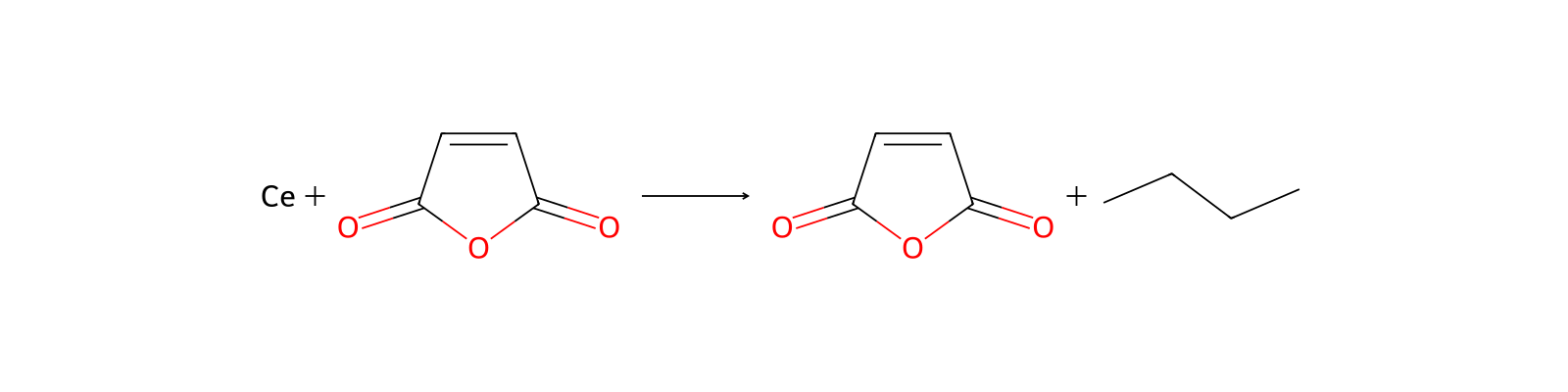
HRID 27653 reaction equation
HRID 27653As reactantuspto-grants-1980_09
HRID 100103 reaction equation
HRID 100103As reactantTraining data from https://doi.org/10.1039/C8SC04228D (2/10)
HRID 102067 reaction equation
HRID 102067As reactantTraining data from https://doi.org/10.1039/C8SC04228D (2/10)
HRID 109880 reaction equation
HRID 109880As reactantTraining data from https://doi.org/10.1039/C8SC04228D (2/10)
HRID 124576 reaction equation
HRID 124576As reactantTraining data from https://doi.org/10.1039/C8SC04228D (2/10)
HRID 169342 reaction equation
HRID 169342As reactantTraining data from https://doi.org/10.1039/C8SC04228D (9/10)
HRID 184836 reaction equation
HRID 184836As reactantTraining data from https://doi.org/10.1039/C8SC04228D (6/10)
HRID 231205 reaction equation
HRID 231205As reactantuspto-grants-1989_07
Page 1 of 8

Compound notes

Loading…

On this pageBasic informationOverviewNames & identifiersPropertiesSafety & regulationChemistry & industryRelated reactionsCompound notes
More actions
New noteNew reactionRequest quotes

Solid

Physicochemical properties

InChI
InChI=1S/C4H9NO.C3H5ClO.C3H4N2/c1-3-6-4-2-5-1;4-1-3-2-5-3;1-2-5-3-4-1/h5H,1-4H2;3H,1-2H2;1-3H,(H,4,5)
InChIKey
WRTGHLKTHCGYEB-UHFFFAOYSA-N
SMILES
C(C1OC1)Cl.C1NCCOC1.C1N=CNC=1
Symbol(GHS)
7 · GHS07
Signal word
Warning
Hazard statements
312 · H312-H302
Precautionary statements
280 · P280-P302+P352-P312-P322-P363-P501-P264-P270-P301+P312-P330-P501

Excerpt from ERG Guide 170 [Metals (Powders, Dusts, Shavings, Borings, Turnings, or Cuttings, etc.)]:

Excerpt from ERG Guide 138 [Substances - Water-Reactive (Emitting Flammable Gases)]:

· Inhalation or contact with vapors, substance or decomposition products may cause severe injury or death.

Hazards Summary · 1 item

Reacts violently with water and produces flammable gas on contact with moist air; May produce corrosive solutions; [CAMEO] Oxidizes readily in air at room temperature; Pure metal may ignite if scratched with a knife; [Reference #1] See RARE EARTH METALS and linked occupational diseases.

DOT ID and Guide3078 138
Reactive Group · 2 items

Metals, Elemental and Powder, Active

Metals, Elemental and Powder, Active

Reactivity Alerts · 2 items

Strong Reducing Agent

Strong Reducing Agent

Reactivity Profile · 2 items

CERIUM is a strong reducing agent. Resembles aluminum in its chemical properties. [Lewis]. Reactivity is enhanced by a state of high physical subdivision, as in TURNINGS OR GRITTY POWDER. Attacked by dilute and concentrated mineral acids and alkalis with the generation of flammable gases. Readily oxidized by moist air at room temperature. Reacts with zinc with explosively violence. Gives very exothermic reactions with antimony or bismuth. Reacts violently with phosphorus at 400-500 °C [Mellor 8, Supp. 3:347 1971].

CERIUM is a strong reducing agent. Resembles aluminum in its chemical properties. [Lewis]. Reactivity is enhanced by a state of high physical subdivision, as in TURNINGS OR GRITTY POWDER. Attacked by dilute and concentrated mineral acids and alkalis with the generation of flammable gases. Readily oxidized by moist air at room temperature. Reacts with zinc with explosive violence. Gives very exothermic reactions with antimony or bismuth. Reacts violently with phosphorus at 400-500 °C [Mellor 8, Supp. 3:347 1971].

DOT Hazard Classification · 6 items

Cerium, slabs, ingots, or rods

UN1333

Div 4.1 Flammable solid (49 eCFR § 173.124)

PG II: the degree of danger presented by the material is medium

Cerium, turnings or gritty powder

UN3078

Air and Water Reactions · 2 items

Finely divided metal powder is pyrophoric [Bretherick 1979 p. 170-171]. This material will react vigorously if exposed to water or moist air and will generate flammable and/or toxic fumes.

Finely divided cerium powder is pyrophoric [Bretherick 1979 p. 170-171]. Can react vigorously if exposed to water or moist air and will generate flammable fumes.

Safety & protection

Fire Fighting · 2 items

Excerpt from ERG Guide 170 [Metals (Powders, Dusts, Shavings, Borings, Turnings, or Cuttings, etc.)]:

Excerpt from ERG Guide 138 [Substances - Water-Reactive (Emitting Flammable Gases)]:

Accidental Release Measures · 2 items

· CALL 911. Then call emergency response telephone number on shipping paper. If shipping paper not available or no answer, refer to appropriate telephone number listed on the inside back cover.

· ELIMINATE all ignition sources (no smoking, flares, sparks or flames) from immediate area.

First Aid · 3 items

Excerpt from ERG Guide 170 [Metals (Powders, Dusts, Shavings, Borings, Turnings, or Cuttings, etc.)]:

Excerpt from ERG Guide 138 [Substances - Water-Reactive (Emitting Flammable Gases)]:

General First Aid:

Exposure Control and Personal Protection· Wear positive pressure self-contained breathing apparatus (SCBA).
Nonfire Spill Response · 2 items

Excerpt from ERG Guide 170 [Metals (Powders, Dusts, Shavings, Borings, Turnings, or Cuttings, etc.)]:

Excerpt from ERG Guide 138 [Substances - Water-Reactive (Emitting Flammable Gases)]:

Isolation and Evacuation · 3 items

Excerpt from ERG Guide 170 [Metals (Powders, Dusts, Shavings, Borings, Turnings, or Cuttings, etc.)]:

Excerpt from ERG Guide 138 [Substances - Water-Reactive (Emitting Flammable Gases)]:

Immediate precautionary measure

Protective Action Criteria (PAC) · 3 items

30 [mg/m3]

330 [mg/m3]

2000 [mg/m3]

Personal Protective Equipment (PPE) · 2 items

Excerpt from ERG Guide 170 [Metals (Powders, Dusts, Shavings, Borings, Turnings, or Cuttings, etc.)]:

Excerpt from ERG Guide 138 [Substances - Water-Reactive (Emitting Flammable Gases)]:

Emergency Response Planning Guidelines· DO NOT USE WATER OR FOAM.

Toxicology

Adverse EffectsDermatotoxin - Skin burns.

Safety data

Signal word
Warning
Symbol(GHS)
GHS07
Hazard statements
H312-H302
Precautionary statements
P280-P302+P352-P312-P322-P363-P501-P264-P270-P301+P312-P330-P501