
HRID 6518As reactant
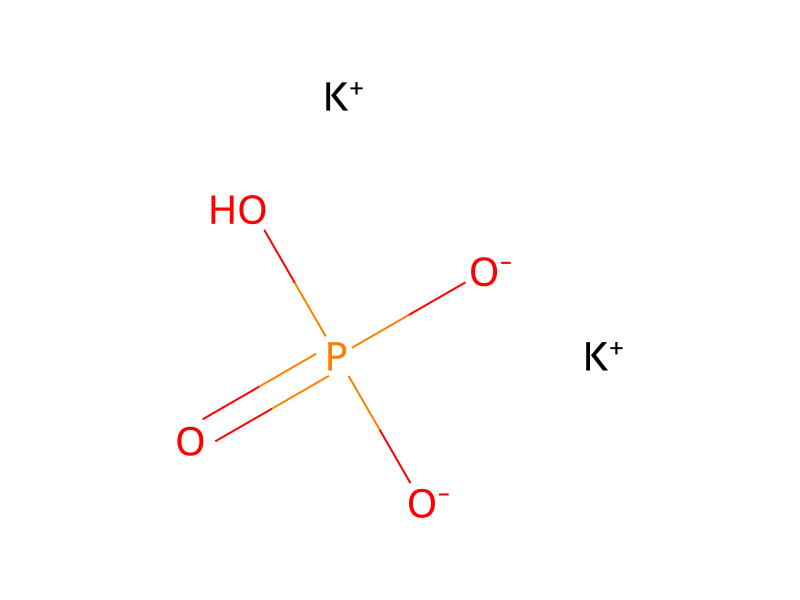
7758-11-4O=P([O-])([O-])O.[K+].[K+]ZPWVASYFFYYZEW-UHFFFAOYSA-LDipotassium hydrogen phosphate is a potassium salt that is the dipotassium salt of phosphoric acid. It has a role as a buffer. It is an inorganic phosphate and a potassium salt.
7758-11-4DTXSID8035506Cosmetic ingredients (Dipotassium Phosphate) -> CIR (Cosmetic Ingredient Review)
Buffering
Between 8,7 and 9,4 (1 % solution)
PH= 8.8, DETERMINED IN A 1% SOLN
White crystals
Colorless or white granules or powder
Freely soluble in water. Insoluble in ethanol
Very sol in water; 100 g dissolves rapidly & completely in 67 g cold water
Slightly sol in alcohol
FDA approved drugs -> Active ingredient
FDA approved drugs -> Active ingredient
Safety information is for reference only and does not replace the supplier’s Safety Data Sheet (SDS), applicable regulations, or professional assessment.
This chemical does not meet GHS hazard criteria for 48.2% (580 of 1203) of reports.
Danger
H315 (40.7%): Causes skin irritation [Warning Skin corrosion/irritation]
P264, P264+P265, P280, P302+P352, P305+P354+P338, P317, P321, P332+P317, and P362+P364 (click each P-code to see the statement)
Aggregated GHS information provided per 1203 reports by companies from 9 notifications to the ECHA C&L Inventory. Each notification may be associated with multiple companies.
Chemical: Phosphoric acid, dipotassium salt
REACH registered substance: Dipotassium hydrogenorthophosphate (EC: 231-834-5)
Dipotassium phosphate: Does not have an individual approval but may be used under an appropriate group standard
Dipotassium phosphate used as a sequestrant in food for human consumption is generally recognized as safe when used in accordance with good manufacturing practice.
Dipotassium phosphate used as a sequestrant in animal drugs, feeds, and related products is generally recognized as safe when used in accordance with good manufacturing or feeding practice.
Potassium phosphates (mono-, di-, and tribasic) are indirect food additives for use only as a component of adhesives. /Potassium phosphates (mono-, di-, and tribasic)/
Phosphate is a major intracellular anion which participates in providing energy for metabolism of substances and contributes to important metabolic and enzymatic reactions in almost all organs and tissues. Phosphate exerts a modifying influence on calcium concentrations, a buffering effect on acid-base equilibrium, and has a major role in the renal excretion of hydrogen ions. /Phosphate/
Phosphate as nutrient is a limiting factor to plant growth. /Phosphate/
Phosphate is a major intracellular anion which participates in providing energy for metabolism of substances and contributes to important metabolic and enzymatic reactions in almost all organs and tissues. Phosphate exerts a modifying influence on calcium concentrations, a buffering effect on acid-base equilibrium, and has a major role in the renal excretion of hydrogen ions.
Once phosphate gains access to the body fluids and tissues, it exerts little pharmacological effect. If the ion is introduced into the intestine, the absorbed phosphate is rapidly excreted. If large amounts are given by this route, much of it may escape absorption. Because this property leads to a cathartic action, phosphate salts are employed as mild laxatives.
Once phosphate gains access to the body fluids and tissues, it exerts little pharmacological effect. If the ion is introduced into the intestine, the absorbed phosphate is rapidly excreted. If large amounts are given by this route, much of it may escape absorption. Because this property leads to a cathartic action, phosphate salts are employed as mild laxatives. Inorganic phosphate poisoning following ingestion of laxatives that contain phosphate salts has been reported in adults and children. Ingestion of large amounts of sodium dihydrogen phosphate lowers urinary pH. If excessive phosphate salts are introduced intravenously or orally, they may prove toxic by reducing the concentration of Ca 2+ in the circulation and from the precipitation of calcium phosphate in soft tissues. /Phosphates/





CHEMBL1200459CHEBI:131527Colourless or white granular powder, crystals or masses; deliquescent substance, hygroscopic
White partially hygroscopic solid; [Merck Index] Colorless or white odorless solid; Hygroscopic; [CHEMINFO] White odorless granules; [MSDSonline]
Converted into pyrophosphate by ignition; somewhat hygroscopic
Hygroscopic
Dipotassium hydrogen phosphate is exempted from the requirement of a tolerance when used as a buffering agent in accordance with good agricultural practice as inert (or occasionally active) ingredients in pesticide formulations applied to growing crops only.
Residues of potassium phosphate are exempted from the requirement of a tolerance when used as a buffer in accordance with good agricultural practices as inert (or occasionally active) ingredients in pesticide formulations applied to growing crops or to raw agricultural commodities after harvest. /Potassium phosphate/
SRP: At the time of review, criteria for land treatment or burial (sanitary landfill) disposal practices are subject to significant revision. Prior to implementing land disposal of waste residue (including waste sludge), consult with environmental regulatory agencies for guidance on acceptable disposal practices.
Dipotassium hydrogen phosphate is exempted from the requirement of a tolerance when used as a buffering agent in accordance with good agricultural practice as inert (or occasionally active) ingredients in pesticide formulations applied to growing crops only.
Residues of potassium phosphate are exempted from the requirement of a tolerance when used as a buffer in accordance with good agricultural practices as inert (or occasionally active) ingredients in pesticide formulations applied to growing crops or to raw agricultural commodities after harvest. /Potassium phosphate/
17 [mg/m3]
190 [mg/m3]
1100 [mg/m3]
The CIR Expert Panel concluded that the following 31 ingredients are safe in the present practices of use and concentration in cosmetics as described in this safety assessment, when formulated to be non-irritating...Dipotassium Phosphate...
Safe for use in cosmetics, with qualifications
ACUTE POTASSIUM INTOXICATION BY MOUTH IS RARE BECAUSE LARGE SINGLE DOSES USUALLY INDUCE VOMITING & BECAUSE IN ABSENCE OF PREEXISTING KIDNEY DAMAGE, POTASSIUM IS RAPIDLY EXCRETED. /POTASSIUM SALTS/
SIDE EFFECTS OF /ORAL/ POTASSIUM SALTS MAY INCLUDE NAUSEA, VOMITING, DIARRHEA, AND ABDOMINAL DISCOMFORT. /POTASSIUM SALTS/
CLINICAL SIGNS AND SYMPTOMS OF /ORAL/ POTASSIUM OVERDOSAGE INCLUDE PARESTHESIAS OF THE EXTREMITIES, LISTLESSNESS, MENTAL CONFUSIONS, WEAKNESS OR HEAVINESS OF THE LEGS, FLACCID PARALYSIS, COLD SKIN, GRAY PALLOR, PERIPHERAL VASCULAR COLLAPSE WITH FALL IN BLOOD PRESSURE, CARDIAC ARRHYTHMIAS, AND HEART BLOCK. /POTASSIUM SALTS/
/IN POTASSIUM POISONING/ RESPIRATIONS ARE INITIALLY ACCELERATED BUT SKELETAL MUSCLE WEAKNESS MAY ADVANCE TO STAGE OF PARALYSIS. /POTASSIUM SALTS/
For more Human Toxicity Excerpts (Complete) data for DIPOTASSIUM PHOSPHATE (6 total), please visit the HSDB record page.
INVESTIGATED BY PLEDGET TECHNIQUE IN 1 ESOPHAGEAL STUDY WITH CATS, PRODUCED EXTENSIVE NECROSIS & ULCERATION. INGESTION MAY PRODUCE OROPHARYNGEAL BURNS, ESOPHAGITIS & GASTRITIS ACCOMPANIED BY ULCERATION, BLEEDING & DIARRHEA.
AFTER ORAL ADMIN OF 0.8 G/KG BODY WT FOR 14 OR 38 WK DOGS VOMITED, WERE CACHECTIC, & HAD ELEVATED CREATININE & BLOOD UREA NITROGEN. RENAL DAMAGE WAS MOST MARKED @ 38 WK, THERE WERE DISSEMINATED ATROPHY (USUALLY OF PROXIMAL TUBLES), FOCAL SCAR TISSUE & NEPHROCALCINOSIS.
ORALLY POISONED ANIMALS DIED FROM RESP FAILURE SOMETIMES FOLLOWING CONVULSIONS & ... GASTROENTERITIS, DEHYDRATION OF ORGANS & EARLY RENAL TUBULAR NECROSIS. /POTASSIUM SALTS/
/ORALLY POISONED ANIMALS/ SURVIVORS HAD ANOREXIA, POLYDIPSIA, POLYURIA, FEVER, CONVULSIVE MOVEMENTS & GI DISTURBANCES DURING FIRST 24 HR, BUT RAPIDLY RECOVERED ... . /POTASSIUM SALTS/
For more Non-Human Toxicity Excerpts (Complete) data for DIPOTASSIUM PHOSPHATE (8 total), please visit the HSDB record page.
Basic treatment: Establish a patent airway. Suction if necessary. Watch for signs of respiratory insufficiency and assist ventilations if necessary. Administer oxygen by nonrebreather mask at 6 to 12 L/min. Monitor for pulmonary edema and treat if necessary ... . Monitor for shock and treat if necessary ... . For eye contamination, flush eyes immediately with water. Irrigate each eye continuously with normal saline during transport ... . Do not use emetics. For ingestion, rinse mouth and administer 5 mL/kg up to 200 mL of water for dilution if the patient can swallow, has a strong gag reflex, and does not drool ... . Do not attempt to neutralize. Cover the skin burns with dry sterile dressings after decontamination ... . /Inorganic Bases/Alkaline Corrosives and Related Compounds/
Advanced treatment: Consider orotracheal or nasotracheal intubation for airway control in the patient who is unconscious or in respiratory arrest. Early intubation, at the first signs of upper airway obstruction, may be necessary. Positive-pressure ventilation techniques with a bag-valve-mask device may be beneficial. Monitor cardiac rhythm and treat arrhythmias as necessary ... . Start an IV of D5W TKO /SRP: "To keep open", minimal flow rate/. Use lactated Ringer's if signs of hypovolemia are present. Watch for signs of pulmonary edema. For hypotension with signs of hypovolemia, administer fluid cautiously. Watch for signs of fluid overload ... . Consider drug therapy for pulmonary edema ... . Use proparacaine hydrochloride to assist eye irrigation ... . /Inorganic Bases/Alkaline Corrosives and Related compounds/
1
PPRTV Current
4
PPRTV Current
FAO/WHO EXPERT COMMITTEE ON FOOD ADDITIVES...RECOMMENDED.../LEVELS/ FOR TOTAL DIETARY PHOSPHORUS...UNCONDITIONAL ACCEPTANCE LEVEL /OF LESS THAN 30 MG/KG BODY WT/ IS CONSIDERED SAFE IN ANY TYPE OF DIET...CONDITIONAL ACCEPTANCE LEVEL /OF 30-70 MG/KG BODY WT/ IS ACCEPTABLE ONLY WHEN DIETARY CALCIUM LEVEL IS HIGH /PHOSPHATES/
7.80e+04
1.20e+06
2.00e+04
1.5E+01(G)
1.00e+00
Volatile
2.30e+05
3.50e+06
6.00e+04
1.5E+01 (G)
1.00e+00
Volatile
Dipotassium phosphate used as a sequestrant in food for human consumption is generally recognized as safe when used in accordance with good manufacturing practice.
Dipotassium phosphate used as a sequestrant in animal drugs, feeds, and related products is generally recognized as safe when used in accordance with good manufacturing or feeding practice.
Potassium phosphates (mono-, di-, and tribasic) are indirect food additives for use only as a component of adhesives. /Potassium phosphates (mono-, di-, and tribasic)/
Dipotassium hydrogen phosphate is exempted from the requirement of a tolerance when used as a buffering agent in accordance with good agricultural practice as inert (or occasionally active) ingredients in pesticide formulations applied to growing crops only.
Residues of potassium phosphate are exempted from the requirement of a tolerance when used as a buffer in accordance with good agricultural practices as inert (or occasionally active) ingredients in pesticide formulations applied to growing crops or to raw agricultural commodities after harvest. /Potassium phosphate/
KALI PHOSPHORICUM
Potassium Compounds [CS]; Osmotic Laxative [EPC]; Osmotic Activity [MoA]; Inhibition Large Intestine Fluid/Electrolyte Absorption [PE]; Potassium Salt [EPC]; Increased Large Intestinal Motility [PE]
POTASSIUM PHOSPHATE, DIBASIC
Inhibition Large Intestine Fluid/Electrolyte Absorption [PE]; Osmotic Activity [MoA]; Potassium Compounds [CS]; Osmotic Laxative [EPC]; Increased Large Intestinal Motility [PE]; Potassium Salt [EPC]
Potassium salts are well absorbed from gastro intestinal tract. Net phosphorus absorption may occur in the small intestine in some species but is primarily a function of the colon in horses.
Potassium is excreted primarily by kidney.
Distribution is largely intracellular, but it is the intravascular concentration that is primarily responsible for toxicity.
Phosphates are rapidly cleared by dialysis.
POTASSIUM SALTS ARE WELL ABSORBED FROM THE GASTROINTESTINAL TRACT. ... POTASSIUM IS EXCRETED PRIMARILY BY THE KIDNEY. /POTASSIUM SALTS/
Net phosphorus absorption may occur in the small intestine in some species but is primarily a function of the colon in horses. /SRP: Phosphates/
CIR ingredient: Dipotassium Phosphate
Used as a buffering agent and corrosion inhibitor in anti-freeze, a culture nutrient for the production of antibiotics, a sequestrant, an emulsifier in cheeses, and a buffer in coffee creamers; Also used in specialty fertilizers, paper-processing aids, and saline cathartics; [HSDB] Used as yeast nutrient, humectant, and laboratory reagent; [CHEMINFO]
Pulp and Paper Processing [Category: Industry]
Buffering agent in anti-freeze; nutrient in the culturing of antibiotics
Sequestrant; emulsifier in specified cheeses
Most of the commercial output of dipotassium phosphate is used in conjunction with borates, nitrites, nitrates, and/or silicates as corrosion inhibitor systems in ethylene glycol antifreeze formulations. Its second largest use is as a buffer in coffee creamers to prevent casein protein precipitation by coffee acids. Other uses include specialty fertilizers, paper-processing aids, and saline cathartics.
(1973) PROBABLY GREATER THAN 5X10+9 G (USE)
(1975) 4.54-6.36X10+9 GRAMS (SUPPLY)
INJECTION, 2 MEQ OF POTASSIUM ION AND 1 MEQ OF HYDROGEN PHOSPHATE ION PER ML WITH BENZYL ALCOHOL 0.9%; 30 ML VIALS; POWDER NATIONAL FORMULARY.
Grades: commercial; pure; highest purity; NF /National Formulary/; FCC /Food Chemicals Codex/
Solid and 50% active solution
Food additives
Food Additives -> ACIDITY_REGULATOR; SEQUESTRANT; YEAST_FOOD -> JECFA Functional Classes
Food Additives -> ACIDITY_REGULATOR; SEQUESTRANT; YEAST_FOOD -> JECFA Functional Classes
Food Additives -> ACIDITY_REGULATOR; SEQUESTRANT; YEAST_FOOD -> JECFA Functional Classes
Food Additives -> ACIDITY_REGULATOR; SEQUESTRANT; YEAST_FOOD -> JECFA Functional Classes
Food Additives -> ACIDITY_REGULATOR; SEQUESTRANT; YEAST_FOOD -> JECFA Functional Classes
Phosphoric acid, potassium salt (1:2): ACTIVE
THE PROPERTIES OF /POTASSIUM PHOSPHATE/ ... DI-SALTS GIVE THEM EXCELLENT POTENTIAL AS FERTILIZERS, BUT HERETOFORE THEY HAVE RECEIVED SCANT ATTENTION BY THE INDUSTRY BECAUSE OF HIGH COSTS OF PRODUCTION.
... CAN INACTIVATE METALLIC IONS, WHICH ARE CAPABLE OF INTERFERING WITH NECESSARY FOOD-PROCESSING REACTIONS ... /INACTIVATION IS/ EITHER BY PPTN & REMOVING THEM FROM INTERFERENCE WITH DESIRED FOOD-PROCESSING REACTIONS OR BY COMPLEXING & MAINTAINING THEM IN SOL, BOUND STATE. /PHOSPHATES/
DescriptionPotassium Phosphate Dibasic is a common source of phosphorus and potassium, which is often used as a fertilizer. It is also widely applied in the food industry, such as food additive and electrolyte replenisher for workout supplement. Another usage of Potassium Phosphate Dibasic is as a medicine, who serves as a diuretic or laxative. Besides, it is employed in the production of imitation dairy creamers to prevent coagulation and used in certain powders to prepare beverages. In addition, it is commonly seen in chemical laboratories for producing buffer solutions and trypticase soy agar which is used to make agar plates for culturing bacteria.
UsesBuffering agent in antifreeze solutions; nutrient in the culturing of antibiotics; ingredient of instant fertilizers; as sequestrant in the preparation of non-dairy powdered coffee creams.
UsesPotassium Phosphate Dibasic is used as a buffering agent to control the degree of acidity in solutions.
UsesPotassium Phosphate Dibasic is the dipotassium salt of phosphoric acid which functions as a stabilizing salt, buffer, and sequestrant. It is mildly alkaline with a ph of 9 and is soluble in water with a solubility of 170 g/100 ml of water at 25°c. It improves the colloidal solubility of proteins. It acts as a buffer against variation in ph. For example, it is used in coffee whiteners as a buffer against ph variation in hot coffee and to prevent feathering. It also functions as an emulsifier in specified cheeses and as a buffering agent for processed foods. It is also termed dipotassium monohydrogen orthophosphate and dipotassium monophosphate.
UsesBuffer solutions.
General DescriptionPotassium phosphate dibasic is a useful biological buffer having a pH in the range of 8.5-9.6. Potassium phosphate is present in various forms: monobasic (KH2PO4), dibasic (KH2PO4), and tribasic (K3PO4). Potassium phosphate buffers are widely employed in equilibrium dialysis, high performance liquid chromatography (HPLC) and affinity capillary electrophoresis studies.
PreparationDipotassium phosphate is prepared by partial neutralization of phosphoric acid with potassium hydroxide, followed by crystallization:H3PO4+ 2KOH →K2HPO4+ 2H2O.
DefinitionChEBI: A potassium salt that is the dipotassium salt of phosphoric acid.