Basic information
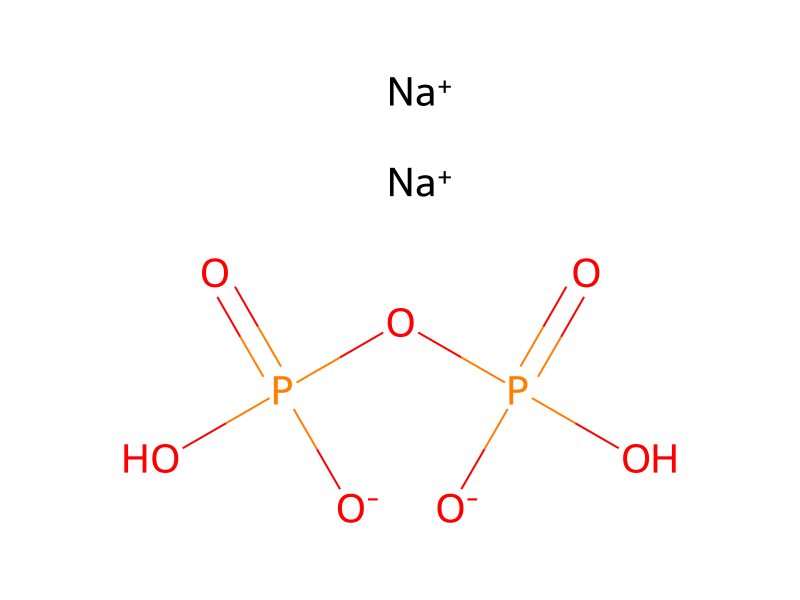
- Standard SMILES
O=P([O-])(O)OP(=O)([O-])O.[Na+].[Na+]- InChIKey
GYQBBRRVRKFJRG-UHFFFAOYSA-L- Molecular formula
- Na2H2P2O7
- Average molar mass
- 221.94 g/mol
- Monoisotopic mass
- 221.90711422
Overview
The CIR Expert Panel concluded that the following 31 ingredients are safe in the present practices of use and concentration in cosmetics as described in this safety assessment, when formulated to be non-irritating...Disodium Pyrophosphate...
Names & identifiers
- Preferred name
- Disodium Pyrophosphate
- IUPAC
- disodium;[hydroxy(oxido)phosphoryl] hydrogen phosphate
- English name
- Sodium polyphosphate
- Molecular formula
- Na3O10P3X2
- Molecular weight
- 321.88
Names & synonyms
Show more names
Database identifiers
- CAS
68915-31-1、7758-16-9- PubChem CID
- 24451
- DTXSID
DTXSID7044261- ChEMBL
CHEMBL3184949- UNII
- H5WVD9LZUD
- EC Number
- 231-835-0
Properties
Computed structural properties
- Topological polar surface area
- 130 Ų
- Hydrogen bond donors
- 2
- Hydrogen bond acceptors
- 7
- Rotatable bonds
- 2
- Heavy atoms
- 11
- Formal charge
- 0
- Complexity
- 143
Experimental & physicochemical properties
Cosmetics
Cosmetic ingredients (Disodium Pyrophosphate) -> CIR (Cosmetic Ingredient Review)
Chelating; Buffering
Food Additives
COLOR OR COLORING ADJUNCT, DOUGH STRENGTHENER, EMULSIFIER OR EMULSIFIER SALT, FLAVORING AGENT OR ADJUVANT, FLOUR TREATING AGENT, FORMULATION AID, LEAVENING AGENT, OXIDIZING OR REDUCING AGENT, SEQUESTRANT -> FDA Substance added to food
Density
Density: 1.86 /Hexahydrate/
1.862 @25 °C
Solubility
Soluble in water
Sol in water
Physical Description
Large Crystals; CBI; Dry Powder; Other Solid; Liquid
White powder or grains
White solid; [Merck Index] White odorless powder; [MSDSonline]
Other Experimental Properties
Decomp @ 220 °C; water soln having acid reaction
MONOCLINIC CRYSTALS; SOLUBILITY IN WATER @ 0 °C: 6.9 G/100 CC; SOLUBILITY IN WATER @ 40 °C: 35 G/100 CC; INDEX OF REFRACTION: 1.4599, 1.4645, 1.4649 /HEXAHYDRATE/
Physicochemical properties
- refractive index
- 1.482 · 1.482
- solubility
- Aqueous Acid (Sparingly), Water (Slightly)
- form
- crystalline
- color
- White to off-white
- Odor
- Odorless
- Cosmetics Ingredients Functions
- FRAGRANCECHELATINGANTICORROSIVE
- InChI
- InChI=1S/Na.6HO3P/c;6*1-4(2)3/h;6*(H,1,2,3)/q+1;;;;;;/p-6
- InChIKey
- FWYVLGJBTZNHEM-UHFFFAOYSA-H
- SMILES
- [Na+].P([O-])(=O)=O.P([O-])(=O)=O.P([O-])(=O)=O.P([O-])(=O)=O.P([O-])(=O)=O.P([O-])(=O)=O
- CAS DataBase Reference
- 68915 · 68915-31-1(CAS DataBase Reference)
- FDA 21 CFR
- 182.676 · 182.6760; 182.90; 582.6760
- SCOGS (Select Committee on GRAS Substances)
- Sodium hexametaphosphate
- FDA UNII
- 1 BM4ZH95L · P1BM4ZH95L
- EPA Substance Registry System
- Sodium polyphosphates (68915-31-1)
- UNSPSC Code
- 12352302 · 12352302
- NACRES
- 22 · NA.22
- PPE
- 95 · Eyeshields, Gloves, type N95 (US)
- WGK Germany
- 1 · 1
- RTECS
- 4950250 · TR4950250
- F
- 3 · 3
- TSCA
- TSCA listed
- Storage Class
- 13 · 13 - Non Combustible Solids
Safety & regulation
GHS classification
GHS Classification
This chemical does not meet GHS hazard criteria for 14.5% (71 of 490) of reports.
Warning
H302 (25.5%): Harmful if swallowed [Warning Acute toxicity, oral]
P264, P264+P265, P270, P280, P301+P317, P305+P351+P338, P330, P337+P317, and P501 (click each P-code to see the statement)
Aggregated GHS information provided per 490 reports by companies from 8 notifications to the ECHA C&L Inventory. Each notification may be associated with multiple companies.
Hazard information
Regulatory Information
Chemical: Diphosphoric acid, disodium salt
Regulation (EC) No 1935/2004 (amended)
Diphosphoric acid, sodium salt (1:2) is listed on the EPA's Chemical Data Reporting (CDR) system. Manufacturers and importers of Diphosphoric acid, sodium salt (1:2) are required to report information about their production and use of this chemical to the EPA under the Toxic Substances Control Act (TSCA). (40 eCFR Part 711)
REACH registered substance: Disodium dihydrogenpyrophosphate (EC: 231-835-0)
Diphosphoric acid, disodium salt: Does not have an individual approval but may be used under an appropriate group standard
Hazards Summary
A skin, eye, and mucous membrane irritant; [SAX] Generally regarded as safe (GRAS) for use in foods; Ingestion of high doses may cause GI irritation; Absorption of sufficient phosphate can induce hyperphosphatemia, hypocalcemia, and/or hypomagnesemia and lead to cardiac arrest; Oral LD50 (mouse) = 2650 mg/kg; Intravenous LD50 (mouse) = 59 mg/kg; [HSDB] An eye and respiratory tract irritant; [MSDSonline]
FDA Requirements
Sodium acid pyrophosphate used as a general purpose food additive in animal drugs, feeds, and related products is generally recognized as safe when used in accordance with good manufacturing or feeding practice.
Sodium acid pyrophosphate used as a multiple purpose GRAS food substance in food for human consumption is generally recognized as safe when used in accordance with good manufacturing practice.
Safety & protection
Disposal Methods
SRP: At the time of review, criteria for land treatment or burial (sanitary landfill) disposal practices are subject to significant revision. Prior to implementing land disposal of waste residue (including waste sludge), consult with environmental regulatory agencies for guidance on acceptable disposal practices.
Preventive Measures
SRP: The scientific literature for the use of contact lenses in industry is conflicting. The benefit or detrimental effects of wearing contact lenses depend not only upon the substance, but also on factors including the form of the substance, characteristics and duration of the exposure, the uses of other eye protection equipment, and the hygiene of the lenses. However, there may be individual substances whose irritating or corrosive properties are such that the wearing of contact lenses would be harmful to the eye. In those specific cases, contact lenses should not be worn. In any event, the usual eye protection equipment should be worn even when contact lenses are in place.
Protective Action Criteria (PAC)
9.2 [mg/m3]
100 [mg/m3]
600 [mg/m3]
Toxicology
Toxicity Summary
The CIR Expert Panel concluded that the following 31 ingredients are safe in the present practices of use and concentration in cosmetics as described in this safety assessment, when formulated to be non-irritating...Disodium Pyrophosphate...
Safe for use in cosmetics, with qualifications
Acceptable Daily Intakes
FAO/WHO EXPERT COMMITTEE ON FOOD ADDITIVES...RECOMMENDED.../LEVELS/ FOR TOTAL DIETARY PHOSPHORUS...UNCONDITIONAL ACCEPTANCE LEVEL /OF LESS THAN 30 MG/KG BODY WT/ IS CONSIDERED SAFE IN ANY TYPE OF DIET...CONDITIONAL ACCEPTANCE LEVEL /OF 30-70 MG/KG BODY WT/ IS ACCEPTABLE ONLY WHEN DIETARY CALCIUM LEVEL IS HIGH /PHOSPHATES/
Non-Human Toxicity Values
LD50 Mouse oral 2650 mg/kg
LD50 Mouse sc 480 mg/kg
LD50 Mouse iv 59 mg/kg
Regulatory information
FDA Requirements
Sodium acid pyrophosphate used as a general purpose food additive in animal drugs, feeds, and related products is generally recognized as safe when used in accordance with good manufacturing or feeding practice.
Sodium acid pyrophosphate used as a multiple purpose GRAS food substance in food for human consumption is generally recognized as safe when used in accordance with good manufacturing practice.
Safety data
- F
- 3
- PPE
- Eyeshields, Gloves, type N95 (US)
- wgk
- 1
- tsca
- TSCA listed
- rtecs
- TR4950250
- Storage Class
- 13 - Non Combustible Solids
Chemistry & industry
Uses & manufacturing
Uses
CIR ingredient: Disodium Pyrophosphate
Used in baking powders and as food acidulant; Hexahydrate: Used in electroplating, metal cleaning and phosphatizing, and drilling muds; [HSDB]
Acid and Alkali Cleaning of Metals [Category: Clean]
FOOD ACIDULANT
Electroplating; metal cleaning & phosphatizing; drilling muds buffer; sesquestrent peptizing agent in cheese & meat products; frozen desserts /Hexahydrate/
Chiefly in baking powders.
U.S. Production
2023: 100,000,000 - <500,000,000 lb
(1972) 2.48X10+10 GRAMS
(1975) 2.14X10+10 GRAMS
Methods of Manufacturing
REACTION OF SODIUM CARBONATE WITH PHOSPHORIC ACID, FOLLOWED BY HEATING OF THE RESULTING MONOSODIUM PHOSPHATE TO 220 DEGREES C
Incomplete decomp of monobasic sodium phosphate. /Hexahydrate/
Use Classification
EPA Safer Chemical Functional Use Classes -> Oxidants and Oxidant Stabilizers
Safer Chemical Classes -> Yellow triangle - The chemical has met Safer Choice Criteria for its functional ingredient-class, but has some hazard profile issues
Food additives
Food Additives -> ACIDITY_REGULATOR; RAISING_AGENT; SEQUESTRANT -> JECFA Functional Classes
Food Additives -> ACIDITY_REGULATOR; RAISING_AGENT; SEQUESTRANT -> JECFA Functional Classes
Food Additives -> ACIDITY_REGULATOR; RAISING_AGENT; SEQUESTRANT -> JECFA Functional Classes
General Manufacturing Information
All Other Basic Inorganic Chemical Manufacturing
Diphosphoric acid, sodium salt (1:2): ACTIVE
...SODIUM ACID PYROPHOSPHATE.../IS/ INGREDIENT OF BAKING POWDERS & OTHER LEAVENING MIXTURES.
MID /MEAT INSPECTION DIV/ LIMITATIONS: TO DECR AMT OF COOKED-OUT JUICES IN CURED HAMS, PORK SHOULDER PICNICS & LOINS, CANNED HAMS & PORK SHOULDER PICNICS, CHOPPED HAM, & BACON; 5.0% OF PHOSPHATE IN PICKLE @ 10% PUMP LEVEL; 0.5% OF PHOSPHATE IN PRODUCT (ONLY CLEAR SOLN MAY BE INJECTED INTO PRODUCT).
Applications
Usessodium polyphosphate is a preservative against bacteria, molds, and yeasts. When used in high concentrations, it can cause skin irritation.
UsesSodium hexametaphosphate has been used as a polyphosphate anion source to prepare hydrated calcium polyphosphate powder. It can be used as a deflocculant to prepare suspensions of kaolinite and ceramic grade kaolin.
UsesSequestering and deflocculating agents, primar- ily in water treatment, food processing, and cleaning compounds; heavy-set detergent builders.
General DescriptionSodium hexametaphosphate is an inorganic polyphosphate salt commonly used as a corrosion inhibitor, emulsifying agent and as a tooth whitening agent in dentifrice formulations.
Upstream & downstream products
Upstream raw materials
Suppliers50 total
Additional notes
DefinitionThe two most important crystalline sodium polyphosphates are the pyrophosphate (n = 2) and the tripolyphosphate, also called the triphosphate (n = 3). The term sodium polyphosphate also includes the system of vitreous sodium phosphates for which the mole ratio of Na2O/P2O5 is between 1 and 2.
Related reactions
No reaction records under the current filter.
Linked notes
Loading…