HomeMCPWorkbenchSkills
HomeWorkbenchNotificationsMe
llms.txt · MCP GuidePrivacy Policy · Terms of Service · Supportv1.8.3
  1. Home
  2. /Compound

Broxyquinoline

HCID 2453
New reaction
Print
Basic informationOverviewNames & identifiersPropertiesSafety & regulationChemistry & industryRelated reactionsCompound notes
Substructure searchFind similar structures

Basic information

CAS
521-74-4
Standard SMILES
Oc1c(Br)cc(Br)c2cccnc12
InChIKey
ZDASUJMDVPTNTF-UHFFFAOYSA-N
Molecular formula
C9H5Br2NO
Average molar mass
302.95 g/mol
Monoisotopic mass
300.87379

Overview

5,7-dibromo-8-quinolinol is an organohalogen compound and a member of quinolines.

Names & identifiers

Preferred name
Broxyquinoline
IUPAC
5,7-dibromoquinolin-8-ol
English name
5,7-Dibromo-8-hydroxyquinoline
Molecular formula
C9H5Br2NO
Molecular weight
302.95

Names & synonyms

broxyquinoline5,7-Dibromoquinolin-8-ol521-74-45,7-Dibromo-8-hydroxyquinoline5,7-Dibromo-8-quinolinolDibromoxinBroxyquinolinDibromoxineFenilorDibromoxyquinolineBroxiquinolineBroxykinolin
Show more names
PavamibeBromoxinBROMOXINE
DibromoquinBrodiarColepurColipar5,7-DibromooxineDibromoksinParamibaParamibe

Database identifiers

CAS
521-74-4
PubChem CID
2453
DTXSID
DTXSID9045849
ChEMBL
CHEMBL223448
ChEBI
CHEBI:109543
UNII
UK4C618C8T
EC Number
208-317-8
Nikkaji
J6.615J

Properties

Computed structural properties

XLogP
3.2
Topological polar surface area
33.1 Ų
Hydrogen bond donors
1
Hydrogen bond acceptors
2
Rotatable bonds
0
Heavy atoms
13
Formal charge
0
Complexity
190

Experimental & physicochemical properties

SpringerMaterials PropertiesBoiling point
Collision Cross Section · 2 items

137.7 Ų [M+H]+ [CCS Type: TW; Method: calibrated with polyalanine and drug standards]

136.76 Ų [M+H]+ [CCS Type: TW; Method: calibrated with polyalanine and drug standards]

Physicochemical properties

Melting point
198 · 198-200 °C(lit.)
Boiling point
363.74 °C · 363.74°C (rough estimate)
Density
2.189 · 2.189
refractive index
1.64 · 1.6400 (estimate)
storage temp.
Keep in dark place,Sealed in dry,Room Temperature
solubility
DMSO (Slightly, Sonicated), Methanol (Slightly, Sonicated)
form
Solid
pka
2.23 · 2.23±0.30(Predicted)
color
Off-White to Pale Beige

Safety & regulation

Safety information is for reference only and does not replace the supplier’s Safety Data Sheet (SDS), applicable regulations, or professional assessment.

GHS classification

GHS Classification · 4 items

Warning

H315 (100%): Causes skin irritation [Warning Skin corrosion/irritation]

P261, P264, P264+P265, P271, P280, P302+P352, P304+P340, P305+P351+P338, P319, P321, P332+P317, P337+P317, P362+P364, P403+P233, P405, and P501 (click each P-code to see the statement)

Aggregated GHS information provided per 45 reports by companies from 5 notifications to the ECHA C&L Inventory. Each notification may be associated with multiple companies.

Hazard information

Hazard Classes and CategoriesSkin Irrit. 2 (100%)

Toxicology

Treatment · 1 item

EYES: irrigate opened eyes for several minutes under running water. INGESTION: do not induce vomiting. Rinse mouth with water (never give anything by mouth to an unconscious person). Seek immediate medical advice. SKIN: should be treated immediately by rinsing the affected parts in cold running water for at least 15 minutes, followed by thorough washing with soap and water. If necessary, the person should shower and change contaminated clothing and shoes, and then must seek medical attention. INHALATION: supply fresh air. If required provide artificial respiration.

Health Effects · 1 item

Bromine vapour causes irritation and direct damage to the mucous membranes. Elemental bromine also burns the skin. The bromide ion is a central nervous system depressant and chronic exposure produces neuronal effects. This is called bromism and can result in central reactions reaching from somnolence to coma, cachexia, exicosis, loss of reflexes or pathologic reflexes, clonic seizures, tremor, ataxia, loss of neural sensitivity, paresis, papillar edema of the eyes, abnormal speech, cerebral edema, delirium, aggressiveness, and psychoses. (L625, L626, L627)

Chemistry & industry

Pharmacology

ATC Code · 5 items

P - Antiparasitic products, insecticides and repellents

G - Genito urinary system and sex hormones

A - Alimentary tract and metabolism

QA - Alimentary tract and metabolism

QG - Genito urinary system and sex hormones

Metabolism/Metabolites · 1 item

Bromine is mainly absorbed via inhalation, but may also enter the body through dermal contact. Bromine salts can be ingested. Due to its reactivity, bromine quickly forms bromide and may be deposited in the tissues, displacing other halogens. (L626)

Uses & manufacturing

UsesIt is used as an anti-infective. Diatomic bromine does not occur naturally, but bromine salts can be found in crustal rock.
General Manufacturing Information8-Quinolinol, 5,7-dibromo-: INACTIVE
Applications · 3 items

Usesantiinfectant, disinfectant

UsesIn testing for Cu, Fe, Ti.

Uses5,7-Dibromoquinolin-8-ol

Upstream & downstream products

Upstream raw materials

8-HydroxyquinolineHydrogen bromide7-Bromoquinolin-8-ol

Downstream products

Related reactions

9 records
New reaction record
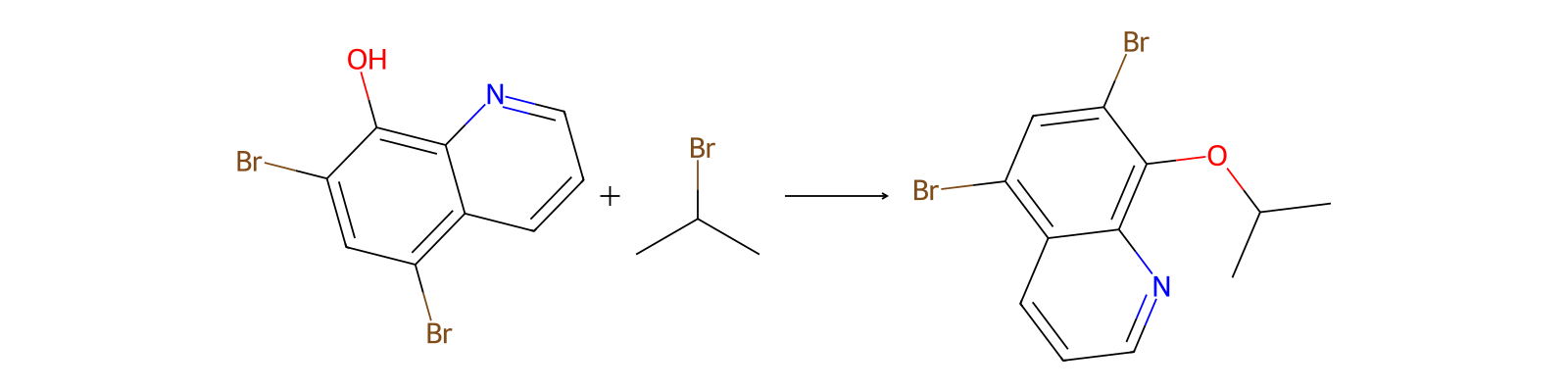
HRID 281040 reaction equation
HRID 281040As reactant
HRID 623404 reaction equation
HRID 623404As reactant
HRID 872227 reaction equation
HRID 872227As reactant
HRID 1137945 reaction equation
HRID 1137945As reactant
HRID 1371256 reaction equation
HRID 1371256As reactant
HRID 1436952 reaction equation
HRID 1436952As reactant
HRID 1556578 reaction equation
HRID 1556578As reactant
HRID 1754089 reaction equation
HRID 1754089As reactant
PreviousPage 1 of 2

Compound notes

On this pageBasic informationOverviewNames & identifiersPropertiesSafety & regulationChemistry & industryRelated reactionsCompound notes
Merck
14 · 14,1453
BRN
153624 · 153624
CAS DataBase Reference
521 · 521-74-4(CAS DataBase Reference)
EWG's Food Scores
1 · 1
FDA UNII
4 C618C8T · UK4C618C8T
ATC code
7 AX01,G01AC06,P01AA01 · A07AX01,G01AC06,P01AA01
EPA Substance Registry System
Broxyquinoline (521-74-4)
Symbol(GHS)
7 · GHS07
Signal word
Warning
Hazard statements
335 · H335-H315-H319
Precautionary statements
264 · P264-P280-P302+P352+P332+P313+P362+P364-P305+P351+P338+P337+P313-P261-P280a-P304+P340-P305+P351+P338-P405-P501a
Hazard Codes
Xi
Risk Statements
36 · 36/37/38
Safety Statements
26 · 26-36
WGK Germany
2 · 2
RTECS
5300000 · VC5300000
F
8 · 8
TSCA
TSCA listed
HS Code
2933490090 · 2933490090
Exposure RoutesOral (L626) ; inhalation (L626) ; dermal (L626)
Toxicity Summary · 1 item

Bromine is a powerful oxidizing agent and is able to release oxygen free radicals from the water in mucous membranes. These free radicals are also potent oxidizers and produce tissue damage. In additon, the formation of hydrobromic and bromic acids will result in secondary irritation. The bromide ion is also known to affect the central nervous system, causing bromism. This is believed to be a result of bromide ions substituting for chloride ions in the in actions of neurotransmitters and transport systems, thus affecting numerous synaptic processes. (L626, L627, A543)

Signs and Symptoms · 1 item

Bromine vapour causes irritation and direct damage to the mucous membranes. Symptoms include lacrimation, rhinorrhoea, eye irritation with mucous secretions from the oropharyngeal and upper airways, coughing, dyspnoea, choking, wheezing, epistaxis, and headache. The bromide ion is a central nervous system depressant producing ataxia, slurred speech, tremor, nausea, vomiting, lethargy, dizziness, visual disturbances, unsteadiness, headaches, impaired memory and concentration, disorientation and hallucinations. This is called bromism. (L626, L627)

Carcinogen ClassificationNo indication of carcinogenicity to humans (not listed by IARC).

Safety data

F
8
wgk
2
tsca
TSCA listed
rtecs
VC5300000
hs_code
2933490090
risk_code
36/37/38
Signal word
Warning
Symbol(GHS)
GHS07
hazard_code
Xi
safety_code
26-36
Hazard statements
H335-H315-H319
Precautionary statements
P264-P280-P302+P352+P332+P313+P362+P364-P305+P351+P338+P337+P313-P261-P280a-P304+P340-P305+P351+P338-P405-P501a
5-bromoquinolin-8-ol
5,7-dibromo-8-benzyloxyquinoline

Additional notes

DefinitionChEBI: 5,7-dibromo-8-quinolinol is a member of quinolines and an organohalogen compound.