HomeMCPWorkbenchSkills
HomeWorkbenchNotificationsMe
llms.txt · MCP GuidePrivacy Policy · Terms of Service · Supportv1.8.0
  1. Home
  2. /Compound

Sodium amide

HCID 24533
New noteNew reactionRequest quotes
Print preview

Completing data — refresh the page later to see the latest
Basic informationOverviewNames & identifiersPropertiesSafety & regulationChemistry & industryRelated reactionsCompound notes
Substructure searchFind similar structures

Basic information

CAS
7782-92-5
Standard SMILES
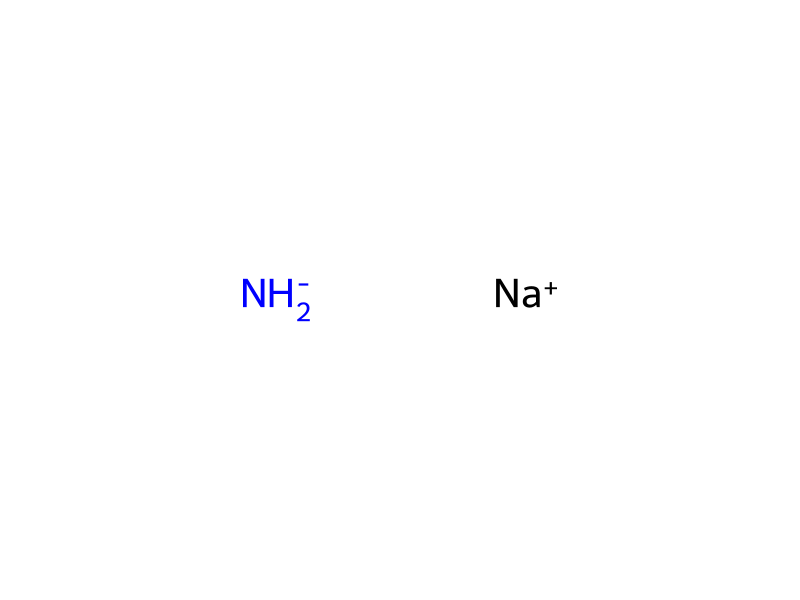
[NH2-].[Na+]
InChIKey
ODZPKZBBUMBTMG-UHFFFAOYSA-N
Molecular formula
H2NNa
Average molar mass
39.013 g/mol
Monoisotopic mass
39.00849334

Overview

Sodium amide is an odorless colorless solid. Denser than water.

Names & identifiers

Preferred name
Sodium amide
IUPAC
sodium azanide
English name
Sodium amide
Molecular formula
H2NNa
Molecular weight
39.01

Names & synonyms

SODIUM AMIDE7782-92-5Sodamidesodium azanideSodium amide (Na(NH2))5DB3G6PX9DHSDB 692EINECS 231-971-0NaNH2EC 231-971-0SODIUM AMIDE [MI]SODIUM AMIDE [HSDB]
Show more names
m amideNatriumamidAminosodiumSodium aminoSodiumamide,94%SODIUM AMIDE 95%Sodium amide (8CI)
DTXSID2064816CHEBI:176791RefChem:887257DTXCID9048017UN1390231-971-0sodium;azanideUNII-5DB3G6PX9D

Database identifiers

CAS
7782-92-5
PubChem CID
24533
DTXSID
DTXSID2064816
ChEBI
CHEBI:176791
UNII
5DB3G6PX9D
EC Number
231-971-0
Nikkaji
J1.296C

Properties

Computed structural propertiesFilling in

Topological polar surface area
1 Ų
Hydrogen bond donors
1
Hydrogen bond acceptors
1
Rotatable bonds
0
Heavy atoms
2
Formal charge
0
Complexity
2

Experimental & physicochemical properties

Chemical ClassesNitrogen Compounds -> Other Nitrogen Compounds
OdorAMMONIA ODOR
Density · 2 items

1.39 at 68 °F (USCG, 1999) - Denser than water; will sink

1.39 @ 20 °C

Color/FormWHITE CRYSTALLINE POWDER
Solubility · 2 items

SOLUBILITY IN LIQ AMMONIA AT 20 °C= ABOUT 0.1%

Soluble in water; insoluble in alcohol.

Boiling Point · 2 items

752 °F at 760 mmHg (USCG, 1999)

400 °C

Melting Point · 2 items

410 °F (USCG, 1999)

210 °C

Physical Description · 2 items

Sodium amide is an odorless colorless solid. Denser than water.

Solid; Commercial form is white to olive-green; Quickly absorbs water and carbon dioxide from atmosphere; [Merck Index] White solid with an odor of ammonia; [Hawley] Grey powder or granules with an ammoniacal odor; [Alfa Aesar MSDS]

Safety & regulation

Safety information is for reference only and does not replace the supplier’s Safety Data Sheet (SDS), applicable regulations, or professional assessment.

GHS classification

GHS Classification · 4 items

Danger

H260 (42.1%): In contact with water releases flammable gases which may ignite spontaneously [Danger Substances and mixtures which in contact with water, emit flammable gases]

P223, P231+P232, P260, P264, P264+P265, P273, P280, P301+P330+P331, P302+P335+P334, P302+P361+P354, P304+P340, P305+P354+P338, P316, P317, P321, P363, P370+P378, P391, P402+P404, P405, and P501 (click each P-code to see the statement)

Aggregated GHS information provided per 297 reports by companies from 17 notifications to the ECHA C&L Inventory. Each notification may be associated with multiple companies.

Hazard information

Regulatory Information · 3 items

Chemical: Sodium amide (Na(NH2))

Status: Active Update: 25-10-2022 https://echa.europa.eu/registration-dossier/-/registered-dossier/11165

Sodium amide: HSNO Approval: HSR004679 Approved with controls

DOT LabelDangerous When Wet
Fire HazardsSpecial Hazards of Combustion Products: Toxic and irritating ammonia gas may be formed. (USCG, 1999)
Fire Potential · 2 items

FLAMMABLE, DANGEROUS FIRE RISK.

The reduction with 1,1-diethoxy-2-chloroethane in the presence of ammonia produces sodium ethoxyacetylide, which is extremely pyrophoric. Sodium amide reacts violently with water and frequently bursts into flame.

Health HazardsAmmonia gas formed by reaction of solid with moisture irritates eyes and skin. Solid causes caustic burns of eyes and skin. Ingestion burns mouth and stomach in same way as caustic soda and may cause perforation of tissue. (USCG, 1999)
Hazards Summary

Chemistry & industry

Uses & manufacturing

Uses · 2 items

Used as a dehydrating agent, in ammonolysis reactions, in Claisen condensations, and for alkylation of nitriles and ketones; Also used to make indigo, hydrazine, ethynyl compounds, acetylenic carbinols, and sodium cyanide; [Merck Index]

DEHYDRATING AGENT; PRODN OF INDIGO & HYDRAZINE; INTERMEDIATE IN PREPN OF SODIUM CYANIDE; IN AMMONOLYSIS REACTIONS; IN CLAISEN CONDENSATIONS, ALKYLATION OF NITRILES & KETONES, SYNTH OF ETHYNYL CMPD, ACETYLENIC CARBINOLS

Methods of Manufacturing · 2 items

PREPARED FROM SODIUM METAL & GASEOUS AMMONIA (OR LIQ AMMONIA WITH FERRIC NITRATE CATALYST): DENNIS, BROWNE, INORG SYN 1, 74 (1939); GREENLEE, HENNE, INORG SYN 2, 128 (1946). ...ALTERNATE METHOD: BERGSTROM, ORG SYN, COLL VOL III, 778 (1955).

DRY AMMONIA GAS IS PASSED OVER METALLIC SODIUM @ 350 °C.

Formulations/PreparationsGRADES OR PURITY: PURE; TECHNICAL
General Manufacturing InformationSodium amide (Na(NH2)): ACTIVE
Applications · 5 items

Uses1. It can be used as the condensation accelerator in organic chemical reactions. It is raw material in synthesis of vitamin A. It can be also used as dehydrating agent, dehalogenating agent, alkylating agent, ammoniated agent. In liquid ammonia, the dissociation of NHf in liquid ammonia can be used as initiator of anionic polymerization producting polyvinyl chloride ion. It is also used in the manufacture azides, cyanide, hydrazine, and indigo. 2. It can be used as condensation-accelerating agent in organic synthesis, dehydration and the like. The above information is edited by the chemicalbook of Wang Xiaodong.

UsesSodium Amide is widely used in organic chemical synthesis as a strong base in reactions such as in the preparation of phenylacetylene from 1,2-dibromophenylethane. Also used in the synthesis of 2,6-diamination of substituted pyridines as initiator of heterogeneous chichibabin reaction.

Dehydrating agent. In the production of indigo and hydrazine. Intermediate in the preparation of sodium cyanide. In ammonolysis reactions, in Claisen condensations, alkylation of nitriles and ketones, synthesis of ethynyl Compounds, acetylenic carbinols. Fused NaNH2 dissolves metallic Mg, Zn, Mo, W, quartz, glass, silicates and other substances.

Related reactions

478 records
New reaction record
HRID 4351 reaction equation
HRID 4351As reactantuspto-grants-1988_02
HRID 4509 reaction equation
HRID 4509As reactantuspto-grants-1988_02
HRID 4779 reaction equation
HRID 4779As reactantuspto-grants-1988_02
HRID 5592 reaction equation
HRID 5592As reactantuspto-grants-1993_09
HRID 5600 reaction equation
HRID 5600As reactantuspto-grants-1993_09
HRID 26007 reaction equation
HRID 26007As reactantuspto-grants-1979_04
HRID 26482 reaction equation
HRID 26482As reactantuspto-grants-1979_04
HRID 26568 reaction equation
HRID 26568As reactantuspto-grants-1979_04
Page 1 of 60

Compound notes

Loading…

On this pageBasic informationOverviewNames & identifiersPropertiesSafety & regulationChemistry & industryRelated reactionsCompound notes
More actions
New noteNew reactionRequest quotes
Other Experimental Properties · 3 items

BEGINS TO VOLATILIZE @ 400 °C & DECOMP INTO ITS ELEMENTS BETWEEN 500 & 600 °C; HEAT OF FORMATION (FOR SOLID) @ 18 °C & 1 ATM: -32.26 KCAL/MOLE; HEAT OF SOLN: -31.06 KCAL/MOLE @ 21 °C. ... FUSED NaNH2 DISSOLVES METALLIC MAGNESIUM, ZINC, MOLYBDENUM, TUNGSTEN, QUARTZ, GLASS, SILICATES & OTHER SUBSTANCES.

DECOMP IN WATER & ALCOHOL

WHITE TO OLIVE-GREEN SOLID WITH SEA-SHELL FRACTURE /COMMERCIAL PRODUCT/

Physicochemical properties

Melting point
210 °C · 210 °C (lit.)
Boiling point
400 °C · 400 °C (lit.)
Density
1.39 g/cm3 · 1.39 g/cm3 (25℃)
Flash point
85 °F · 85 °F
storage temp.
30 °C · Store below +30°C.
solubility
2 O · reacts with H2O
form
crystalline
color
Greyish white powder
Odor
Ammonia like
Water Solubility
REACTS VERY VIOLENTLY, EVEN EXPLOSIVELY
Specific Heat Capacity
1.7 J/ · Cp(crystal): 1.7 J/(g·K), at 25℃
Sensitive
Air & Moisture Sensitive
Merck
14 · 14,8576
Stability
Stability Flammable. Reacts violently with water producing very toxic fumes. In case of fire do not use water, but instead smother with soda ash. May form explosive peroxides if heated, or if stored for extended periods in contact with air or oxygen. Incompatible with water and aqueous solutions, carbon dioxide, halogenated hydrocarbo
InChI
1S/H2N.Na/h1H2;/q-1;+1
InChIKey
ODZPKZBBUMBTMG-UHFFFAOYSA-N
SMILES
N[Na]
CAS DataBase Reference
7782 · 7782-92-5(CAS DataBase Reference)
FDA UNII
5 DB3G6PX9D · 5DB3G6PX9D
EPA Substance Registry System
Sodium amide (Na(NH2)) (7782-92-5)
UNSPSC Code
26111700 · 26111700
NACRES
23 · NA.23
Symbol(GHS)
2 · GHS02,GHS05,GHS07,GHS08
Signal word
Danger
Hazard statements
225 · H225-H261-H304-H314-H336-H361d-H373-H412
Precautionary statements
210 · P210-P231+P232-P280-P301+P330+P331-P303+P361+P353-P304+P340+P310-P305+P351+P338
PPE
3 · Eyeshields, Faceshields, Gloves, type P3 (EN 143) respirator cartridges
Hazard Codes
F,C,Xi,N
Risk Statements
14 · 14/15-19-34-20/21-10-67-65-63-48/20-11-36/37-15/29-14-50-29
Safety Statements
26 · 26-43-45-62-7/8-43D-36/37/39-27-16-61
RIDADR
3129 · UN 3129 4.3/PG 2
WGK Germany
2 · 2
F
3 · 3-10-23
Autoignition Temperature
450 °C · 450 °C
TSCA
TSCA listed
HS Code
2853 · 2853 90 90
HazardClass
4.3 · 4.3
PackingGroup
II
Storage Class
4.3 · 4.3 - Hazardous materials which set free flammable gases upon contact with water
Hazard Classifications
3 Eye · Aquatic Chronic 3Eye Dam. 1Skin Corr. 1BWater-react 2
Hazardous Substances Data
7782 · 7782-92-5(Hazardous Substances Data)
REACH Registrations
Active
Limited Quantities
0.5 Kg · 0.5 Kg (1.1 lbs) (solid)
Excepted Quantities
Max Inner Pack (30g or 30ml) and Max Outer Pack (500g or 500ml)
· 1 item

Emergency treatment: Corrosives- alkaline; [HSDB] Reacts violently with water producing sodium hydroxide and ammonia; Oxidation products after air exposure may be highly explosive; A severe skin, eye, and mucous membrane irritant; [Merck Index] A strong reducing agent; An explosive peroxide may be produced on storage; May cause caustic burns to skin and eyes; [CAMEO] Reacts violently with water evolving highly flammable gases; Explosive on contact with oxidizing substances; A highly corrosive substance that can cause injury to the skin, eyes, and respiratory tract; Inhalation may cause chemical pneumonitis; [Alfa Aesar MSDS]

Reactive GroupBases, Strong
Reactivity AlertsHighly Flammable
Reactivity Profile · 1 item

SODIUM AMIDE is a powerful reducing agent. Reacts violently with oxidizing agents. Reacts violently with steam and water to form caustic NaOH and NH3 vapors [Bergstrom et al., Chem. Reviews, 12:6 1932]. May form explosive compounds in the presence of water and carbon dioxide [Handling Chemicals Safely 1980 p 826]. Liable to deflagration upon heating and friction. Forms an explosive peroxide on storage. When sodium amide and chromic anhydride are mixed together a vigorous reaction results; the same occurs with other oxidizing agents including dinitrogen tetraoxide, potassium chlorate, sodium nitrite. [Mellor 11:234 1946-47]. Reaction with 1,1-diethoxy-2- chloroethane produces sodium ethoxyacetylide, which is extremely pyrophoric [Rutledge 1968 p. 35]. Reactions with halogenated hydrocarbons may be violently explosive. Sodium amide forms toxic and flammable H2S gas with CS2. (714).

Air and Water ReactionsHighly flammable. Reacts violently with water and bursts into flame.
Peroxide Forming Chemical · 3 items

Sodium amide

A: Compounds that form explosive levels of peroxides without concentration

Clark

Hazard Classes and CategoriesWater-react. 1 (42.1%)

Safety & protection

Fire FightingFire Extinguishing Agents Not to Be Used: Water
First AidINGESTION: give water or milk followed by dilute vinegar or fruit juice; do NOT induce vomiting; call a doctor.
Fire Fighting ProceduresDRY SODA ASH, GRAPHITE, SALT, OR OTHER RECOMMENDED DRY POWDER, SUCH AS DRY LIMESTONE.
Storage Conditions · 2 items

SEALED CONTAINERS MUST BE STORED IN WELL-VENTILATED AREA.

SHOULD BE STORED IN SEALED CONTAINERS WHICH PREVENT ALL CONTACT WITH AIR DURING STORAGE ...

Nonfire Spill ResponseNeutralizing Agents for Acids and Caustics: Caustic solution formed by reaction with water can be diluted with water and/or neutralized by acetic acid. (USCG, 1999)
Isolation and EvacuationExcerpt from ERG Guide 139 [Substances - Water-Reactive (Emitting Flammable and Toxic Gases)]:
Personal Protective Equipment (PPE) · 2 items

Goggles or face shield; dust respirator; rubber gloves and shoes. (USCG, 1999)

GOGGLES OR FACE SHIELD; DUST RESPIRATOR; RUBBER GLOVES AND SHOES.

Toxicology

Adverse EffectsDermatotoxin - Skin burns.

Safety data

F
3-10-23
PPE
Eyeshields, Faceshields, Gloves, type P3 (EN 143) respirator cartridges
wgk
2
tsca
TSCA listed
ridadr
UN 3129 4.3/PG 2
hs_code
2853 90 90
risk_code
14/15-19-34-20/21-10-67-65-63-48/20-11-36/37-15/29-14-50-29
Signal word
Danger
Symbol(GHS)
GHS02,GHS05,GHS07,GHS08
hazard_code
F,C,Xi,N
safety_code
26-43-45-62-7/8-43D-36/37/39-27-16-61
hazard_class
4.3
Storage Class
4.3 - Hazardous materials which set free flammable gases upon contact with water
packing_group
II
Hazard statements
H225-H261-H304-H314-H336-H361d-H373-H412
Limited Quantities
0.5 Kg (1.1 lbs) (solid)
Excepted Quantities
Max Inner Pack (30g or 30ml) and Max Outer Pack (500g or 500ml)
REACH Registrations
Active
Hazard Classifications
Aquatic Chronic 3Eye Dam. 1Skin Corr. 1BWater-react 2
Autoignition Temperature
450 °C
Precautionary statements
P210-P231+P232-P280-P301+P330+P331-P303+P361+P353-P304+P340+P310-P305+P351+P338
Hazardous Substances Data
7782-92-5(Hazardous Substances Data)
Uses

UsesReagent for: Synthesis of allylic amines and amides1 Synthesis of antibacterials2 Aggregative activation and heterocyclic chemistry3 Phenylation with diphenyliodonium chloride4

General DescriptionOdorless colorless solid. Denser than water.

Preparation methods · 1 item

PreparationSodium amide is prepared by passing dry ammonia gas over sodium metal at 350°C: 2Na + 2NH3 → 2NaNH2 + H2Also, it may be prepared by reacting sodium metal with liquid ammonia in the presence of a catalyst such as iron(III) nitrate. The compound must be stored in well-sealed containers free from air or moisture.

Upstream & downstream products

Upstream raw materials

SodiumHydrogenAmmonia

Downstream products

cis-6-Nonen-1-ol1-ethynyl-2-methyl penten-2-oldiethyl [[(6-methyl-2-pyridyl)amino]methylene]malonate2-Amino-4-ethylpyridineEthyl 4-pyridylacetate2-Methylindole3-(o-chlorophenyl)-3-hydroxy-3-phenylpropiononitrileethyl 4-hydroxy-7-methyl-1,8-naphthyridine-3-carboxylate4-Phenyl-pyridin-2-ylamineACETOPHENAZINE MALEATE (200 MG)MeclozineAprindine2-Amino-4,6-dimethylpyridineNORMEPERIDINEFmoc-2-aminonicotinic acid3-(p-Chlorophenyl)-3-(2-pyridyl)propylaldehyde diethyl acetalBEPRIDIL4-Bromo-2,2-diphenylbutyric acid4-Cyano-4-phenylpiperidine hydrochloride(1-phenylcyclopropyl)methanamineSetastine2-PyridinepropanolFEMA 3082Cyclohexylphenylacetonitrile4-phenyl-1-(p-tolylsulphonyl)piperidine-4-carboxylic acidalpha,alpha-Diphenyl-gamma-butyrolactoneLoperamide2-Amino-3,5-dichloro-4,6-dimethyl pyridine(1-Hydroxy-cyclohexyl)-acetonitrilePigment Yellow 1393-Cyclohexyl-1-propynePyridine-4-acetic acid2,6-Diamino-4-methyl pyridine2,6-Dimethyl-3,5-heptanedione3-Propylisoxazol-5-amineEthyl 3-methyl-3-phenylglycidate4-Propyl-pyridin-2-ylamine4-Phenylpiperidine6-Chloro-4-methoxy-pyridine-2-carboxylic acid1-methyl-4-phenylpiperidine-4-carbonitrile
Additional notes · 1 item

DefinitionA white ionic solid formed by passing dry ammonia over sodium at 300–400°C. The compound reacts with water to give sodium hydroxide and ammonia. It reacts with red-hot carbon to form sodium cyanide and with nitrogen(I) oxide to form sodium azide. Sodamide is used in the Castner process and in the explosives industry.