Basic information
- CAS
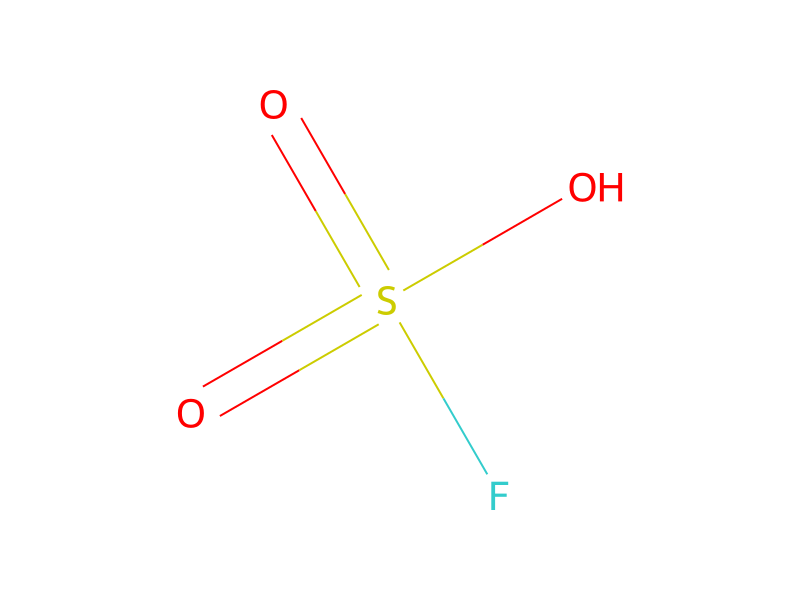
7789-21-1- Standard SMILES
O=S(=O)(O)F- InChIKey
UQSQSQZYBQSBJZ-UHFFFAOYSA-N- Molecular formula
- FHO3S
- Average molar mass
- 100.07 g/mol
- Monoisotopic mass
- 99.96304311
Overview
Fluorosulfonic acid appears as a fuming liquid. Boiling point 163 °C. Density 1.73 g / cm3. Corrosive to metals and to tissue. Both very short contact and the fumes can cause severe painful burns. Used as a catalyst in organic synthesis, in electroplating and as a fluorinating agent.
Names & identifiers
- Preferred name
- Fluorosulfuric acid
- IUPAC
- sulfurofluoridic acid
- English name
- Fluorosulfonic acid
- Molecular formula
- FHO3S
- Molecular weight
- 100.07
Names & synonyms
Fluorosulfonic acidFluorosulfuric acid7789-21-1Fluosulfuric acidMonofluorosulfuric acidFLUOSULFONIC ACIDFluorosulfuric acid (HSO3F)Fluorosulphonic acidDTXSID3033511PPX0648643DTXCID1013511RefChem:140969
Show more names
HSO3FfluorosulfonicFluorsulfonsureNcgc00091007-01fluosulfuricacidFluorosulforic Acid
232-149-4sulfurofluoridic acidFluorosulphuric acidHSDB 467EINECS 232-149-4UN1777UNII-PPX0648643MFCD00066174
Database identifiers
- CAS
7789-21-1- PubChem CID
- 24603
- DTXSID
DTXSID3033511- ChEMBL
CHEMBL1207889- ChEBI
CHEBI:193136- UNII
- PPX0648643
- EC Number
- 232-149-4
- Nikkaji
- J95.177C
Properties
Computed structural properties
- XLogP
- -0.3
- Topological polar surface area
- 62.8 Ų
- Hydrogen bond donors
- 1
- Hydrogen bond acceptors
- 4
- Rotatable bonds
- 0
- Heavy atoms
- 5
- Formal charge
- 0
- Complexity
- 92.6
Experimental & physicochemical properties
Chemical Classes
Other Classes -> Organic Acids
Corrosives
pHCONSIDERABLY MORE ACIDIC THAN CONCN H2SO4
Density
1.73 at 77 °F (USCG, 1999) - Denser than water; will sink
1.726 AT 25 °C/4 °C
Relative density (water = 1): 1.7
1.726 @25 °C
Color/FormCOLORLESS LIQUID; REDDISH-BROWN COLOR WITH ACETONE
Solubility
SOL IN NITROBENZENE
Solubility in water: reaction
CorrosivityHIGHLY CORROSIVE
Boiling Point
324.9 °F at 760 mmHg (USCG, 1999)
163 °C @ 760 MM HG
FORMS STABLE SALTS WHICH ARE LITTLE HYDROLYZED BY WATER & WHICH MAY BE RECRYSTALLIZED FROM WATER; BP: 110 °C AT 120 MM HG; 77.0 °C @ 18 MM HG
163 °C
163 °C @760 [mm Hg]
DecompositionSEE FLUOSULFONATES. ...WHEN HEATED TO DECOMPOSITION, THEY EMIT HIGHLY TOXIC FUMES OF FLUORIDES AND OXIDES OF SULFUR. ... /FLUOSULFONATES/
Safety & regulation
GHS classification
GHS Classification
Danger
H314: Causes severe skin burns and eye damage [Danger Skin corrosion/irritation]
P260, P261, P264, P271, P280, P301+P330+P331, P302+P361+P354, P304+P340, P305+P354+P338, P316, P317, P321, P363, P405, and P501 (click each P-code to see the statement)
Danger
H314 (100%): Causes severe skin burns and eye damage [Danger Skin corrosion/irritation]
P260, P261, P264, P264+P265, P271, P280, P301+P330+P331, P302+P361+P354, P304+P340, P305+P354+P338, P316, P317, P321, P363, P405, and P501 (click each P-code to see the statement)
Hazard information
Hazards IdentificationWater-reactive material (WR)
Regulatory Information
Chemical: Fluorosulfuric acid
Fluorosulfuric acid is listed on the EPA's Chemical Data Reporting (CDR) system. Manufacturers and importers of Fluorosulfuric acid are required to report information about their production and use of this chemical to the EPA under the Toxic Substances Control Act (TSCA). (40 eCFR Part 711)
Status: Active Update: 01-12-2021 https://echa.europa.eu/registration-dossier/-/registered-dossier/1784
The New Jersey Worker and Community Right to Know Act requires public and private employers to provide information about hazardous substances at their workplaces. (N.J.S.A. 34:5A-1 et. seq.)
DOT LabelCorrosive
Fire Hazards
Special Hazards of Combustion Products: Toxic and irritating fumes of hydrogen fluoride and sulfuric acid may form in fires.
· EXCEPT FOR ACETIC ANHYDRIDE (UN1715), THAT IS FLAMMABLE, some of these materials may burn, but none ignite readily.
Not combustible but enhances combustion of other substances. Gives off irritating or toxic fumes (or gases) in a fire.
Health Hazards
Inhalation of fumes causes severe irritation of nose and throat. Contact of liquid with eyes or skin causes very severe burns of mouth and stomach. (USCG, 1999)
Chemistry & industry
Uses & manufacturing
Uses
Used in the chemical industry as a fluorinating agent and catalyst; Used in electropolishing; [HSDB]
Toxic Gas from Spilling Chemical in Water [Category: Other]
FLUORINATING AGENT; CATALYST IN ALKYLATION, ACYLATION, POLYMERIZATION & CONDENSATION REACTIONS; IN HYDROFLUORINATION OF OLEFINS; IN PRODN OF SUBSTITUTED PYRIDINES; IN PRODN OF PETROLEUM PRODUCTS; PREPN OF MAGIC ACID
IN ELECTROPOLISHING
U.S. Production2020: 1,000,000 - <5,000,000 lb
Methods of Manufacturing
THORPE, KIRMAN, J CHEM SOC 61: 921 (1892); MEYER, SCHRAMM, Z ANORG ALLGEM CHEM 206: 25 (1932); KWASNIK IN HANDBOOK OF PREPARATIVE INORG CHEM, VOL 1, G BRAUER, ED (ACADEMIC PRESS, NEW YORK, 2ND ED, 1963) PP 177.
REACTION OF ANHYDROUS HYDROGEN FLUORIDE WITH SULFURIC ACID ANHYDRIDE.
General Manufacturing InformationFluorosulfuric acid: ACTIVE
Applications
DescriptionFluorosulphuric acid (FSO3H) is a free-flowing colourless fuming liquid. It is soluble in polar organic solvents such as acetic acid, ethyl acetate, and nitrobenzene but poorly soluble in nonpolar solvents such as alkanes. FSO3H is corrosive to metals and body tissues, corrodes glass, and is incompatible with many metals and bases. With its strong acidity, FSO3H dissolves almost all organic compounds that are even weak proton acceptors. FSO3H hydrolyses slowly to HF and sulphuric acid (H2SO4). The related triflic acid (CF3SO3H) retains the high acidity of FSO3H but is more hydrolytically stable. FSO3H is one of the strongest known simple Bronsted acids. FSO3H is useful for regenerating mixtures of HF and H2SO4 for etching lead glass. FSO3H isomerises alkanes and the alkylation of hydrocarbons with alkenes, although it is unclear if such applications are of commercial importance. FSO3H is used as a catalyst in organic synthesis and in electroplating and as a fluorinating agent and as a laboratory fluorinating agent. FSO3H has been reported as a highly toxic and corrosive chemical substance. FSO3H is non-combustible but enhances combustion of other substances. It gives off irritating or toxic fumes (or gases) in a fire. FSO3H hydrolyses to release HF. Addition of water to FSO3H causes very violent reactions similar to the addition of water to H2SO4. Addition of FSO3H to water is a much more violent process than addition of H2SO4. The combination of FSO3H and others is categorised as ‘magic acids and super acids’. Very short contact and the fumes of FSO3H cause severe painful burns.
Related reactions
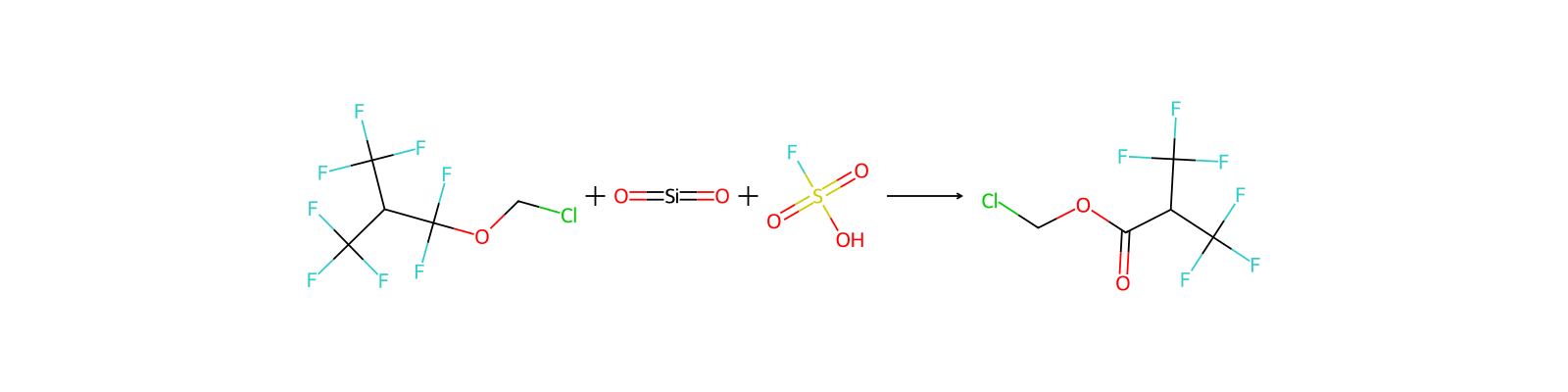
41 records


Compound notes
Loading…