HomeMCPWorkbenchSkills
HomeWorkbenchNotificationsMe
llms.txt · MCP GuidePrivacy Policy · Terms of Service · Supportv1.8.3
  1. Home
  2. /Compound

Stannane, tetrabromo-

HCID 24616
New reaction
Print
Basic informationOverviewNames & identifiersPropertiesSafety & regulationChemistry & industryRelated reactionsCompound notes
Substructure searchFind similar structures

Basic information

CAS
7789-67-5
Standard SMILES
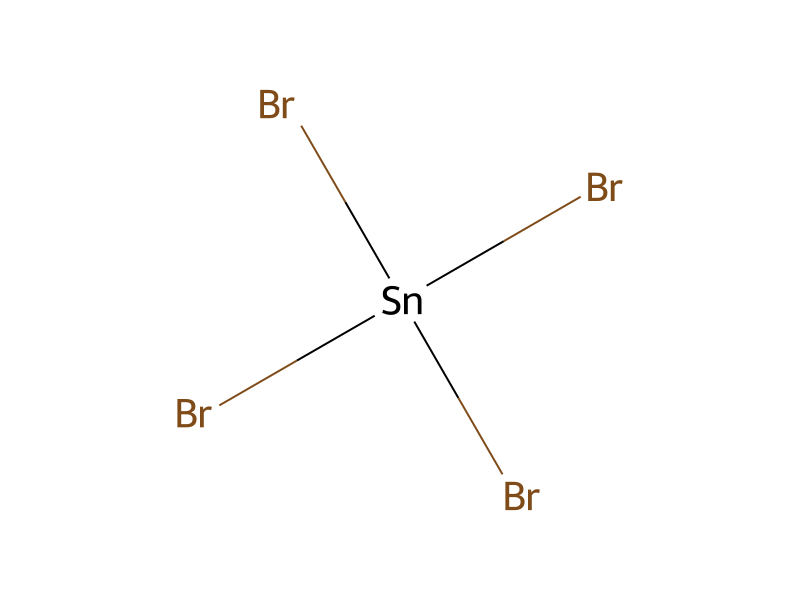
[Br][Sn]([Br])([Br])[Br]
InChIKey
LTSUHJWLSNQKIP-UHFFFAOYSA-J
Molecular formula
Br4Sn
Average molar mass
438.33 g/mol
Monoisotopic mass
435.57555

Overview

Tin(IV) bromide is a bromide of tin. Tin is a chemical element with the symbol Sn and atomic number 50. It is a natural component of the earth's crust and is obtained chiefly from the mineral cassiterite, where it occurs as tin dioxide. Bromine is a halogen element with the symbol Br and atomic number 35. Diatomic bromine does not occur naturally, but bromine salts can be found in crustal rock. (L625, L307, L309)

Names & identifiers

Preferred name
Stannane, tetrabromo-
IUPAC
tetrabromostannane
English name
TIN(IV) BROMIDE
Molecular formula
Br4Sn
Molecular weight
438.32

Names & synonyms

Tin(IV) bromideTin tetrabromideStannane, tetrabromo-7789-67-5Stannic bromideTin perbromideTIN(IV) BROMIDE (1:4)23C21BW281DTXSID1064873RefChem:1181146232-184-5Tetrabromostannane
Show more names
TIN BROMIDEtinperbromidetetrabromo-stannan
SnBr4EINECS 232-184-5Tin (IV) bromideUNII-23C21BW281TetrabromotinTin bromide (SnBr4)Stannic tetrabromidetin-(IV)-bromide

Database identifiers

CAS
7789-67-5
PubChem CID
24616
DTXSID
DTXSID1064873
UNII
23C21BW281
EC Number
232-184-5

Properties

Computed structural properties

Topological polar surface area
0 Ų
Hydrogen bond donors
0
Hydrogen bond acceptors
0
Rotatable bonds
0
Heavy atoms
5
Formal charge
0
Complexity
19.1

Experimental & physicochemical properties

Chemical ClassesMetals -> Metals, Inorganic Compounds
Physical DescriptionWhite solid; Fumes in air; mp = 31 deg C; [Merck Index] Colorless crystals; [Aldrich MSDS]

Physicochemical properties

Melting point
31 °C · 31 °C(lit.)
Boiling point
202 °C · 202 °C(lit.)
Density
3.34 g/mL · 3.34 g/mL at 25 °C(lit.)
Flash point
202 °C/734mm · 202°C/734mm
solubility
2 O; · very soluble in H2O; soluble in ethanol
form
Lumps
Specific Gravity
3.34 · 3.34
color
Colorless to white
Water Solubility
Very soluble in water. Soluble in ethyl alcohol.
Specific Heat Capacity
0.24 J/ · Cp(gas): 0.24 J/(g·K), at 25℃
Sensitive

Safety & regulation

Safety information is for reference only and does not replace the supplier’s Safety Data Sheet (SDS), applicable regulations, or professional assessment.

GHS classification

GHS Classification · 4 items

Danger

H314 (100%): Causes severe skin burns and eye damage [Danger Skin corrosion/irritation]

P260, P261, P264, P271, P280, P301+P330+P331, P302+P361+P354, P304+P340, P305+P354+P338, P316, P319, P321, P363, P403+P233, P405, and P501 (click each P-code to see the statement)

Aggregated GHS information provided per 43 reports by companies from 3 notifications to the ECHA C&L Inventory. Each notification may be associated with multiple companies.

Hazard information

Regulatory Information · 2 items

Chemical: Stannane, tetrabromo-

Stannane, tetrabromo-: Does not have an individual approval but may be used under an appropriate group standard

Hazards SummaryA skin and eye irritant; [Hawley] See Bromine.
Hazard Classes and CategoriesSkin Corr. 1B (100%)

Safety & protection

Threshold Limit Values (TLV)2.0 [mg/m3], as Sn
Permissible Exposure Limit (PEL)2.0 [mg/m3], as Sn

Toxicology

Treatment · 1 item

EYES: irrigate opened eyes for several minutes under running water. INGESTION: do not induce vomiting. Rinse mouth with water (never give anything by mouth to an unconscious person). Seek immediate medical advice. SKIN: should be treated immediately by rinsing the affected parts in cold running water for at least 15 minutes, followed by thorough washing with soap and water. If necessary, the person should shower and change contaminated clothing and shoes, and then must seek medical attention. INHALATION: supply fresh air. If required provide artificial respiration.

Chemistry & industry

Pharmacology

Metabolism/Metabolites · 1 item

Though tin metal is very poorly absorbed, tin compounds may be absorbed via oral, inhalation, or dermal routes, with organotin compounds being much more readily absorbed than inorganic tin compounds. Tin may enter the bloodstream and bind to hemoglobin, where it is distributed and accumulates mainly in the kidney, liver, lung, and bone. Tin and its metabolites are excreted mainly in the urine and feces. Bromine is mainly absorbed via inhalation, but may also enter the body through dermal contact. Bromine salts can be ingested. Due to its reactivity, bromine quickly forms bromide and may be deposited in the tissues, displacing other halogens. (L626, L308)

Uses & manufacturing

Uses · 2 items

Used in metallurgy (separation of minerals); [Merck Index]

Metal Extraction and Refining [Category: Industry]

General Manufacturing InformationStannane, tetrabromo-: ACTIVE

Applications

UsesA specialty product for proteomics research. Used as a precursor for SnO2 through laser-assisted CVD with higher efficiency than other precursors such as dibutyl tin diacetate.

UsesIn metallurgical separation of minerals.

Upstream & downstream products

Downstream products

TetraallyltinARSENIC (III) BROMIDE

Related reactions

5 records
New reaction record
HRID 16725 reaction equation
HRID 16725As reactant
HRID 43229 reaction equation
HRID 43229As reactant
HRID 254606 reaction equation
HRID 254606As reactant
HRID 974377 reaction equation
HRID 974377As reactant
HRID 1093099 reaction equation
HRID 1093099As reactant

Compound notes

On this pageBasic informationOverviewNames & identifiersPropertiesSafety & regulationChemistry & industryRelated reactionsCompound notes
Air & Moisture Sensitive
Merck
14 · 14,8773
Exposure limits
2 mg/m3NIOSH: · ACGIH: TWA 2 mg/m3NIOSH: IDLH 100 mg/m3; TWA 2 mg/m3
InChI
1S/4BrH.Sn/h4*1H;/q;;;;+4/p-4
InChIKey
LTSUHJWLSNQKIP-UHFFFAOYSA-J
SMILES
Br[Sn](Br)(Br)Br
CAS DataBase Reference
7789 · 7789-67-5(CAS DataBase Reference)
EWG's Food Scores
1 · 1
FDA UNII
23 C21BW281 · 23C21BW281
EPA Substance Registry System
Stannane, tetrabromo- (7789-67-5)
UNSPSC Code
12161600 · 12161600
NACRES
22 · NA.22
Symbol(GHS)
5 · GHS05,GHS07
Signal word
Danger
Hazard statements
314 · H314-H335
Precautionary statements
260 · P260-P264-P280-P261-P271-P301+P330+P331-P303+P361+P353-P363-P304+P340-P310-P305+P351+P338-P312-P405-P403+P233-P501
target organs
Respiratory system
PPE
3 · Eyeshields, Faceshields, Gloves, type P3 (EN 143) respirator cartridges
Hazard Codes
C
Risk Statements
14 · 14-34-37
Safety Statements
26 · 26-36/37/39-45-7/8
RIDADR
3260 · UN 3260 8/PG 2
WGK Germany
3 · 3
RTECS
8300000 · XP8300000
F
1 · 1-10
TSCA
TSCA listed
HazardClass
8 · 8
PackingGroup
II
Storage Class
8 B · 8B - Non-combustible corrosive hazardous materials
Hazard Classifications
1 BSTOT · Skin Corr. 1BSTOT SE 3
Health Effects · 1 item

Ingestion of large amounts of inorganic tin compounds can cause stomachache, anemia, and liver and kidney problems. Bromine vapour causes irritation and direct damage to the mucous membranes. Elemental bromine also burns the skin. The bromide ion is a central nervous system depressant and chronic exposure produces neuronal effects. This is called bromism and can result in central reactions reaching from somnolence to coma, cachexia, exicosis, loss of reflexes or pathologic reflexes, clonic seizures, tremor, ataxia, loss of neural sensitivity, paresis, papillar edema of the eyes, abnormal speech, cerebral edema, delirium, aggressiveness, and psychoses. (L625, L626, L627, L307, L308)

Exposure RoutesOral (L308) ; inhalation (L308) ; dermal (L308)
Toxicity Summary · 1 item

Bromine is a powerful oxidizing agent and is able to release oxygen free radicals from the water in mucous membranes. These free radicals are also potent oxidizers and produce tissue damage. In additon, the formation of hydrobromic and bromic acids will result in secondary irritation. The bromide ion is also known to affect the central nervous system, causing bromism. This is believed to be a result of bromide ions substituting for chloride ions in the in actions of neurotransmitters and transport systems, thus affecting numerous synaptic processes. Inorganic and organic tin compounds are weak inhibitors of alcohol dehydrogenase. (A183, L626, L627, A543)

Signs and Symptoms · 1 item

Inorganic or organic tin compounds placed on the skin or in the eyes can produce skin and eye irritation. Bromine vapour causes irritation and direct damage to the mucous membranes. Symptoms include lacrimation, rhinorrhoea, eye irritation with mucous secretions from the oropharyngeal and upper airways, coughing, dyspnoea, choking, wheezing, epistaxis, and headache. The bromide ion is a central nervous system depressant producing ataxia, slurred speech, tremor, nausea, vomiting, lethargy, dizziness, visual disturbances, unsteadiness, headaches, impaired memory and concentration, disorientation and hallucinations. This is called bromism. (L626, L627, L308)

Carcinogen ClassificationNo indication of carcinogenicity to humans (not listed by IARC).

Safety data

F
1-10
PPE
Eyeshields, Faceshields, Gloves, type P3 (EN 143) respirator cartridges
wgk
3
tsca
TSCA listed
rtecs
XP8300000
ridadr
UN 3260 8/PG 2
risk_code
14-34-37
Signal word
Danger
Symbol(GHS)
GHS05,GHS07
hazard_code
C
safety_code
26-36/37/39-45-7/8
hazard_class
8
Storage Class
8B - Non-combustible corrosive hazardous materials
packing_group
II
target organs
Respiratory system
Hazard statements
H314-H335
Hazard Classifications
Skin Corr. 1BSTOT SE 3
Precautionary statements
P260-P264-P280-P261-P271-P301+P330+P331-P303+P361+P353-P363-P304+P340-P310-P305+P351+P338-P312-P405-P403+P233-P501