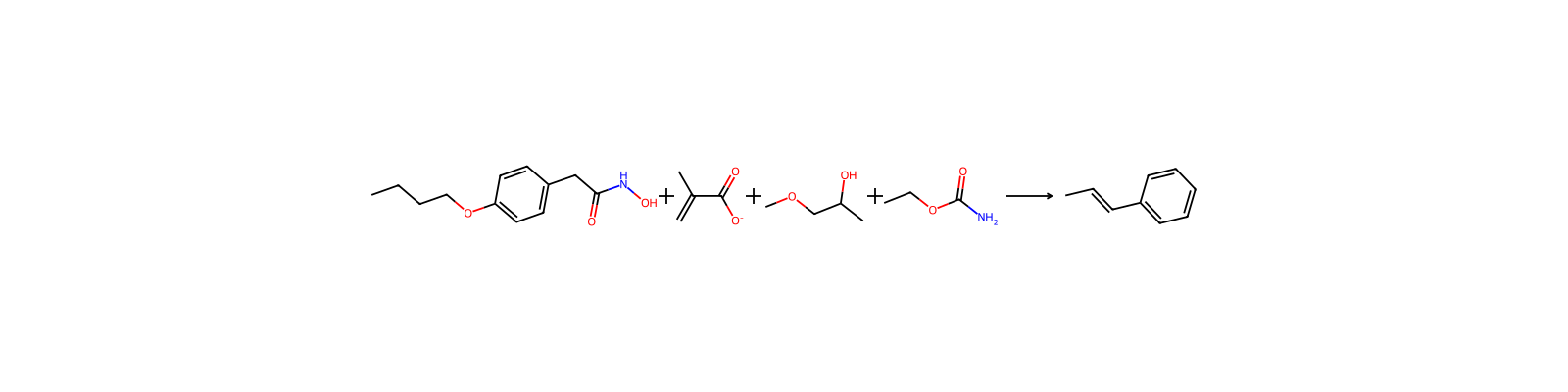

Basic information
- CAS
2438-72-4- Standard SMILES
CCCCOc1ccc(CC(=O)NO)cc1- InChIKey
MXJWRABVEGLYDG-UHFFFAOYSA-N- Molecular formula
- C12H17NO3
- Average molar mass
- 223.27 g/mol
- Monoisotopic mass
- 223.1208434
Names & identifiers
- Preferred name
- Bufexamac
- IUPAC
- 2-(4-butoxyphenyl)-N-hydroxyacetamide
- English name
- Bufexamac
- Molecular formula
- C12H17NO3
- Molecular weight
- 223.27
Names & synonyms
bufexamac2438-72-42-(4-Butoxyphenyl)-N-hydroxyacetamideBufexamic acidParfenacAndermParadermBufexamacop-Butoxyphenylacetohydroxamic acid4-Butoxy-N-hydroxybenzeneacetamideBufexamacum4-Butoxyphenylacetohydroxamic acid
Show more names
j3cp1044feximacmofenardroxaryldroxarolcp1044j3flogicidnorfemac
2-(p-Butoxyphenyl)-acetohydroxamic acidCP 1044 J3Acide p-butoxyphenylacethydroxamiqueDTXSID7045368CP-1044-J3NSC-758153CHEBI:313174T3C38J78L
Database identifiers
- CAS
2438-72-4- PubChem CID
- 2466
- DTXSID
DTXSID7045368- ChEMBL
CHEMBL94394- ChEBI
CHEBI:31317- UNII
- 4T3C38J78L
- EC Number
- 219-451-1
- Nikkaji
- J3.390A
Properties
Computed structural properties
- XLogP
- 1.9
- Topological polar surface area
- 58.6 Ų
- Hydrogen bond donors
- 2
- Hydrogen bond acceptors
- 3
- Rotatable bonds
- 6
- Heavy atoms
- 16
- Formal charge
- 0
- Complexity
- 200
Experimental & physicochemical properties
Solubility
Immiscible
>33.5 [ug/mL] (The mean of the results at pH 7.4)
Melting Point153
Collision Cross Section
161.48 Ų [M+Na]+ [CCS Type: TW; Method: calibrated with polyalanine and drug standards];158.8 Ų [M+H]+ [CCS Type: TW; Method: calibrated with polyalanine and drug standards]
161 Ų [M+H]+ [CCS Type: TW; Method: calibrated with polyalanine and drug standards]
Physicochemical properties
- Melting point
- 153 · 153-155°
- Boiling point
- 364.56 °C · 364.56°C (rough estimate)
- Density
- 1.1223 · 1.1223 (rough estimate)
- refractive index
- 1.53 · 1.5300 (estimate)
- storage temp.
- -20 °C · Inert atmosphere,Store in freezer, under -20°C
- solubility
- Practically insoluble in water, soluble in dimethylformamide, slightly soluble in ethyl acetate and in methanol.
- pka
- 9.24 · 9.24±0.20(Predicted)
- form
- Solid
- color
- White to Off-White
- Merck
- 14 · 14,1474
- CAS DataBase Reference
- 2438 · 2438-72-4(CAS DataBase Reference)
- FDA UNII
- 4 T3C38J78L · 4T3C38J78L
- ATC code
- 1 AB17,M02AA09 · M01AB17,M02AA09
- UNSPSC Code
- 41116107 · 41116107
- NACRES
- 24 · NA.24
- Symbol(GHS)
- 7 · GHS07
- Signal word
- Warning
- Hazard statements
- 317 · H317
- Precautionary statements
- 261 · P261-P272-P280-P302+P352+P333+P313+P363-P501
- WGK Germany
- 2 · 2
- RTECS
- 8280000 · AK8280000
- HS Code
- 2928 · 2928.00.2500
- Toxicity
- 50 orally · LD50 orally in mice, rats: >8, >4 g/kg (Lambelin)
Safety & regulation
GHS classification
GHS Classification
This chemical does not meet GHS hazard criteria for 33.3% (1 of 3) of reports.
Warning
H302 (33.3%): Harmful if swallowed [Warning Acute toxicity, oral];H317 (33.3%): May cause an allergic skin reaction [Warning Sensitization, Skin]
P261, P264, P270, P272, P280, P301+P317, P302+P352, P321, P330, P333+P317, P362+P364, and P501 (click each P-code to see the statement)
Aggregated GHS information provided per 3 reports by companies from 3 notifications to the ECHA C&L Inventory. Each notification may be associated with multiple companies.;Reported as not meeting GHS hazard criteria per 1 of 3 reports by companies.;There are 2 notifications provided by 2 of 3 reports by companies with hazard statement code(s).;Information may vary between notifications depending on impurities, additives, and other factors. The percentage value in parenthesis indicates the notified classification ratio from companies that provide hazard codes. Only hazard codes with percentage values above 10% are shown. For more detailed information, please visit ECHA C&L website.
Hazard information
Other Safety InformationIMAP assessments - Benzeneacetamide, 4-butoxy-N-hydroxy-: Environment tier I assessment;IMAP assessments - Benzeneacetamide, 4-butoxy-N-hydroxy-: Human health tier I assessment
Hazard Classes and CategoriesSkin Sens. 1B (33.3%)
Safety data
- wgk
- 2
- rtecs
- AK8280000
- hs_code
- 2928.00.2500
- Toxicity
- LD50 orally in mice, rats: >8, >4 g/kg (Lambelin)
- Signal word
- Warning
- Symbol(GHS)
- GHS07
- Hazard statements
- H317
- Precautionary statements
- P261-P272-P280-P302+P352+P333+P313+P363-P501
Chemistry & industry
Pharmacology
ATC Code
M - Musculo-skeletal system;M02 - Topical products for joint and muscular pain;M02A - Topical products for joint and muscular pain;M02AA - Antiinflammatory preparations, non-steroids for topical use;M02AA09 - Bufexamac
M - Musculo-skeletal system;M01 - Antiinflammatory and antirheumatic products;M01A - Antiinflammatory and antirheumatic products, non-steroids;M01AB - Acetic acid derivatives and related substances;M01AB17 - Bufexamac
QM - Musculo-skeletal system;QM02 - Topical products for joint and muscular pain;QM02A - Topical products for joint and muscular pain;QM02AA - Antiinflammatory preparations, non-steroids for topical use;QM02AA09 - Bufexamac
QM - Musculo-skeletal system;QM01 - Antiinflammatory and antirheumatic products;QM01A - Antiinflammatory and antirheumatic products, non-steroids;QM01AB - Acetic acid derivatives and related substances;QM01AB17 - Bufexamac
Protein BindingNo data available.
Pharmacodynamics
Bufexamac is a topically-active anti-inflammatory agent that inhibits the cyclooxygenase enzyme. In cutaneous and deep experimental inflammation, topical administration of bufexamac exerted a dose-related anti-inflammatory effect. In guinea pigs, bufexamax was shown to be more active than topical acetylsalicylic acid 5% or phenylbutazone 5% in delaying the local increase in temperature resulting from UV exposure. Bufexamac is unlikely to have any effect on wound healing.
Mechanism of Action
The full mechanism of action is unclear. It is proposed that bufexamac acts similarly to other non-steroidal anti-inflammatory drugs to inhibit prostaglandin biosynthesis _in vitro_, via inhibiting cyclo-oxygenase (COX) enzymes. Systematically administered bufexamac may accumulate preferentially in the adrenal cortex of rats and may play a role in adrenal stimulation; however its topical anti-inflammatory action is likely to be independent of this effect.
Biological Half-LifeNo data available.
Metabolism/MetabolitesNo data available.
MeSH Pharmacological Classification
Anti-inflammatory agents that are non-steroidal in nature. In addition to anti-inflammatory actions, they have analgesic, antipyretic, and platelet-inhibitory actions. They act by blocking the synthesis of prostaglandins by inhibiting cyclooxygenase, which converts arachidonic acid to cyclic endoperoxides, precursors of prostaglandins. Inhibition of prostaglandin synthesis accounts for their analgesic, antipyretic, and platelet-inhibitory actions; other mechanisms may contribute to their anti-inflammatory effects.
Absorption, Distribution and Excretion
Method of application affects the extent of cutaneous absorption. Following rectal administration as suppositories, the systemic absorption was reported to be low.
Following topical administration of 5% bufexamac, the recovery in the urine was 3.5% of the applied dose within 144 hours. Studies in healthy volunteers receiving an oral dose of 125 to 500 mg indicate that an average of 80% of the total dose is excreted in the urine within 48 hours.
No data available.
No data available.
Uses & manufacturing
UsesUse (kg; approx.) in Germany (2009): >5000;Consumption (g per capita; approx.) in Germany (2009): 0.0611;Excretion rate: 0.845;Calculated removal (%): 76
Use ClassificationPharmaceuticals
Applications
Usesantiinflammatory, analgesic, antipyretic
UsesBufexamac is a specific inhibitor of class IIB histone deacetylases (HDAC6 and HDAC10). Bufexamac is a non-steroidal anti-inflammatory drug used topically as well as rectally. Formulations containing Bufexamac is used by many patients with eczematous disorders as an alternative to topical corticosteroids.
UsesBufexamac is a non-steroidal topical medication used for treatment of a variety of problems in which the skin is inflamed. These vary widely from insect bites to bums, plant stings and a wide variety of medical conditions induding psoriasis, hemorrhoidal symptoms, eczema and inflammation of the skin following radiotherapy. In this last case, it can be used before radiotherapy to help prevent inflammation of the skin caused by radiation therapy.
Upstream & downstream products
Upstream raw materials
Suppliers100 total
梯希爱(上海)化成工业发展有限公司021-67121386 · [email protected]
湖北永阔科技有限公司027-59223108 15972152991 · [email protected]
上海阿拉丁生化科技股份有限公司400-6206333 13167063860 · [email protected]
湖北万得化工有限公司15377098680 15377098680 · [email protected]
成都彼样生物科技有限公司18108052721 · [email protected]
Baoji Guokang Healthchem co.,ltd+8615604608665 15604608665 · [email protected]
LGM Pharma1-(800)-881-8210 · [email protected]
湖北辰心化工有限公司18696113233 · [email protected]
Syntechem Co.,Ltd[email protected]
上海迈瑞尔生化科技有限公司4006356688 18621169109 · [email protected]
安耐吉化学&3A(安徽泽升科技有限公司)021-58432009 400-005-6266 · [email protected]
太原市瑞和丰科贸有限公司+86 351 7031519 · [email protected]
上海德默医药科技有限公司400-021-7337 2355568890 · [email protected]
梯希爱(上海)化工贸易有限公司021-61109150 · [email protected]
MedBio脉铂医药021-69568360 18916172912 · [email protected]
嘉兴市艾森化工有限公司0573-85285100 18627885956 · [email protected]
Pure Chemistry Scientific Inc.001-857-928-2050 or 1-888-588-9418 · [email protected]
MedChemexpress LLC021-58955995 · [email protected]
湖北广奥生物科技有限公司027-02702759223056 18162699093 · [email protected]
贵州迪大科技有限责任公司0851-8475-2296 18096062265 · [email protected]
ChemeGen 中国18818260767 · [email protected]
厦门欣达诺生物科技有限公司0592-6266840 15750707980 · [email protected]
天津希恩思生化科技有限公司400 638 7771 · [email protected]
上海遐瑞医药科技有限公司+86 21 61551611
TCI AMERICA800-4238616 · [email protected]
TOKYO CHEMICAL INDUSTRY CO., LTD.03-36680489 · [email protected]
TCI Europe320-37350700 · [email protected]
深圳振强药物研发有限公司0755-66853366 13670046396 · [email protected]
武汉普洛夫生物科技有限公司17612776928 · [email protected]
湖北隆信化工实业有限公司15271551270 · [email protected]
南京世洲生物科技有限公司13675144456 · [email protected]
天津普西唐生物医药科技有限公司010-60605840 · [email protected]
杭州杰恒化工有限公司0571-87396432 · [email protected]
上海寰川实业有限公司021-61478794 · [email protected]
凯试(上海)科技有限公司021-50135380 · [email protected]
湖北巨胜科技有限公司027-59599241 18871490274 · [email protected]
珠海安哲生物科技有限公司13169972583 · [email protected]
TargetMol中国(陶术生物)021-021-33632979 15002134094 · [email protected]
上海昕凯医药科技有限公司21-619849051-1 18521059765 · [email protected]
上海陶术生物科技股份有限公司+1-781-999-5354; +1-00000000000 · [email protected]
珠海柏瑞医药科技有限公司0756-8699456 13427714006
BOC Sciences16314854226; +8616314854226 · [email protected]
厦门志信化学有限公司+86-5922680277 +86-13806087780 · [email protected]
湖北辰心化工有限公司17362916295
上海珞珐生化科技有限公司021-51111890 15317326293 · [email protected]
郑州阿尔法化工有限公司0371-53765687 18937137882 · [email protected]
上海岚克医药科技发展有限公司0086-21-58956006
南京艾比克斯生化科技有限公司025-87193546 18652950785 · [email protected]
广州市齐云生物技术有限公司020-61288194 61288195 · [email protected]
上海源叶生物科技有限公司13636370518 · [email protected]
Additional notes
DefinitionChEBI: A hydroxamic acid derived from phenylacetamide in which the benzene moiety is substituted at C-4 by a butoxy group. It has anti-inflammatory, analgesic, and antipyretic properties.
Related reactions
1 records
Compound notes
Loading…