Sodium hydride
NAH · Sodium Hydride, 60% oil · QHN · Sodium hydride (NaH) · Sodium hydride suspension · Sodium Hydride 60% in mineral oil · 340F · nah80
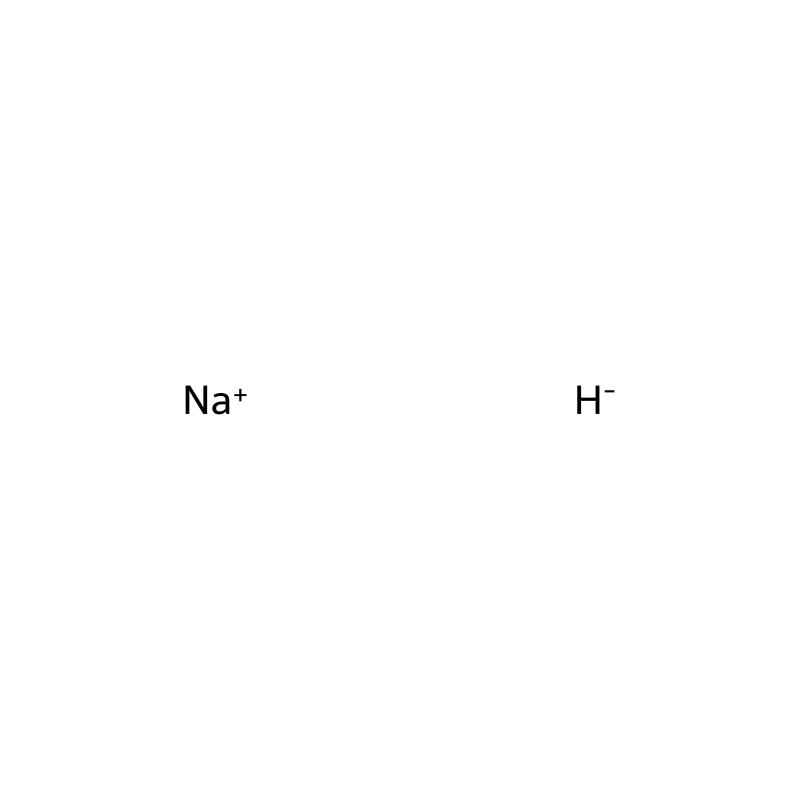
Identifiers & Physical Properties
| CAS No. | 7646-69-7 |
|---|---|
| Molecular formula | HNa |
| Average molar mass | 23.9977 g/mol |
| Monoisotopic mass | 23.99759431 g/mol |
| SMILES | [H-].[Na+] |
| InChIKey | BZKBCQXYZZXSCO-UHFFFAOYSA-N |
| PubChem CID | 24758 |
| DTXSID | DTXSID90893680 |
Chemical & Physical Properties
| Topological polar surface area | 0 |
|---|---|
| Hydrogen bond donors | 0 |
| Hydrogen bond acceptors | 1 |
| Rotatable bonds | 0 |
| Heavy atoms | 1 |
| Formal charge | 0 |
| Complexity | 0 |
| Melting point | 800 °C (dec.) (lit.) |
| Density | 1.2 |
| Flash point | 185°C |
| Storage conditions | Store below +30°C. |
| Solubility | Soluble in molten sodium. Insoluble in ammonia, benzene,carbon tetrachloride, carbon disulfide and all organic solvents.REACTS |
| Physical state | powder (moistened with oil) |
| Color | White to pale gray |
| Specific heat capacity | Cp(crystal): 1.52 J/(g·K), at 25℃ |
| Sensitivity | Air & Moisture Sensitive |
| Merck | 14,8625 |
| Exposure limits | ACGIH: TWA 5 mg/m3OSHA: TWA 5 mg/m3NIOSH: IDLH 2500 mg/m3STEL 10 mg/m3 |
| InChI | InChI=1S/Na.H |
| InChIKey | MPMYQQHEHYDOCL-UHFFFAOYSA-N |
| SMILES | [NaH] |
| CAS DataBase Reference | 7646-69-7(CAS DataBase Reference) |
| EWG's Food Scores | 1 |
| FDA UNII | 23J3BHR95O |
| NIST Chemistry Reference | Sodium hydride(7646-69-7) |
| EPA Substance Registry System | Sodium hydride (NaH) (7646-69-7) |
| UNSPSC Code | 26111700 |
| NACRES | NA.23 |
| GHS pictogram | GHS02,GHS05,GHS08 |
| Signal word | Danger |
| GHS hazard statements | H314-H304-H260 |
| GHS precautionary statements | P501-P223-P260-P231+P232-P264-P280-P370+P378-P335+P334-P303+P361+P353-P301+P310-P301+P330+P331-P363-P304+P340+P310-P305+P351+P338+P310-P402+P404-P405 |
| Personal protective equipment (PPE) | Eyeshields, Gloves, type P3 (EN 143) respirator cartridges |
| Hazard symbols | F,C |
| Risk statements (R) | 15-36-35-11 |
| Safety statements (S) | 26-43-7/8-43A-24/25-7-60-22-45-37/39-16 |
| UN transport number | UN 1427 |
| Water hazard class (WGK) | 3 |
| RTECS number | WB3910000 |
| F | 10-21 |
| TSCA inventory status | TSCA listed |
| Hazard class | 4.3Eye Dam. 1Flam. Sol. 1Met. Corr. 1Skin Corr. 1AWater-react 1 |
| Packing group | I |
| Customs code | 28500090 |
| Storage class | 4.3 - Hazardous materials which set free flammable gases upon contact with water |
| Hazardous substances data | 7646-69-7(Hazardous Substances Data) |
| REACH registrations | Active |
| Excepted quantities | Not Permitted as Excepted Quantity |
Safety & Regulations
| CSL Reaction Information | CSL00007N,N-DIMETHYLFORMAMIDE + SODIUM HYDRIDEThermal runaway reaction already at temperatures > 40°CDeprotonationC&EN6/29/18 |
|---|---|
| F | 10-21 |
| Personal protective equipment (PPE) | Eyeshields, Gloves, type P3 (EN 143) respirator cartridges |
| Water hazard class (WGK) | 3 |
| TSCA inventory status | TSCA listed |
| RTECS number | WB3910000 |
| UN transport number | UN 1427 |
| Customs code | 28500090 |
| Risk statements (R) | 15-36-35-11 |
| Signal word | Danger |
| GHS pictogram | GHS02,GHS05,GHS08 |
| Hazard symbols | F,C |
| Safety statements (S) | 26-43-7/8-43A-24/25-7-60-22-45-37/39-16 |
| Hazard class | 4.3Eye Dam. 1Flam. Sol. 1Met. Corr. 1Skin Corr. 1AWater-react 1 |
| Storage class | 4.3 - Hazardous materials which set free flammable gases upon contact with water |
| Packing group | I |
| GHS hazard statements | H314-H304-H260 |
| Excepted quantities | Not Permitted as Excepted Quantity |
| REACH registrations | Active |
| GHS precautionary statements | P501-P223-P260-P231+P232-P264-P280-P370+P378-P335+P334-P303+P361+P353-P301+P310-P301+P330+P331-P363-P304+P340+P310-P305+P351+P338+P310-P402+P404-P405 |
| Hazardous substances data | 7646-69-7(Hazardous Substances Data) |
Applications & Uses
Uses
Sodium hydride can be used for condensation and alkylation reaction and can be used as a polymerization catalyst, used for the manufacture of drug synthetic and used in fragrance industry, used for manufacturing boron hydrides, used as metal surface rust, reducing agents, condensing agent, desiccant and Clay Johnson's reagents. Used as a condensing agent, an alkylating agent and a reducing agent, etc. It is an important reductant for Pharmaceutical, perfumes, dyes, but also as a drying agent, an alkylating agent, etc.
Description
Sodium hydride, is a binary salt that has a specific hazard of releasing hydrogen upon contact with water. It is an odorless powder that is violently water reactive. The four-digit UN identification number is 1427. The NFPA 704 designation is health 3, flammability 3, and reactivity 2. The white space at the bottom of the diamond has a W with a slash through it, indicating water reactivity.
Uses
At low temperatures where reducing properties of sodium are undesirable as in the condensation of ketones and aldehydes with acid esters; in solution with molten sodium hydroxide for the reduction of oxide scale on metals; at high temperatures as a reducing agent and reduction catalyst.
Uses
Sodium hydride is used to enhance the condensation reactions of carbonyl compounds through the Dieckmann condensation, Stobbe condensation, Darzens condensation and Claisen condensation. It acts as a reducing agent used to prepare diborane from boron trifluoride. It is also used in fuel cell vehicles. Further, it is used to dry some organic solvents. In addition to this, it is involved in the preparation of sulfur ylides, which is utilized for the conversion of ketones into epoxides.
Uses
Direct intercalation into C60 results in the superconducting material (NaH)4C60.
General Description
A silvery to whitish powder or slurry in oil. Used to make other chemicals.
Preparation & Synthesis
Preparation
Sodium hydride is prepared by passing hydrogen gas into molten sodium metal dispersed in oil. Alternatively, the hydride can be made by passing hydrogen into sodium dispersed over the surface of an inert solid, such as, hydrocarbon above 200°C 2Na + H2 → 2NaH