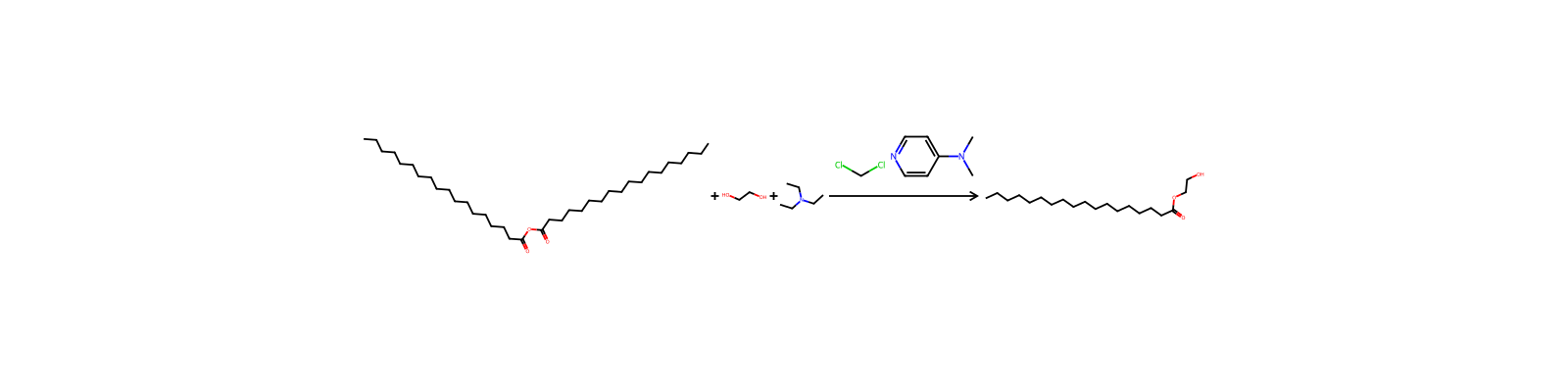
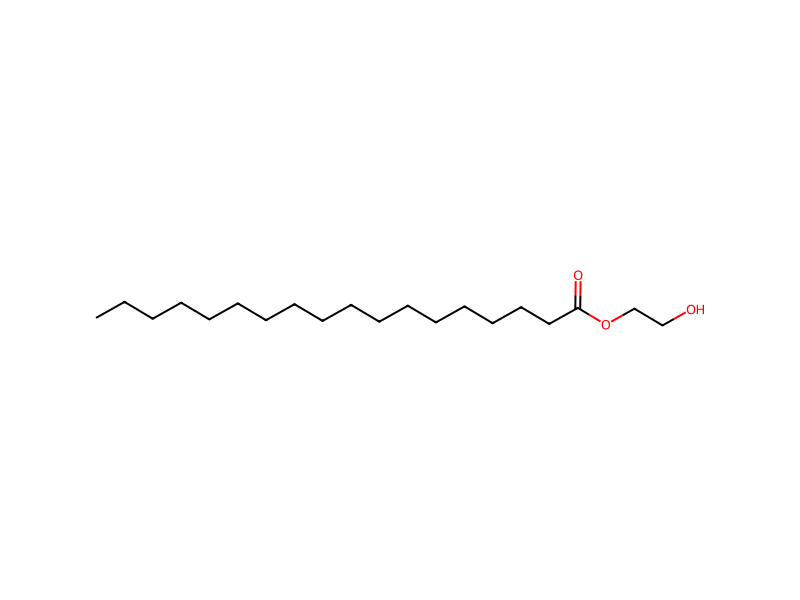
Basic information
- CAS
111-60-4- Standard SMILES
CCCCCCCCCCCCCCCCCC(=O)OCCO- InChIKey
RFVNOJDQRGSOEL-UHFFFAOYSA-N- Molecular formula
- C20H40O3
- Average molar mass
- 328.5 g/mol
Overview
Polyoxyl 40 stearate is an octadecanoate ester composed of repeating 8-40 ethyleneoxy units. It is an ingredient used in cosmetics and beauty products primarily as a surfactant and emulsifier. It has a role as a nonionic surfactant, an emulsifier and a food emulsifier. It is a hydroxypolyether and an octadecanoate ester.
Names & identifiers
- Preferred name
- Glycol monostearate
- IUPAC
- 2-hydroxyethyl octadecanoate
- English name
- ETHYLENE GLYCOL MONOSTEARATE
- Molecular formula
- C20H40O3
- Molecular weight
- 328.53
Names & synonyms
Ethylene glycol monostearateGlycol stearate111-60-42-Hydroxyethyl octadecanoateMonthybaseMonthyleParastarinIvoritSedetolGlycol monostearateProdhybase ethylProdhybas N
Show more names
s151FGMSS 151lipoegms
Clindrol SEGEmerest 2350Ethylene glycol stearateLipo EGMSEmpilan 2848OCTADECANOIC ACID, 2-HYDROXYETHYL ESTERUSAF KE-11STEARIC ACID, 2-HYDROXYETHYL ESTER
Database identifiers
- CAS
111-60-4、86418-55-5、9004-99-3- PubChem CID
- 24762
- DTXSID
DTXSID5026881- ChEMBL
CHEMBL2355383- ChEBI
CHEBI:32027- UNII
- 0324G66D0E
- EC Number
- 203-886-9、617-851-4、618-405-1、926-608-4
- Nikkaji
- J110.879D
Properties
Computed structural properties
- XLogP
- 7.8
- Topological polar surface area
- 46.5 Ų
- Hydrogen bond donors
- 1
- Hydrogen bond acceptors
- 3
- Rotatable bonds
- 19
- Heavy atoms
- 23
- Formal charge
- 0
- Complexity
- 241
Experimental & physicochemical properties
PolymersOther Classes -> Polyoxyethylenes
Cosmetics
Cosmetic ingredients (Glycol Stearate) -> CIR (Cosmetic Ingredient Review)
Cosmetic ingredients (Glycol Stearate SE) -> CIR (Cosmetic Ingredient Review)
Emollient; Opacifying; Surfactant; Humectant; Emulsifying
OdorFAINT FATTY ODOR
TasteSLIGHTLY BITTER, FATTY TASTE
Color/FormCREAM-COLORED SOFT, WAXY OR PASTY SOLID @ 25 °C
Solubility
POLYETHYLENE GLYCOL ESTERS AND ETHERS INCR THE WATER SOLUBILITY OF TYROTHRICIN.
SOL IN CARBON TETRACHLORIDE, PETROLEUM BENZIN, CHLOROFORM, ETHER; SLIGHTLY SOL IN ALCOHOL; INSOL IN WATER /POLYETHYLENE GLYCOL 400 MONOSTEARATE USP XVI/
GENERALLY SOL OR DISPERSIBLE IN WATER
SOL IN TOLUENE, ACETONE, ETHER AND ETHANOL
Flash PointMYRJ 45: 500 °F OC
Melting Point
MP: 30-34 °C /POLYETHYLENE GLYCOL 400 MONOSTEARATE USP XVI/
60.00 to 61.00 °C. @ 760.00 mm Hg
Physical Description
Dry Powder; Other Solid; Large Crystals; Liquid; Liquid
Light tan solid; [Hawley]
Other Experimental Properties
NONIONIC SURFACTANT
NEARLY ODORLESS /POLYETHYLENE GLYCOL 400 MONOSTEARATE USP XVI/
Physicochemical properties
- Melting point
- 55 · 55-60 °C
- Boiling point
- 149 °C · 149 °C
- Density
- 0.878 · 0.8780
- refractive index
- 1.431 · 1.4310 (estimate)
- Flash point
- 425 · 425
- storage temp.
- 2 · 2-8°C
- solubility
- Chloroform (Slightly), Methanol (Slightly, Heated)
- pka
- 13.9 · 13.90±0.10(Predicted)
- form
- Flakes
- color
- White to pale yellow
- Odor
- 100 % · at 100.00%. mild waxy
- Stability
- Stable under normal conditions., Stable Under Normal Conditions.
- Cosmetics Ingredients Functions
- SURFACTANT - EMULSIFYINGSURFACTANT - CLEANSINGOPACIFYINGSKIN CONDITIONING - EMOLLIENT
- Cosmetic Ingredient Review (CIR)
- ETHYLENE GLYCOL MONOSTEARATE (111-60-4)
- LogP
- 7.629 · 7.629 (est)
- CAS DataBase Reference
- 111 · 111-60-4(CAS DataBase Reference)
- EWG's Food Scores
- 1 · 1
- FDA UNII
- 324 G66D0E · 0324G66D0E
- EPA Substance Registry System
- Ethylene glycol monostearate (111-60-4)
- Symbol(GHS)
- 7 · GHS07
- Signal word
- Warning
- Hazard statements
- 319 · H319
- Precautionary statements
- 264 · P264-P280-P305+P351+P338-P337+P313P
- Hazard Codes
- T
- Risk Statements
- 60 · 60-22-36/37/38-63
- Safety Statements
- 24 · 24/25-45-36/37/39-28-27-26-53
- RTECS
- 4100000 · WI4100000
- TSCA
- TSCA listed
- HS Code
- 29189900 · 29189900
Safety & regulation
GHS classification
GHS Classification
This chemical does not meet GHS hazard criteria for 75.2% (357 of 475) of all reports.
Warning
H315 (18.9%): Causes skin irritation [Warning Skin corrosion/irritation]
P261, P264, P264+P265, P271, P280, P302+P352, P304+P340, P305+P351+P338, P319, P321, P332+P317, P337+P317, P362+P364, P403+P233, P405, and P501 (click each P-code to see the statement)
Aggregated GHS information provided per 475 reports by companies from 12 notifications to the ECHA C&L Inventory. Each notification may be associated with multiple companies.
This chemical does not meet GHS hazard criteria for 87% (267 of 307) of all reports.
Hazard information
Regulatory Information
Chemical: Poly(oxy-1,2-ethanediyl), .alpha.-(1-oxooctadecyl)-.omega.-hydroxy-
Chemical: Octadecanoic acid, 2-hydroxyethyl ester
Octadecanoic acid, 2-hydroxyethyl ester is listed on the EPA's Chemical Data Reporting (CDR) system. Manufacturers and importers of Octadecanoic acid, 2-hydroxyethyl ester are required to report information about their production and use of this chemical to the EPA under the Toxic Substances Control Act (TSCA). (40 eCFR Part 711)
FRI - indicates a polymeric substance containing no free-radical initiator in its Inventory name but is considered to cover the designated polymer made with any free-radical initiator regardless of the amount used.
Octadecanoic acid, 2-hydroxyethyl ester: Does not have an individual approval but may be used under an appropriate group standard
Tegin G: Does not have an individual approval but may be used under an appropriate group standard
Hazards Summary
Caused bladder stones in rats when fed at >20% of diet; [JECFA] Mild irritant effect in eye of rabbit; [RTECS] Hydrolyzed in the intestines--fatty acids metabolized and the polyoxyethylene residues excreted unchanged in the urine; [HSDB] An irritant; [MSDSonline] See STEARATES.
EPA Safer Chemical
Chemical: Ethylene glycol monostearate
Chemical: Polyethylene glycol stearate
Hazard Classes and Categories
Skin Irrit. 2 (18.9%)
Eye Irrit. 2 (13%)
Safety & protection
Threshold Limit Values (TLV)
8 hr Time Weighted Avg (TWA): 10 mg/cu m. /Stearates; does not include stearates of toxic metals/
Excursion Limit Recommendation: Excursions in worker exposure levels may exceed 3 times the TLV-TWA for no more than a total of 30 minutes during a work day, and under no circumstances should they exceed 5 times the TLV-TWA, provided that the TLV-TWA is not exceeded. /Stearates; does not include stearates of toxic metals/
A4; Not classifiable as a human carcinogen. /Stearates; does not include stearates of toxic metals/
Toxicology
Interactions
MYRI 32 INCREASED GI ABSORPTION OF ORAL GENTAMICIN IN RATS.
SENSITIVITY OF FEEDING TESTS IN DETECTING CARCINOGENICITY OF SMALL DOSE OF 7,12-DIMETHYLBENZ[A]ANTHRACENE IN FEMALE RATS INCR WHEN IT WAS GIVEN AT AN EARLIER AGE AND WHEN A HIGH FAT DIET CONTAINING 1% POLYOXYETHYLENE MONOSTEARATE WAS ADMIN.
Toxicity Summary
Safe in the present practices of use and concentration. Ingredient, concentration, and use information are available in documents discoverable at https://cir-reports.cir-safety.org
Safe in the present practices of use and concentration. Ingredient, concentration, and use information are available in documents discoverable at https://cir-reports.cir-safety.org
Non-Human Toxicity Excerpts
MALE & FEMALE RATS WERE FED HIGH DOSES OF MYRJ 45 FOR MORE THAN 12 WK, THEN REPRODUCTION & LACTATION WERE MEASURED. A SOMEWHAT GREATER PROP OF INFANT DEATHS NOTED AT 10% LEVEL THAN AT 5% LEVEL, WHEREAS AT 20% LEVEL SIGNIFICANT DIMINUTION OF SURVIVAL OF NEWBORN WAS OBSERVED.
Evidence for CarcinogenicityA4; Not classifiable as a human carcinogen. /Stearates; does not include stearates of toxic metals/
Safety data
- tsca
- TSCA listed
- rtecs
- WI4100000
- hs_code
- 29189900
- risk_code
- 60-22-36/37/38-63
- Signal word
- Warning
- Symbol(GHS)
- GHS07
- hazard_code
- T
- safety_code
- 24/25-45-36/37/39-28-27-26-53
- Hazard statements
- H319
- Precautionary statements
- P264-P280-P305+P351+P338-P337+P313P
Chemistry & industry
Pharmacology
Absorption, Distribution and Excretion
THESE ESTERS ARE HYDROLYZED IN THE BOWEL. THE FATTY ACID IS ABSORBED & METABOLIZED; AT LEAST THE SHORTER POLYOXYETHYLENE RESIDUES ARE ALSO ABSORBED, BUT THEY ARE EXCRETED UNCHANGED IN THE URINE (NO DETECTABLE METABOLISM TO OXALIC ACID IN MAN).
Cellular LocationsExtracellular
Uses & manufacturing
Uses
CIR ingredient: Glycol Stearate
CIR ingredient: Glycol Stearate SE
Used as a surfactant, emulsifier (cosmetics, pharmaceuticals, textile finishes, defoamers, and baked goods), dye assistant, lubricant, and antistatic agent; Also used in dentifrice compositions and to make creams, lotions, ointments, and pharmaceutical preparations; [HSDB]
Textiles (Printing, Dyeing, or Finishing) [Category: Industry]
SURFACTANT
PEG 400 MONOSTEARATE USP XVI: IN PREPN OF CREAMS, LOTIONS, OINTMENTS & PHARMACEUTICAL PREPN WHICH ARE SOL IN WATER
U.S. Production
2023: 1,000,000 - <2,500,000 lb
(1972) 2.4X10+9 GRAMS (MONOSTEARATE)
(1975) 3.13X10+9 GRAMS (MONOSTEARATES)
(1984) 2.91X10+9 g
Consumer UsesSurfactant (surface active agent)
Industry UsesSurfactant (surface active agent)
Methods of ManufacturingREACTION OF ETHYLENE OXIDE WITH STEARIC ACID
Formulations/PreparationsPOLYOXYETHYLENE (8) STEARATE: MIXTURE OF MONO- & DIESTERS OF STEARIC ACID & MIXED POLYOXYETHYLENE DIOLS HAVING AN AVG POLYMER LENGTH OF 7.5 OXYETHYLENE UNITS.
Household Products
Information on 150 consumer products that contain Glycol stearate in the following categories is provided:
Information on 169 consumer products that contain PEG- 100 Stearate in the following categories is provided:
Use Classification
EPA Safer Chemical Functional Use Classes -> Surfactants
Safer Chemical Classes -> Green circle - The chemical has been verified to be of low concern
EPA Safer Chemical Functional Use Classes -> Defoamers;Surfactants
Safer Chemical Classes -> Green circle - The chemical has been verified to be of low concern
Cosmetics -> Emollient; Opacifying; Surfactant; Humectant; Emulsifying
General Manufacturing Information
Soap, Cleaning Compound, and Toilet Preparation Manufacturing
Octadecanoic acid, 2-hydroxyethyl ester: ACTIVE
Poly(oxy-1,2-ethanediyl), .alpha.-(1-oxooctadecyl)-.omega.-hydroxy-: ACTIVE
POLYETHYLENE GLYCOL 400 MONOSTEARATE USP XVI: IT IS AN ETHER, ALCOHOL & ESTER.
Applications
UsesPegosperse(R) 50 MS is a low HLB surface agent suggested for use as an opacifier, pearlescing agent and auxiliary emulsifier in cosmetic and household product formulations.
Usesglycol stearate can be utilized as a detergent, emulsifier, surfactant, thickener, stabilizer, and emollient in cosmetic formulations. It also converts clear cleansers or other preparations to ones that are pearly.
Usesethylene glycol monostearate (glycol stearate) is a non-comedogenic raw material that provides a pearly look and consistency to clear preparations.
Upstream & downstream products
Upstream raw materials
Suppliers100 total
国药集团化学试剂有限公司86-21-63210123 · [email protected]
北京华美互利生物化工010-56205725 · [email protected]
梯希爱(上海)化成工业发展有限公司021-67121386 · [email protected]
上海阿拉丁生化科技股份有限公司400-6206333 13167063860 · [email protected]
Shandong chuangyingchemical Co., Ltd.18853181302 · [email protected]
南通鲁尔化工有限公司18012215199 · [email protected]
武汉欣扬瑞和化学科技有限公司153-07155313 15307155313 · [email protected]
河北展药生物科技有限公司15369953316 +8615369953316 · [email protected]
Baoji Guokang Healthchem co.,ltd+8615604608665 15604608665 · [email protected]
Dayang Chem (Hangzhou) Co.,Ltd.+86-0571-88938639 17705817739 · [email protected]
Hebei Yanxi Chemical Co., Ltd.+86-17531190177 · [email protected]
上海迈瑞尔生化科技有限公司4006356688 18621169109 · [email protected]
上海晶抗生物工程有限公司021-54721350 13524668266 · [email protected]
安耐吉化学&3A(安徽泽升科技股份有限公司)400-0056266 · [email protected]
武汉卡诺斯科技有限公司027-83238443 15327105076 · [email protected]
山东瑞生药用辅料有限公司0635-5018008 15240035289
山东洛克化工有限公司17653113209 13065062079 · [email protected]
上海景颜化工科技有限公司13817811078 · [email protected]
上海泰坦科技股份有限公司400-6009262 15618770481 · [email protected]
合肥天健化工有限公司551-65418679 15856988503;15837135945 · [email protected]
山东西亚化学有限公司13355009207 13355009207 · [email protected]
四川库利南科技有限公司400-1166-196 18981987031 · [email protected]
天津希恩思生化科技有限公司400 638 7771 · [email protected]
斯百全化学(上海)有限公司021-021-021-67601398-809-809-809 15221380277 · [email protected]
上海源叶生物科技有限公司13636370518 · [email protected]
艾科试剂4008-755-333 18080918076 · [email protected]
上海思域化工科技有限公司86-21-34053660 · [email protected]
TCI AMERICA800-4238616 · [email protected]
TOKYO CHEMICAL INDUSTRY CO., LTD.03-36680489 · [email protected]
TCI Europe320-37350700 · [email protected]
南京杜莱生物技术有限公司025-84699383-8003;025-846993838003-8003 18013301590 · [email protected]
北京环宇世纪化学科技有限公司hysj_bj.com
上海将来实业股份有限公司400-0066400 13621662912 · [email protected]
湖南华腾制药有限公司400-8592883 · [email protected]
上海麦克林生化科技股份有限公司15221275939 15221275939 · [email protected]
上海永叶生物科技有限公司86-021-61559134 15921386130 · [email protected]
上海有朋化工有限公司021-69005955 13701776567 · [email protected]
北京海力扬化学科技有限公司13718199399 · [email protected]
北京欣赛维化学科技有限公司010-56218822 13717722232 · [email protected]
四川海诺威科技有限公司13708085536 13708085536 · [email protected]
上海凯赛化工有限公司021-33516722 13701817765 · [email protected]
上海彤源化工有限公司021-021-69182866 13701855675 · [email protected]
北京华扬致成科技有限公司13716033033 · [email protected]
上海蓝润化学有限公司021-69515658 ; 69515628 13701998368 · [email protected]
上海容立化学科技有限公司021-69992220 13701886816 · [email protected]
上海康拓化工有限公司021-69185552 13701777608 · [email protected]
湖北巨胜科技有限公司027-59599241 18871490274 · [email protected]
池州凯隆进出口贸易有限公司[email protected]
Sigma-Aldrich西格玛奥德里奇(上海)贸易有限公司021-61415566 800-8193336 · [email protected]
TargetMol中国(陶术生物)021-021-33632979 15002134094 · [email protected]
Additional notes
DefinitionChEBI: Polyoxyl 40 stearate is an octadecanoate ester composed of repeating 8-40 ethyleneoxy units. It is an ingredient used in cosmetics and beauty products primarily as a surfactant and emulsifier. It has a role as a nonionic surfactant, an emulsifier and a food emulsifier. It is a hydroxypolyether and an octadecanoate ester.
Related reactions
1 records
Compound notes
Loading…