
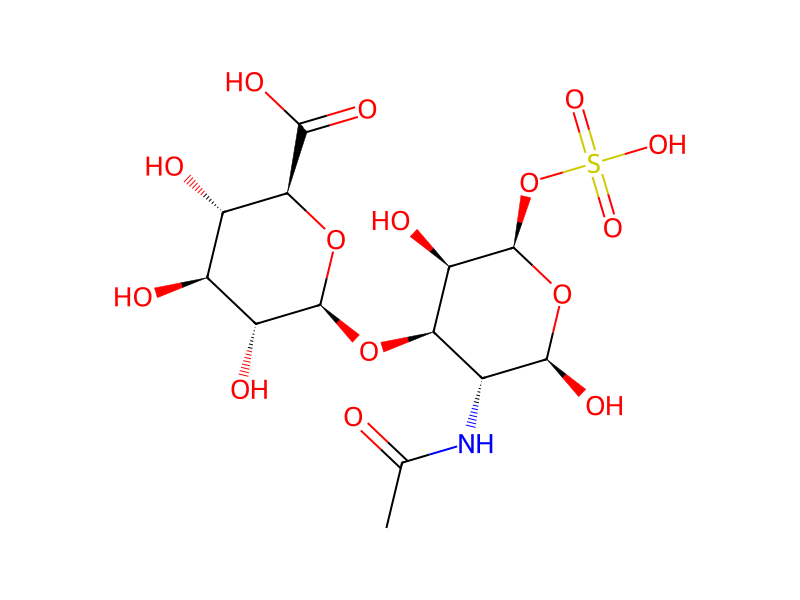
Basic information
- CAS
24967-93-9- Standard SMILES
CC(=O)N[C@@H]1[C@@H](O[C@@H]2O[C@H](C(=O)O)[C@@H](O)[C@H](O)[C@H]2O)[C@@H](O)[C@@H](OS(=O)(=O)O)O[C@H]1O- InChIKey
KXKPYJOVDUMHGS-OSRGNVMNSA-N- Molecular formula
- C13H21NO15S
- Average molar mass
- 463.37 g/mol
- Monoisotopic mass
- 463.06318997
Overview
Chondroitin sulfate is a glycosaminoglycan considered as a symptomatic slow-acting drug for osteoarthritis (SYSADOA). The SYSADOA status suggested a pain relief and increased joint mobility after a relative long regular administration, as well as a long-lasting effect after the end of the treatment. Chondroitin sulfate is composed of alternating 1,3-N-acetyl-β-d-galactosamine and 1,4-β-d-glucuronic acid units which bear 4-O- and/or 6-O-sulfations at the N-acetylgalactosamine units disposed of in specific patterns. Depending on the predominating disaccharide unit, it will present different biological activities. Chondroitin sulfate is sold as an OTC dietary supplement in North America and it is a prescription drug under the EMA in Europe.
Names & identifiers
- Preferred name
- Chondroitin Sulfate
- IUPAC
- (2S,3S,4S,5R,6R)-6-[(2R,3R,4R,5R,6R)-3-acetamido-2,5-dihydroxy-6-sulfooxyoxan-4-yl]oxy-3,4,5-trihydroxyoxane-2-carboxylic acid
- English name
- Chondroitin 4-sulfate
- Molecular formula
- (C14H19NO14SNa2)n
- Molecular weight
- 499.38
Names & synonyms
Chondroitin sulfate9007-28-7Chondroitin, hydrogen sulfateCHEBI:37397(2S,3S,4S,5R,6R)-6-{[(2R,3R,4R,5R,6R)-3-acetamido-2,5-dihydroxy-6-(sulfooxy)oxan-4-yl]oxy}-3,4,5-trihydroxyoxane-2-carboxylic acid(2S,3S,4S,5R,6R)-6-(((2R,3R,4R,5R,6R)-3-acetamido-2,5-dihydroxy-6-(sulfooxy)oxan-4-yl)oxy)-3,4,5-trihydroxyoxane-2-carboxylic acidRefChem:7109DTXSID8031021Chondroitine sulfateChondroitin 4-sulfate sodium salt(2S,3S,4S,5R,6R)-6-[(2R,3R,4R,5R,6R)-3-acetamido-2,5-dihydroxy-6-sulfooxyoxan-4-yl]oxy-3,4,5-trihydroxyoxane-2-carboxylic acidSodium chondroitin sulfate
Show more names
CHONDROITIN-4-SULFATECHONDROITIN SULFATE AturkadonChodroitin SulfatechondroitinasulfateChondroitinSulphateAchondroitinsulfatetypeaCSAChondroitin-4-sulfate
MFCD00146419CondrosulfChondroitinsulfate CC13H21NO15SChondroitin 4 and 6 sulfateChondronStructumGepan
Database identifiers
- CAS
24967-93-9、25322-46-7、39455-18-0、9007-28-7、9082-07-9- PubChem CID
- 24766
- DTXSID
DTXSID601017238- ChEMBL
CHEMBL2303614、CHEMBL5266347- EC Number
- 232-696-9
Properties
Computed structural properties
- XLogP
- -4.8
- Topological polar surface area
- 267 Ų
- Hydrogen bond donors
- 8
- Hydrogen bond acceptors
- 15
- Rotatable bonds
- 6
- Heavy atoms
- 30
- Formal charge
- 0
- Complexity
- 739
Experimental & physicochemical properties
CosmeticsAntistatic; Hair conditioning
SolubilitySoluble
Melting Point190-194ºC
Dissociation Constants1.5-2
Physicochemical properties
- alpha
- -28 to · D -28 to -32°
- storage temp.
- 2 · 2-8°C
- solubility
- 2 O: · H2O: 0.1 g/mL, slightly hazy, faintly yellow
- FDA 21 CFR
- 701.3 · 701.3
- EWG's Food Scores
- 1 · 1
- Symbol(GHS)
- 7 · GHS07
- Signal word
- Warning
- Hazard statements
- 302 · H302-H315-H319-H335
- Precautionary statements
- 280 · P280-P305+P351+P338
- WGK Germany
- 3 · 3
- F
- 3 · 3-10
- Toxicity
- 15 gm/kg · mouse,LD,oral,> 15gm/kg (15000mg/kg),Zhonghua Yixue Zazhi. Chinese Medical Journal. Vol. 58, Pg. 739, 1978.
Safety & regulation
GHS classification
GHS Classification
This chemical does not meet GHS hazard criteria for 63.6% (7 of 11) of all reports.
Danger
H317 (36.4%): May cause an allergic skin reaction [Warning Sensitization, Skin]
P233, P260, P261, P271, P272, P280, P284, P302+P352, P304+P340, P317, P321, P333+P317, P342+P316, P362+P364, P403, and P501 (click each P-code to see the statement)
Aggregated GHS information provided per 11 reports by companies from 2 notifications to the ECHA C&L Inventory. Each notification may be associated with multiple companies.
Hazard information
Regulatory Information
Chemical: Chondroitin, hydrogen sulfate
XU - indicates a substance exempt from reporting under the Chemical Data Reporting Rule, (40 CFR 711).
Chondroitin, hydrogen sulfate, sodium salt: Does not have an individual approval but may be used under an appropriate group standard
Chondroitin hydrogen sulfate: Does not have an individual approval but may be used under an appropriate group standard
Other Safety InformationIMAP assessments - Chondroitin, hydrogen sulfate: Environment tier I assessment
Hazard Classes and CategoriesSkin Sens. 1 (36.4%)
Safety data
- F
- 3-10
- wgk
- 3
- Toxicity
- mouse,LD,oral,> 15gm/kg (15000mg/kg),Zhonghua Yixue Zazhi. Chinese Medical Journal. Vol. 58, Pg. 739, 1978.
- Signal word
- Warning
- Symbol(GHS)
- GHS07
- Hazard statements
- H302-H315-H319-H335
- Precautionary statements
- P280-P305+P351+P338
Chemistry & industry
Pharmacology
ATC Code
M - Musculo-skeletal system
QM - Musculo-skeletal system
Protein BindingChondroitin sulfate protein binding reports have shown a very low percentage of protein binding of only 0.23% of the total protein.
Pharmacodynamics
In clinical trials, chondroitin sulfate has been reported a significant pain relief. Some reports have shown no slow in joint damage. The effects of chondroitin sulfate have been very controversial. One of the characteristics of chondroitin is a slow onset of action with a maximal effect attained after several months. Chondroitin sulfate has been reported to have anti-inflammatory properties by reducing the synovitis and prevent proinflammatory cytokine up-regulation in arthritis models. It is also registered an anabolic effect of chondroitin sulfate in which it induces the synthesis of hyaluronate in synovial cells, it increases type II collagen and proteoglycan synthesis.
Mechanism of Action
Chondroitin sulfate functions as a major component of the intricate extracellular matrix. It is proposed that chondroitin sulfate supply can provide new building blocks for the synthesis of new matrix components. The anti-inflammatory effect of chondroitin sulfate is thought to be caused by the inhibition of the synthesis of inflammatory intermediates such as the inhibition of nitric oxide synthase, COX-2, microsomal prostaglandin synthase 1 and prostaglandin E2. It is reported also an inhibitory activity in the toll-like receptor 4 which will later inhibit inflammatory cytokines, NFkB and MyD88. This activity suggests a modulation of the MAP kinase pathway. On the other hand, some reports have pointed out an induction on the PKC/PI3K/Akt pathway in neuroblastoma. The anabolic effect of chondroitin sulfate is suggested to be caused by the inhibition of metalloproteinases such as MMP-1, -3 and -13 as well as ADAMTS-4 and -5.
Biological Half-Life
The approximate half-life of chondroitin sulfate and its derivative metabolites is 15 hours. After intramuscular administration of chondroitin sulfate in humans, the elimination half-life of the chondroitin sulfate was of 275 min. When administered orally, the elimination half-life was presented at 310 min.
Metabolism/Metabolites
Chondroitin sulfate is not metabolized by cytochrome P450. Reports have indicated the presence in plasma of mono-, oligo- and polysaccharides with a molecular weight of less of 5 kDa which are derived from the partial digestion of exogenous chondroitin sulfate. The reported degradation of chondroitin sulfate seems to be very complex and led by the formation of smaller digestion derivatives of the original form.
Absorption, Distribution and Excretion
Chondroitin sulfate is absorbed from the gastrointestinal tract. The absorbed portion reaches a ratio of 10% as unchanged chondroitin sulfate and 90% as depolymerized low-molecular-weight derivatives. This absorption depends on the sulfation status. The bioavailability of chondroitin sulfate ranges from 10-20% following oral administration. Reports have shown a consistent accumulation of the compound in joint tissue. The steady-state is attained after 3-4 days and it takes around 3-6 months to obtain the maximal effect. After intramuscular administration of chondroitin sulfate, the peak plasma level of 3.8 mcg/ml was reached after 90 min. When given orally, the peak plasma concentration of 4.6 mcg/ml was reached after 240 min.
Chondroitin sulfate is excreted in the urine as intact polymers and as partial degradation products. After intramuscular administration, about 37% of the administered dose is excreted by urine during the first 24 hours as high- and low-molecular-weight derivatives.
After intramuscular administration of chondroitin sulfate, the apparent volume of distribution was 0.40 ml/g. When administered orally, the apparent volume of distribution changed to 0.44ml/g.
Uses & manufacturing
Household ProductsInformation on 4 consumer products that contain Sodium chondroitin sulfate in the following categories is provided:
Use ClassificationCosmetics -> Antistatic; Hair conditioning
General Manufacturing InformationChondroitin, hydrogen sulfate: ACTIVE
Applications
DescriptionChondroitin 4-sulfate is a natural polymer of a disaccharide consisting of glucuronic acid and N-acetyl glucosamine which is sulfated either in the 4 or 6 position. It is a glycosaminoglycan considered as a symptomatic slow-acting drug for osteoarthritis (SYSADOA).
Usessodium chondroitin sulfate is described as a skin-conditioning agent, with possible anti-inflammatory properties. It can be found in such products as moisturizers and night skin care preparations. It is a derivative of natural mucopolysaccharides. Chondroitin 4-sulfate is an important structural component of cartilage and has been used as a dietary supplement to treat symptoms of joint discomfort.
Preparation methods
PreparationChondroitin 4-sulfate can be extracted using the following method:Weigh pig throat and nasal cartilage and put it into a solution of 20g/L (2%) sodium hydroxide, using a ratio of 5 times the weight of the cartilage.Soak the cartilage in the sodium hydroxide solution and stir it intermittently.Filter the solution when the leachate reaches 5.5°Be.Extract the residue left on the filter by adding it to the sodium hydroxide solution again and combining the filtrate.To remove impurities such as protein, hydrolyze the solution with crude trypsin at 50°C.Filter the solution until it becomes clear.Adjust the pH of the solution to 6.Add ethanol to the solution until the alcohol content reaches 75%.Let the solution stand overnight to allow precipitation.Centrifuge the solution to separate the precipitate.Wash the precipitate with absolute ethanol.Dry the precipitate at 60°C to obtain crude chondroitin sulfate.
Upstream & downstream products
Upstream raw materials
Suppliers100 total
国药集团化学试剂有限公司86-21-63210123 · [email protected]
梯希爱(上海)化成工业发展有限公司021-67121386 · [email protected]
湖南韵邦生物科技股份有限公司85561037 15386497078 · [email protected]
Maanshan Tiantai Biotechnology Co., Ltd.+86-0555-8889890 +86-17356584060 · [email protected]
郑州裕和食品添加剂有限公司0371-56060979 13838386843
河北展药生物科技有限公司15369953316 +8615369953316 · [email protected]
Baoji Guokang Healthchem co.,ltd+8615604608665 15604608665 · [email protected]
武汉科美沃化工有限公司+86-2785736489 +8618171418573 · [email protected]
湖北科乐精细化工有限公司027-59101668 19945030958 · [email protected]
Dayang Chem (Hangzhou) Co.,Ltd.+86-0571-88938639 17705817739 · [email protected]
Henan Xiangtong Chemical Co., Ltd.86-371-61312303 · [email protected]
江西瑞威尔生物科技有限公司18502728206 · [email protected]
上海迈瑞尔生化科技有限公司4006356688 18621169109 · [email protected]
江西瑞威尔生物科技有限公司18502762009 · [email protected]
武汉丰泰威远科技有限公司+86-27-8746-5837 +86-18627785180 · [email protected]
武汉丰泰威远科技有限公司027-87465837 19945049750 · [email protected]
佛山宝诺生物科技有限公司0757-85921206 18520245316 · [email protected]
HONG KONG IPURE BIOLOGY CO.,LIMITED86 18062405514 18062405514 · [email protected]
Xiamen AmoyChem Co., Ltd+86-86-5926051114 · [email protected]
武汉科美沃化工有限公司027-85736489 · [email protected]
斯百全化学(上海)有限公司021-021-021-67601398-809-809-809 15221380277 · [email protected]
TOKYO CHEMICAL INDUSTRY CO., LTD.03-36680489 · [email protected]
TCI Europe320-37350700 · [email protected]
广州爱纯医药科技有限公司020-39119399 18927568969 · [email protected]
南京生利德生物科技有限公司025-57798810 18652991625 · [email protected]
南京世洲生物科技有限公司13675144456 · [email protected]
湖北鑫源顺医药化工有限公司13971561712, 13995564702, 027-50664929 · [email protected]
四川省维克奇生物科技有限公司028-81700200 18116577057 · [email protected]
陕西缔都医药化工有限公司+86-029-81138252 +86-173 9270 1263 · [email protected]
天津普西唐生物医药科技有限公司010-60605840 · [email protected]
上海麦克林生化科技股份有限公司15221275939 15221275939 · [email protected]
上海永叶生物科技有限公司86-021-61559134 15921386130 · [email protected]
陕西缔都医药化工有限公司+86-29-87569262 +86-15003564040 · [email protected]
湖北巨胜科技有限公司027-59599241 18871490274 · [email protected]
池州凯隆进出口贸易有限公司[email protected]
Sigma-Aldrich西格玛奥德里奇(上海)贸易有限公司021-61415566 800-8193336 · [email protected]
Alfa Chemistry1-516-6625404 · [email protected]
上海昕凯医药科技有限公司21-619849051-1 18521059765 · [email protected]
BOC Sciences16314854226 · [email protected]
九鼎化学(上海)科技有限公司4009209199 · [email protected]
Henan Alfa Chemical Co., Ltd+8618339805032 · [email protected]
资川生化科技(苏州)有限公司0512-66317708 13372112871 · [email protected]
湖北威德利化学试剂有限公司18327179646 · [email protected]
杭州鼎燕化工有限公司0571-87157530-8003 18267553885 · [email protected]
武汉鑫儒化工有限公司15927387915 15337108568
厦门志信化学有限公司+86-5922680277 +86-13806087780 · [email protected]
Alfa Chemistry+1-5166625404 · [email protected]
上海珈得尔化学技术有限公司021-4007787-550 400-7787-550 · [email protected]
浙江珲达生物科技有限公司0571-89903022 18679456698 · [email protected]
湖北源梦生物科技有限公司027-68897569 18120462897 · [email protected]
Additional notes
DefinitionChEBI: Chondroitin 4'-sulfate is a chondroitin sulfate in which the site of sulfation is carbon 4 of the N-acetylgalactosamine (GalNAc) sugar. It has a role as a mouse metabolite. It is a conjugate acid of a chondroitin 4'-sulfate anion.
Related reactions
5 records


Compound notes
Loading…