HomeMCPWorkbenchSkills
HomeWorkbenchNotificationsMe
llms.txt · MCP GuidePrivacy Policy · Terms of Service · Supportv1.8.3
  1. Home
  2. /Compound

3-(3,4-Dihydroxyphenyl)Prop-2-Enoic Acid

HCID 2518
New reaction
Print
Basic informationOverviewNames & identifiersPropertiesSafety & regulationChemistry & industryRelated reactionsCompound notes
Substructure searchFind similar structures

Basic information

CAS
331-39-5
Standard SMILES
O=C(O)C=Cc1ccc(O)c(O)c1
InChIKey
QAIPRVGONGVQAS-UHFFFAOYSA-N
Molecular formula
C9H8O4
Average molar mass
180.16 g/mol
Monoisotopic mass
180.04225873

Overview

QAIPRVGONGVQAS-UHFFFAOYSA-N has been reported in Salvia miltiorrhiza, Acanthospermum australe, and other organisms with data available.

Names & identifiers

Preferred name
3-(3,4-Dihydroxyphenyl)Prop-2-Enoic Acid
IUPAC
3-(3,4-dihydroxyphenyl)prop-2-enoic acid
English name
Caffeic acid
Molecular formula
C9H8O4
Molecular weight
180.16

Names & synonyms

3-(3,4-dihydroxyphenyl)prop-2-enoic acidRefChem:10666483,4-dihydroxycinnamic acid (caffeic acid)3,4-Dihydroxycinnamic acid, predominantly transSpectrum_001686SpecPlus_000528Prestwick0_000902Prestwick1_000902Spectrum2_001612Spectrum4_0016943,4-dihydroxy cinnamic acidSCHEMBL23359
Show more names
3,4-DIHYDROXYCINNAMIC ACID(E)-3-(3,4-Dihydroxyphenyl)acrylic acidCaffeicCAFFIC ACID31-39-53-(3,4-DIHYDROXYPHENYL)ACRYLIC ACIDCaffeic acid 04-(2’-carboxyvinyl)-1,2-dihydroxybenzeneβ-(3NSC 623438
KBioGR_001988KBioSS_002166orb322303DivK1c_006624SPBio_001643SPBio_002943orb1304995orb3140186

Database identifiers

CAS
331-39-5

Properties

Computed structural properties

XLogP
1.2
Topological polar surface area
77.8 Ų
Hydrogen bond donors
3
Hydrogen bond acceptors
4
Rotatable bonds
2
Heavy atoms
13
Formal charge
0
Complexity
212

Experimental & physicochemical properties

Chemical ClassesStimulant

Physicochemical properties

Melting point
211 · 211-213 °C (dec.) (lit.)
Boiling point
272.96 °C · 272.96°C (rough estimate)
Density
1.2933 · 1.2933 (rough estimate)
refractive index
1.45 · 1.4500 (estimate)
storage temp.
2 · 2-8°C
solubility
50 mg/mL · ethanol: 50 mg/mL
form
powder
pka
4.58 · 4.58±0.10(Predicted)
color
yellow to tan
Water Solubility
soluble in hot water
Merck
14 · 14,1635
BRN
2210883 · 2210883
Henry's Law Constant
7 · 7.0×1010 mol/(m3Pa) at 25℃, HSDB (2015)

Safety & regulation

Safety information is for reference only and does not replace the supplier’s Safety Data Sheet (SDS), applicable regulations, or professional assessment.

Safety data

PPE
Eyeshields, Gloves, type P3 (EN 143) respirator cartridges
wgk
3
rtecs
GD8950000
hs_code
29182990
risk_code
36/37/38-40-63-68
Signal word
Warning
Symbol(GHS)
GHS08
hazard_code
Xn,Xi
hazard_note
Irritant
safety_code
26-36/37/39-36
Storage Class
11 - Combustible Solids
Hazard statements
H351
Hazard Classifications
Carc. 2
Precautionary statements
P280
Hazardous Substances Data
331-39-5(Hazardous Substances Data)

Chemistry & industry

Applications · 7 items

Uses1. Reagents for Organic Synthesis. 2. Intermediate of caffeic acid; can be used in organic synthesis. 3. Used for Biochemical studies.

DescriptionCaffeic acid is abundant in the whole plant of Solidago decurrens Lour. (Yi Zhi Huang Hua), fruit of Crataegus pinnatifida Bge. var. major N.E.Br. (Shan Li Hong), Salix myrtillacea Anderss. (Po Liu), rhizome of Cimicifuga foetida L., rhizome of Polypodiaceae Polypodium vulgare L. (Ou Ya Shui Long Gu), peel of Rutaceae Citrus limonum (Ning Meng), the whole plant of Polygonaceae Polygonum aviculare L. (Pian Xu), root of Valeriana officinalis L. (Xie Cao), the whole plant of Thymus mongolicus Ronn (She Xiang), leaves of Eucommia ulmoides (Du Zhong), and other herbal plants. It is a kind of polyhydroxy styrene acid, with the general chemical properties of phenolic acid. It is easily oxidized for the reason of the unsaturated double bonds, particularly unstable in alkaline solutionCaffeic acid has both cis and trans isomers, and the two isomers of caffeic acid have a mutual transformation in plants, which may regulate some important physiological process. Caffeic acid exists in plants in the main form of complexes; free state accounts for a few proportion.

DescriptionCaffeic acid is an inhibitor of 5-LO with an IC50 value of 3.7-72 μM and 12-LO with an IC50 value of 5.1-30 μM.

UsesCaffeic Acid is a constituent of plants, probably occurs in plants only in conjugated forms. Caffeic acid is found in all plants because it is a key intermediate in the biosynthesis of lignin, one of the principal sources of biomass. Caffeic acid is one of the main natural phenols in argan oi.

UsesCaffeic acid has been used as a standard of phenolic acid in the study to determine the total phenolic acid content in vegetables after subjecting to alkaline and acid hydrolysis. It has also been used to determine its antioxidant activity by various assay methods.

Usesantineoplastic, PGE2 synthase inhibitor, PK inhibitor

General DescriptionYellow prisms or plates (from chloroform or ligroin) or pale yellow granules. Alkaline solutions turn from yellow to orange.

Upstream & downstream products

Related reactions

9 records
New reaction record
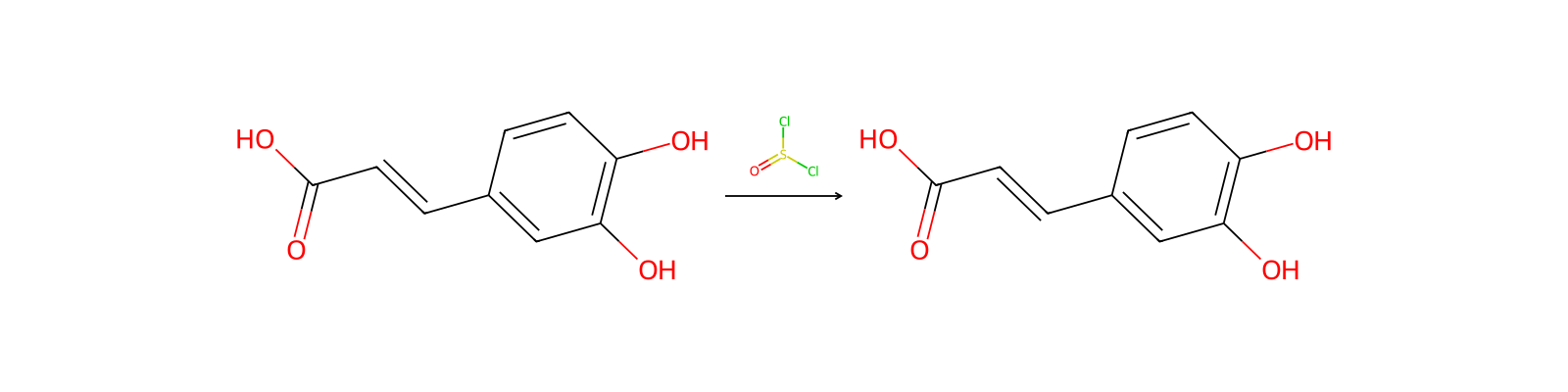
HRID 25331 reaction equation
HRID 25331As reactant
HRID 142113 reaction equation
HRID 142113As reactant
HRID 308207 reaction equation
HRID 308207As reactant
HRID 375698 reaction equation
HRID 375698As reactant
HRID 823251 reaction equation
HRID 823251As reactant
HRID 899551 reaction equation
HRID 899551As reactant
HRID 1157053 reaction equation
HRID 1157053As productAs reactant
HRID 1157057 reaction equation
HRID 1157057As productAs reactant
PreviousPage 1 of 2

Compound notes

On this pageBasic informationOverviewNames & identifiersPropertiesSafety & regulationChemistry & industryRelated reactionsCompound notes
PubChem CID
2518
DTXSID
DTXSID5020231
ChEMBL
CHEMBL3181904
Stability
Stable. Combustible. Incompatible with strong oxidizing agents, strong bases.
Cosmetics Ingredients Functions
FRAGRANCEANTIOXIDANT
InChI
1S/C9H8O4/c10-7-3-1-6(5-8(7)11)2-4-9(12)13/h1-5,10-11H,(H,12,13)/b4-2+
InChIKey
QAIPRVGONGVQAS-DUXPYHPUSA-N
SMILES
OC(=O)\C=C\c1ccc(O)c(O)c1
LogP
1.15 · 1.150
CAS DataBase Reference
331 · 331-39-5(CAS DataBase Reference)
EWG's Food Scores
3 · 3
FDA UNII
2 S3A33KVM · U2S3A33KVM
Proposition 65 List
Caffeic Acid
NCI Drug Dictionary
caffeic acid
IARC
2 B · 2B (Vol. 56) 1993
NIST Chemistry Reference
3 · Cinnamic acid, 3,4-dihydroxy-(331-39-5)
EPA Substance Registry System
2 · 2-Propenoic acid, 3-(3,4-dihydroxyphenyl)- (331-39-5)
UNSPSC Code
41116107 · 41116107
NACRES
77 · NA.77
Symbol(GHS)
8 · GHS08
Signal word
Warning
Hazard statements
351 · H351
Precautionary statements
280 · P280
PPE
3 · Eyeshields, Gloves, type P3 (EN 143) respirator cartridges
Hazard Codes
Xn,Xi
Risk Statements
36 · 36/37/38-40-63-68
Safety Statements
26 · 26-36/37/39-36
WGK Germany
3 · 3
RTECS
8950000 · GD8950000
Hazard Note
Irritant
HS Code
29182990 · 29182990
Storage Class
11 · 11 - Combustible Solids
Hazard Classifications
2 · Carc. 2
Hazardous Substances Data
331 · 331-39-5(Hazardous Substances Data)

Upstream raw materials

Cyclohexanecarboxylic acid, 3-[[(2E)-3-(3,4-dihydroxyphenyl)-1-oxo-2-propen-1-yl]oxy]-1,4,5-trihydroxy-Quinic acid(E)-methyl 3-(benzo[d][1,3]dioxol-5-yl)acrylateProtocatechualdehyde7,8-Dihydroxycoumarin

Downstream products

6-O-FeruloylglucoseCaffeic acid3,4-Dihydroxy-6-nitrobenzaldehyde(E,3R)-1-(1,3-benzodioxol-5-yl)-4,4-dimethylpent-1-en-3-ol1,2-dihydroxy-4-(nitroethenyl)benzene(E)-Caffeic Acid Diacetate
Additional notes · 1 item

DefinitionChEBI: Caffeic acid is a hydroxycinnamic acid that is cinnamic acid in which the phenyl ring is substituted by hydroxy groups at positions 3 and 4. It exists in cis and trans forms; the latter is the more common. It has a role as a plant metabolite, an EC 1.13.11.33 (arachidonate 15-lipoxygenase) inhibitor, an EC 2.5.1.18 (glutathione transferase) inhibitor, an EC 1.13.11.34 (arachidonate 5-lipoxygenase) inhibitor, an antioxidant and an EC 3.5.1.98 (histone deacetylase) inhibitor. It is a hydroxycinnamic acid and a member of catechols.