HomeMCPWorkbenchSkills
HomeWorkbenchNotificationsMe
llms.txt · MCP GuidePrivacy Policy · Terms of Service · Supportv1.8.3
  1. Home
  2. /Compound

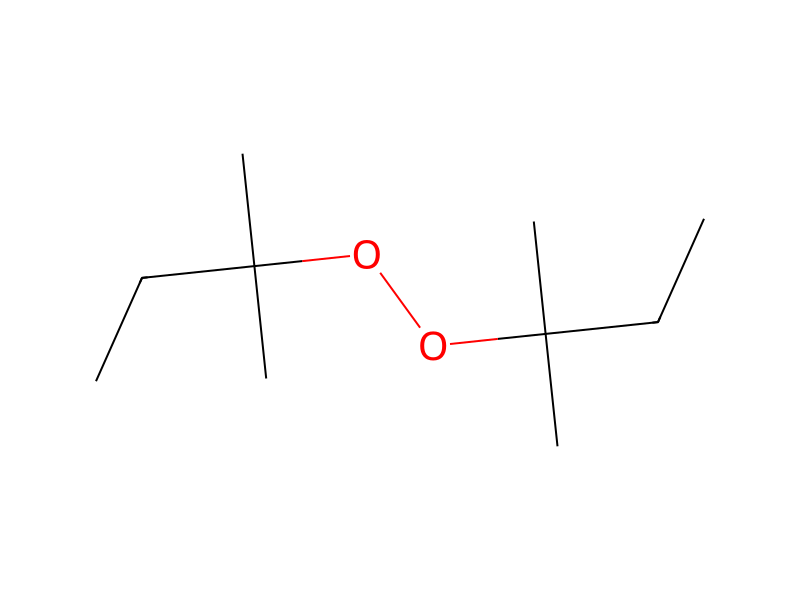
Di-tert-amyl peroxide

HCID 25320
New reaction
Print
Basic informationNames & identifiersPropertiesSafety & regulationChemistry & industryRelated reactionsCompound notes
Substructure searchFind similar structures

Basic information

CAS
10508-09-5
Standard SMILES
CCC(C)(C)OOC(C)(C)CC
InChIKey
JJRDRFZYKKFYMO-UHFFFAOYSA-N
Molecular formula
C10H22O2
Average molar mass
174.28 g/mol
Monoisotopic mass
174.16197994

Names & identifiers

Preferred name
Di-tert-amyl peroxide
IUPAC
2-methyl-2-(2-methylbutan-2-ylperoxy)butane
English name
Di-tert-amyl peroxide
Molecular formula
C10H22O2
Molecular weight
174.28

Names & synonyms

Di-tert-amyl peroxide10508-09-5Di-tert-pentyl peroxidePeroxide, bis(1,1-dimethylpropyl)PEROXIDE, DI-tert-PENTYL-T4HBL5JPXKEINECS 234-042-8BRN 1738675EC 234-042-8RefChem:586091234-042-8Bis(1,1-dimethylpropyl) peroxide
Show more names
Luperox DTATrigonox 201DIAMYLPEROXIDEtert-Pentyl peroxidedi-tert-pentyl-peroxidBis(tert-amyl) peroxide
2-methyl-2-(2-methylbutan-2-ylperoxy)butanetert-amyl peroxideUNII-T4HBL5JPXKdi-t-amyl peroxidedi-tert-amylperoxideDi-tert.-pentylperoxiddi-tert.-amyl peroxidedi-tertiary-amyl peroxide

Database identifiers

CAS
10508-09-5
PubChem CID
25320
DTXSID
DTXSID9051533
UNII
T4HBL5JPXK
EC Number
234-042-8
Nikkaji
J116.170I

Properties

Computed structural properties

XLogP
3.1
Topological polar surface area
18.5 Ų
Hydrogen bond donors
0
Hydrogen bond acceptors
2
Rotatable bonds
5
Heavy atoms
12
Formal charge
0
Complexity
112

Experimental & physicochemical properties

Food Contact Substances · 2 items

FCS -> FDA Cumulative Estimated Daily Intake (CEDI)

FCS -> FDA Inventory of Effective Food Contact Substance (FCS) Notifications

Physical DescriptionLiquid

Physicochemical properties

Melting point
-55 °C · -55°C
Boiling point
146 °C · 146 °C(lit.)
Density
0.818 g/mL · 0.818 g/mL at 25 °C(lit.)
vapor pressure
14.7 hPa · 14.7hPa at 25℃
refractive index
20 · n20/D 1.409(lit.)
Flash point
77 °F · 77 °F
Water Solubility
13.83 mg/L · 13.83mg/L at 20℃
InChI
InChI=1S/C10H22O2/c1-7-9(3,4)11-12-10(5,6)8-2/h7-8H2,1-6H3
InChIKey
JJRDRFZYKKFYMO-UHFFFAOYSA-N

Safety & regulation

Safety information is for reference only and does not replace the supplier’s Safety Data Sheet (SDS), applicable regulations, or professional assessment.

GHS classification

GHS Classification · 4 items

Danger

H225 (57.7%): Highly Flammable liquid and vapor [Danger Flammable liquids]

P203, P210, P233, P234, P235, P240, P241, P242, P243, P264, P270, P273, P280, P301+P317, P302+P352, P303+P361+P353, P318, P321, P330, P332+P317, P362+P364, P370+P378, P391, P403, P403+P235, P405, P410, P411, P420, and P501 (click each P-code to see the statement)

Aggregated GHS information provided per 331 reports by companies from 10 notifications to the ECHA C&L Inventory. Each notification may be associated with multiple companies.

Hazard information

Regulatory Information · 4 items

Chemical: Peroxide, bis(1,1-dimethylpropyl)

Peroxide, bis(1,1-dimethylpropyl) is listed on the EPA's Chemical Data Reporting (CDR) system. Manufacturers and importers of Peroxide, bis(1,1-dimethylpropyl) are required to report information about their production and use of this chemical to the EPA under the Toxic Substances Control Act (TSCA). (40 eCFR Part 711)

REACH registered substance: Di-tert-pentyl peroxide (EC: 234-042-8)

Peroxide, bis(1,1-dimethylpropyl): Does not have an individual approval but may be used as a component in a product covered by a group standard. It is not approved for use as a chemical in its own right.

Hazard Classes and CategoriesFlam. Liq. 2 (57.7%)

Safety data

wgk
2
tsca
TSCA listed
rtecs
SD8300000
ridadr
UN 3107 5.2
hs_code
2909600000
Toxicity
mouse,LD50,oral,1450mg/kg (1450mg/kg),"Prehled Prumyslove Toxikologie; Organicke Latky," Marhold, J., Prague, Czechoslovakia, Avicenum, 1986Vol. -, Pg. 263, 1986.

Chemistry & industry

Uses & manufacturing

U.S. Production2023: 500,000 - <1,000,000 lb
Consumer UsesNot Known or Reasonably Ascertainable
Industry UsesPlasticizer
General Manufacturing Information · 2 items

Plastics Product Manufacturing

Peroxide, bis(1,1-dimethylpropyl): ACTIVE

Applications · 2 items

DescriptionDi-tert-amyl peroxide (DTAP) is a slightly yellowish, mobile liquid. This liquid dialkyl peroxide is used as an initiator (radical source) in the polymerisation of monomers, like e.g. ethylene, styrene, and (meth)acrylates.

UsesDi-tert-amyl peroxide is commonly used as a radical initiator to induce polymerisation (free radical polymerisation process) for the manufacture of plastic (polypropylene visbreaking, acrylicresins, LDPE/EVA), and as cross-linking agent for the production of resins (resin hardener).

Related reactions

19 records
New reaction record
HRID 374558 reaction equation
HRID 374558As reactant
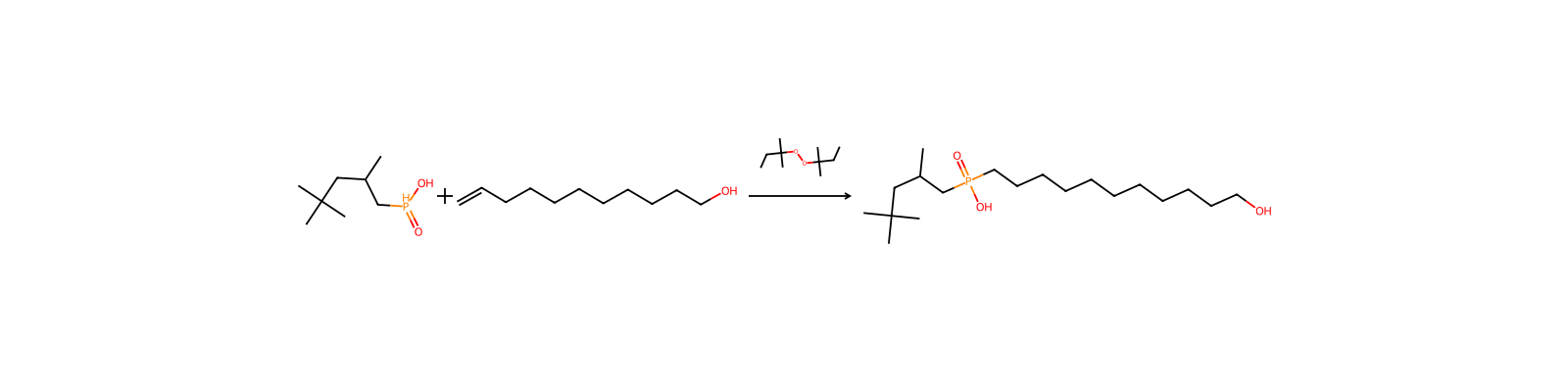
HRID 503700 reaction equation
HRID 503700As reactant
HRID 1167959 reaction equation
HRID 1167959As product
HRID 1661850 reaction equation
HRID 1661850As catalyst
HRID 1661851 reaction equation
HRID 1661851As catalyst
HRID 1661852 reaction equation
HRID 1661852As catalyst
HRID 1661853 reaction equation
HRID 1661853As catalyst
HRID 1661854 reaction equation
HRID 1661854As catalyst
PreviousPage 1 of 3

Compound notes

On this pageBasic informationNames & identifiersPropertiesSafety & regulationChemistry & industryRelated reactionsCompound notes
SMILES
O(C(C)(C)CC)OC(C)(C)CC
LogP
4.7 at · 4.7 at 25℃
EWG's Food Scores
1 · 1
FDA UNII
4 HBL5JPXK · T4HBL5JPXK
NIST Chemistry Reference
(CH3)2C(C2H5)OOC(CH3)2C2H5(10508-09-5)
EPA Substance Registry System
Peroxide, bis(1,1-dimethylpropyl) (10508-09-5)
Symbol(GHS)
2 · GHS02,GHS07,GHS08
Signal word
Warning
Hazard statements
226 · H226-H242-H315-H341-H413
Precautionary statements
210 · P210-P233-P240-P241-P242-P243-P280-P234-P235-P264-P201-P202-P273-P303+P361+P353-P370+P378-P302+P352-P332+P313-P362+P364-P308+P313-P403+P235-P403-P410-P411-P420-P405-P501
Hazard Codes
O,Xn
Risk Statements
8 · 8-22-38-7
Safety Statements
7 · 7-16-17-36/37/39-47-14
RIDADR
3107 · UN 3107 5.2
WGK Germany
2 · 2
RTECS
8300000 · SD8300000
TSCA
TSCA listed
HazardClass
5.2 · 5.2
PackingGroup
II
HS Code
2909600000 · 2909600000
Toxicity
50 · mouse,LD50,oral,1450mg/kg (1450mg/kg),"Prehled Prumyslove Toxikologie; Organicke Latky," Marhold, J., Prague, Czechoslovakia, Avicenum, 1986Vol. -, Pg. 263, 1986.
REACH Registrations
Active
risk_code
8-22-38-7
Signal word
Warning
Symbol(GHS)
GHS02,GHS07,GHS08
hazard_code
O,Xn
safety_code
7-16-17-36/37/39-47-14
hazard_class
5.2
packing_group
II
Hazard statements
H226-H242-H315-H341-H413
REACH Registrations
Active
Precautionary statements
P210-P233-P240-P241-P242-P243-P280-P234-P235-P264-P201-P202-P273-P303+P361+P353-P370+P378-P302+P352-P332+P313-P362+P364-P308+P313-P403+P235-P403-P410-P411-P420-P405-P501