
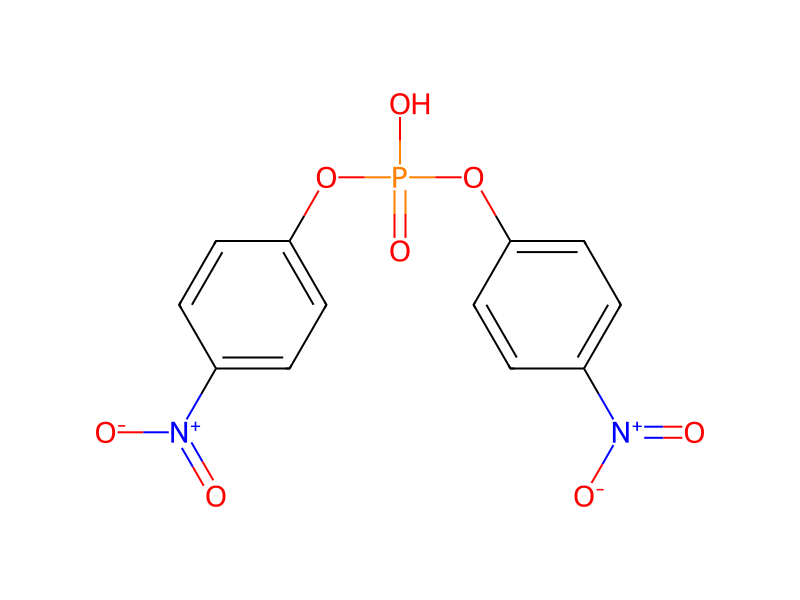
Basic information
- Standard SMILES
O=[N+]([O-])c1ccc(OP(=O)(O)Oc2ccc([N+](=O)[O-])cc2)cc1- InChIKey
MHSVUSZEHNVFKW-UHFFFAOYSA-N- Molecular formula
- C12H9N2O8P
- Average molar mass
- 340.18 g/mol
- Monoisotopic mass
- 340.00965188
Overview
Bis-4-nitrophenyl phosphate is an aryl phosphate. It is functionally related to a 4-nitrophenol.
Names & identifiers
- Preferred name
- Bis(p-nitrophenyl) phosphate
- IUPAC
- bis(4-nitrophenyl) hydrogen phosphate
- English name
- Bis(4-nitrophenyl) phosphate
- Molecular formula
- C12H9N2O8P
- Molecular weight
- 340.18
Names & synonyms
645-15-8Bis(4-nitrophenyl)phosphatebis(p-nitrophenyl)phosphatebis(p-nitrophenyl) phosphatedi-p-nitrophenyl phosphatep-Nitrophenyl monohydrogen phosphatePhosphoric acid, bis(p-nitrophenyl) esterPhenol, p-nitro-, hydrogen phosphate1MF77LEI63NSC-59824DTXSID20870742Bis[4-nitrophenyl]phosphate
Show more names
BNPPdi-p-nitrophenylphosphateDi-4-nitrophenyl phosphatep-nitro-phenohydrogenphosphateDI-P-NITROPHENYLPHOSPHORIC ACIDBis(4-nitrophenyl)phosphate 98%BIS(PARA-NITRO-PHENYL)PHOSPHATE
BNPP-4BpNPPRefChem:120158bis(para-nitrophenol)phosphateDTXCID40203078211-434-7bis(4-nitrophenyl) phosphateBis(4-nitrophenyl) hydrogen phosphate
Database identifiers
- CAS
645-15-8- PubChem CID
- 255
- DTXSID
DTXSID20870742- ChEMBL
CHEMBL1231178- ChEBI
CHEBI:3122- UNII
- 1MF77LEI63
- EC Number
- 211-434-7
- Nikkaji
- J205.923A、J694.749B
Properties
Computed structural properties
- XLogP
- 1
- Topological polar surface area
- 147 Ų
- Hydrogen bond donors
- 1
- Hydrogen bond acceptors
- 8
- Rotatable bonds
- 4
- Heavy atoms
- 23
- Formal charge
- 0
- Complexity
- 434
Physicochemical properties
- Melting point
- 172 · 172-175 °C(lit.)
- Boiling point
- 545.7 · 545.7±60.0 °C(Predicted)
- Density
- 1.614 · 1.614±0.06 g/cm3(Predicted)
- storage temp.
- Sealed in dry,Room Temperature
- solubility
- DMSO (Slightly), Isopropanol (Slightly), Methanol
- pka
- 1.04 · 1.04±0.50(Predicted)
- form
- powder to crystal
- color
- White to Almost white
- Water Solubility
- almost transparency
- InChI
- InChI=1S/C12H9N2O8P/c15-13(16)9-1-5-11(6-2-9)21-23(19,20)22-12-7-3-10(4-8-12)14(17)18/h1-8H,(H,19,20)
- InChIKey
- MHSVUSZEHNVFKW-UHFFFAOYSA-N
- SMILES
- P(O)(OC1=CC=C([N+]([O-])=O)C=C1)(OC1=CC=C([N+]([O-])=O)C=C1)=O
- CAS DataBase Reference
- 645 · 645-15-8(CAS DataBase Reference)
- FDA UNII
- 1 MF77LEI63 · 1MF77LEI63
- NIST Chemistry Reference
- Phosphoric acid, bis(p-nitrophenyl) ester(645-15-8)
- EPA Substance Registry System
- Bis(p-nitrophenyl) phosphate (645-15-8)
- UNSPSC Code
- 12352100 · 12352100
- NACRES
- 22 · NA.22
- Symbol(GHS)
- 6 · GHS06
- Signal word
- Danger
- Hazard statements
- 300 · H300
- Precautionary statements
- 301 · P301+P310+P330
- PPE
- 2 · Eyeshields, Faceshields, Gloves, type P2 (EN 143) respirator cartridges
- Hazard Codes
- T
- Risk Statements
- 25 · 25
- Safety Statements
- 45 · 45
- RIDADR
- 2811 · UN 2811 6.1/PG 3
- WGK Germany
- 3 · 3
- RTECS
- 8260000 · TB8260000
- TSCA
- TSCA listed
- HazardClass
- 6.1 · 6.1
- HS Code
- 29199000 · 29199000
- Storage Class
- 6.1 A · 6.1A - Combustible acute toxic Cat. 1 and 2very toxic hazardous materials
- Hazard Classifications
- 2 Oral · Acute Tox. 2 Oral
- Limited Quantities
- 5 kg · 5.0 kg (11 lbs) (solid)
- Excepted Quantities
- Max Inner Pack (30g or 30ml) and Max Outer Pack (1Kg or 1L)
Safety & regulation
GHS classification
GHS Classification
Danger
H300 (95.2%): Fatal if swallowed [Danger Acute toxicity, oral]
P264, P270, P301+P316, P321, P330, P405, and P501 (click each P-code to see the statement)
Aggregated GHS information provided per 42 reports by companies from 3 notifications to the ECHA C&L Inventory.
Hazard information
Hazard Classes and CategoriesAcute Tox. 2 (95.2%)
Safety data
- PPE
- Eyeshields, Faceshields, Gloves, type P2 (EN 143) respirator cartridges
- wgk
- 3
- tsca
- TSCA listed
- rtecs
- TB8260000
- ridadr
- UN 2811 6.1/PG 3
- hs_code
- 29199000
- risk_code
- 25
- Signal word
- Danger
- Symbol(GHS)
- GHS06
- hazard_code
- T
- safety_code
- 45
- hazard_class
- 6.1
- Storage Class
- 6.1A - Combustible acute toxic Cat. 1 and 2very toxic hazardous materials
- Hazard statements
- H300
- Limited Quantities
- 5.0 kg (11 lbs) (solid)
- Excepted Quantities
- Max Inner Pack (30g or 30ml) and Max Outer Pack (1Kg or 1L)
- Hazard Classifications
- Acute Tox. 2 Oral
- Precautionary statements
- P301+P310+P330
Chemistry & industry
Pharmacology
MeSH Pharmacological ClassificationCompounds or agents that combine with an enzyme in such a manner as to prevent the normal substrate-enzyme combination and the catalytic reaction.
Uses & manufacturing
General Manufacturing InformationPhosphoric acid, bis(4-nitrophenyl) ester: INACTIVE
Applications
UsesBis(4-nitrophenyl) phosphate(BNPP) has been used as substrate to determine the enzyme activity of root phosphodiesterases of wetland plants. BNPP has been used to study the mechanism of cleavage of BNPP using oxamido-bridged dinuclear copper(II) complexes as catalysts.
UsesInhibitor of enzyme. It is used for Phosphodiesterase Substrate.
Upstream & downstream products
Upstream raw materials
Suppliers50 total
梯希爱(上海)化成工业发展有限公司021-67121386 · [email protected]
阿诺西(上海)生物技术有限公司400-1107768 15058188853 · [email protected]
湖北永阔科技有限公司027-59223108 15972152991 · [email protected]
上海阿拉丁生化科技股份有限公司400-6206333 13167063860 · [email protected]
湖南韵邦生物科技股份有限公司85561037 15386497078 · [email protected]
青岛司臣生物科技有限公司15066846586 15712728865 13713086161 15066846586 · [email protected]
广州隽沐生物科技股份有限公司020-36607679; 13502246435 · [email protected]
宁波季诺化学品有限公司0574-87314919 057487319282 · [email protected]
Dayang Chem (Hangzhou) Co.,Ltd.+86-0571-88938639 17705817739 · [email protected]
广州隽唐科技有限公司020-36607679 13502246435 · [email protected]
科瑞迪化学400-821-5857 021-64326257 · [email protected]
毕佳索(上海毕得医药科技股份有限公司)400-6005915 · [email protected]
上海晶抗生物工程有限公司021-54721350 13524668266 · [email protected]
安耐吉化学&3A(安徽泽升科技股份有限公司)400-0056266 · [email protected]
北京绿百草科技发展有限公司010-61136123 · [email protected]
上海瀚鸿科技股份有限公司021-54306202 13764082696 · [email protected]
MedBio脉铂医药021-69568360 18916172912 · [email protected]
嘉兴市艾森化工有限公司0573-85285100 18627885956 · [email protected]
湖北广奥生物科技有限公司027-02702759223056 18162699093 · [email protected]
玛雅试剂+86 (573) 82222445 (0)18006601000 452520369 · [email protected]
四川库利南科技有限公司400-1166-196 18981987031 · [email protected]
上海耐士化工科技有限公司400-188-0725 +86 21 34310725 13611771617
天津希恩思生化科技有限公司400 638 7771 · [email protected]
北京泰亚杰科技有限公司021-33690831-8001 13552411790;18616022633 · [email protected]
上海源叶生物科技有限公司13636370518 · [email protected]
金克隆(北京)生物技术有限公司400-910-1997 15330005590 · [email protected]
上海思域化工科技有限公司86-21-34053660 · [email protected]
TCI AMERICA800-4238616 · [email protected]
TOKYO CHEMICAL INDUSTRY CO., LTD.03-36680489 · [email protected]
TCI Europe320-37350700 · [email protected]
深圳振强药物研发有限公司0755-66853366 13670046396 · [email protected]
越林试剂021-62960152 · [email protected]
陕西麟邦实业有限公司17709134430 · [email protected]
苏州亚科科技股份有限公司0512-87182055 13451648594 · [email protected]
河南赢创生物科技有限公司15672878902 · [email protected]
无锡中坤生化科技有限公司+86 0510-85629785
上海湄水化工科技有限公司021-60549325 18616193163
上海将来实业股份有限公司021-61552785 · [email protected]
雷丁试剂0510-85629785 18013409632 · [email protected]
上海创赛科技有限公司400-6087598 15021221957 · [email protected]
天津普西唐生物医药科技有限公司010-60605840 · [email protected]
上海鑫圭生物科技有限公司15121041756 · [email protected]
上海麦克林生化科技股份有限公司15221275939 15221275939 · [email protected]
江苏艾康生物医药研发有限公司025-66028182 17714375163 · [email protected]
凯试(上海)科技有限公司021-50135380 · [email protected]
Sigma-Aldrich西格玛奥德里奇(上海)贸易有限公司021-61415566 800-8193336 · [email protected]
江苏倍达医药科技有限公司0512-63009836 18994340901 · [email protected]
TargetMol中国(陶术生物)021-021-33632979 15002134094 · [email protected]
上海陶术生物科技股份有限公司+1-781-999-5354; +1-00000000000 · [email protected]
北京诺其雅盛生物科技有限公司4000-819-385 010-62329685 13718666987
Additional notes
DefinitionChEBI: Bis-4-nitrophenyl phosphate is an aryl phosphate. It is functionally related to a 4-nitrophenol.
Related reactions
1 records
Linked notes
Loading…