
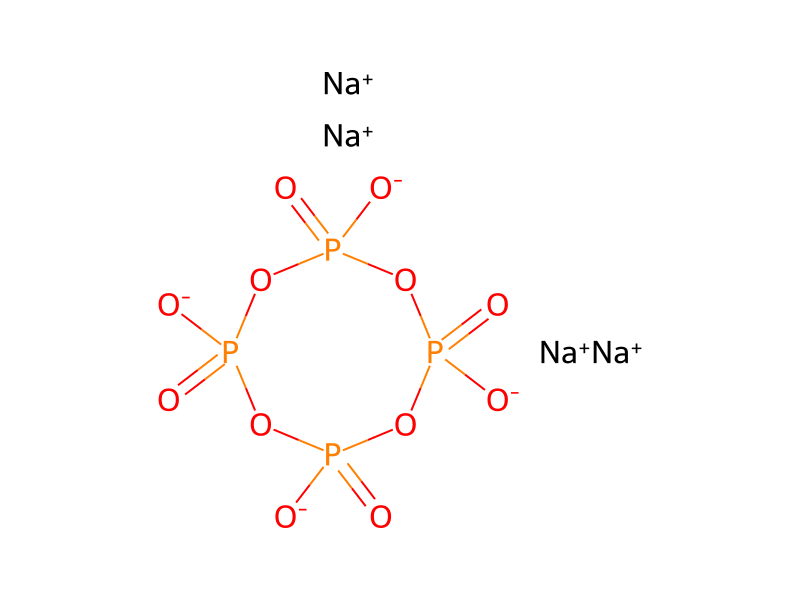
Basic information
- CAS
13396-41-3- Standard SMILES
O=P1([O-])OP(=O)([O-])OP(=O)([O-])OP(=O)([O-])O1.[Na+].[Na+].[Na+].[Na+]- InChIKey
UDEJEOLNSNYQSX-UHFFFAOYSA-J- Molecular formula
- Na4O12P4
- Average molar mass
- 407.85 g/mol
- Monoisotopic mass
- 407.79309908
Overview
RN given refers to metaphosphoric acid, tetra-Na salt
Names & identifiers
- Preferred name
- Sodium tetrametaphosphate
- IUPAC
- tetrasodium;2,4,6,8-tetraoxido-1,3,5,7,2λ5,4λ5,6λ5,8λ5-tetraoxatetraphosphocane 2,4,6,8-tetraoxide
- English name
- Sodium Tetrametaphosphate
- Molecular formula
- Na4O12P4
- Molecular weight
- 407.846924
Names & synonyms
CyclofosSODIUM TETRAMETAPHOSPHATE13396-41-3Tetrasodium cyclotetraphosphateMetaphosphoric acid (H4P4O12), tetrasodium saltTetrasodium tetrametaphosphateSodium tetrametaphosphate (Na4P4O12)Tetrametaphosphoric acid, tetrasodium saltSodium cyclotetraphosphate (Na4(P4O12))Metaphosphoric acid, tetrasodium saltSodium cyclotetraphosphate (Na4P4O12)MLC36A7X39
Show more names
CyclophosTetrasodium tetramethaphosphateMetaphosphoric acid, tetrasodium salt.2,4,6,8-Tetrakis(sodiooxy)-1,3,5,7-tetraoxa-2,4,6,8-tetraphosphacyclooctane-2,4,6,8-tetronetetrasodium,2,4,6,8-tetraoxido-1,3,5,7,2λ5,4λ5,6λ5,8λ5-tetraoxatetraphosphocane 2,4,6,8-tetraoxide
Tetrametaphosphoric acid (H4P4O12), tetrasodium saltDTXSID5074507RefChem:184124DTXCID2034174236-482-6Sodium metaphosphate (Na4P4O12)HSDB 773EINECS 236-482-6
Database identifiers
- CAS
13396-41-3- PubChem CID
- 25951
- DTXSID
DTXSID5074507- UNII
- MLC36A7X39
- EC Number
- 236-482-6
- Nikkaji
- J317.855B
Properties
Computed structural properties
- Topological polar surface area
- 197 Ų
- Hydrogen bond donors
- 0
- Hydrogen bond acceptors
- 12
- Rotatable bonds
- 0
- Heavy atoms
- 20
- Formal charge
- 0
- Complexity
- 316
Experimental & physicochemical properties
Chemical ClassesMetals -> Phosphates, Metallic Salts
Physicochemical properties
- FDA UNII
- 36 A7X39 · MLC36A7X39
- EPA Substance Registry System
- Metaphosphoric acid (H4P4O12), tetrasodium salt (13396-41-3)
- Hazardous Substances Data
- 13396 · 13396-41-3(Hazardous Substances Data)
Safety & regulation
Hazard information
Hazards Summary
Emergency treatment: Inorganic phosphates; Inorganic phosphates can cause diarrhea, hyperphosphatemia, and hypocalcemia after ingestion; An adult died after receiving four sodium phosphate enemas within 24 hours; he had electrolyte abnormalities and died from cardiac arrest; [HSDB]
Safety & protection
Disposal Methods
SRP: At the time of review, criteria for land treatment or burial (sanitary landfill) disposal practices are subject to significant revision. Prior to implementing land disposal of waste residue (including waste sludge), consult with environmental regulatory agencies for guidance on acceptable disposal practices.
Safety data
- Hazardous Substances Data
- 13396-41-3(Hazardous Substances Data)
Chemistry & industry
Uses & manufacturing
Uses
Used in household detergents, water conditioning, toothpaste, processed cheese, and additives in meat, fish, and poultry; [HSDB]
PHOSPHATE BUILDER IN HOUSEHOLD DETERGENTS; AGENT IN WATER CONDITIONING; ADDITIVE IN MEAT, FISH, POULTRY, & PROCESSED CHEESE; ABRASIVE IN TOOTHPASTE
Sequestrants; emulsifiers; textile processing; laundering /Sodium metaphosphate polymers/
Used in substitute dairy products for one or more of the following purposes: to alter buffering capacity of the system; to improve the stability of the protein to calcium ions; to improve the heat stability of the protein; to minimize the age gelatin of ultra-high temperature-(UHT) processed substitute products; to serve as emulsifying salts in imitation cheese manufacturing; and to modify the after-bonding capacity of protein and improve stability.
U.S. Production(1972) 1.08X10+10 GRAMS (INCL HEXA & POLY)
Consumption Patterns(INCL ALL SODIUM METAPHOSPHATES) 69% FOR BUILDERS & WATER TREATMENT; 12% FOR DENTIFRICES; 8% FOR CLAY PROCESSING; 7% FOR FOODS; 4% FOR MISCELLANEOUS USES (1972)
Methods of ManufacturingPREPD BY DEHYDRATION OF SODIUM PHOSPHATES (EG NA2H2P2O7, NAH2PO4, NA2HPO4). SEVERAL DIFFERENT FORMS ARE KNOWN.
General Manufacturing Information
(NaPO3)n, where n ranges from 3-10 (cyclic molecules) or may be a much larger number (polymers). Cyclic sodium metaphosphate, based on rings of alternating phosphorus & oxygen atoms, range from trimetaphosphate, (NaPO3)3, to at least decametaphosphate.
Vitreous sodium phosphates having Na2O/P2O5 mole ratio near unity are classified as sodium metaphosphates (Graham's Salts). Average number of phosphorus atoms per molecules in these glasses ranges from about 25 to infinity.
The term sodium metaphosphate has also been extended to short-chain vitreous compositions, molecules of which exhibit polyphosphate formula Na(n+2)P(n)O3(n+1) with n as low as 4-5. These materials are more correctly called sodium polyphosphates.
THERE ARE NUMBER OF PROPOSED FOOD APPLICATIONS FOR CMPD, BUT NO APPLICATION HAS THUS FAR BEEN THOUGHT IMPORTANT ENOUGH TO BE APPROVED FOR USE IN FOODS BY US FDA.
Applications
UsesSodium Tetrametaphosphate is a sequestrant and emulsifier that is infinitely soluble in water. It is used as a water binder in cured pork. It is also termed graham’s salt.
Suppliers2 total
陕西缔都新材料有限公司029-63373950 17392216152 · [email protected]
DAYANG CHEM (HANGZHOU) CO.,LTD+86-88938639 +86-17705817739 · [email protected]
Related reactions
2 records

Compound notes
Loading…