Butyric Acid
BUTANOIC ACID · butyrate · C4 · N-BUTYRIC ACID · C4A · N-BUTYRATE · FEMA 2221 · N-BUTANOIC ACID
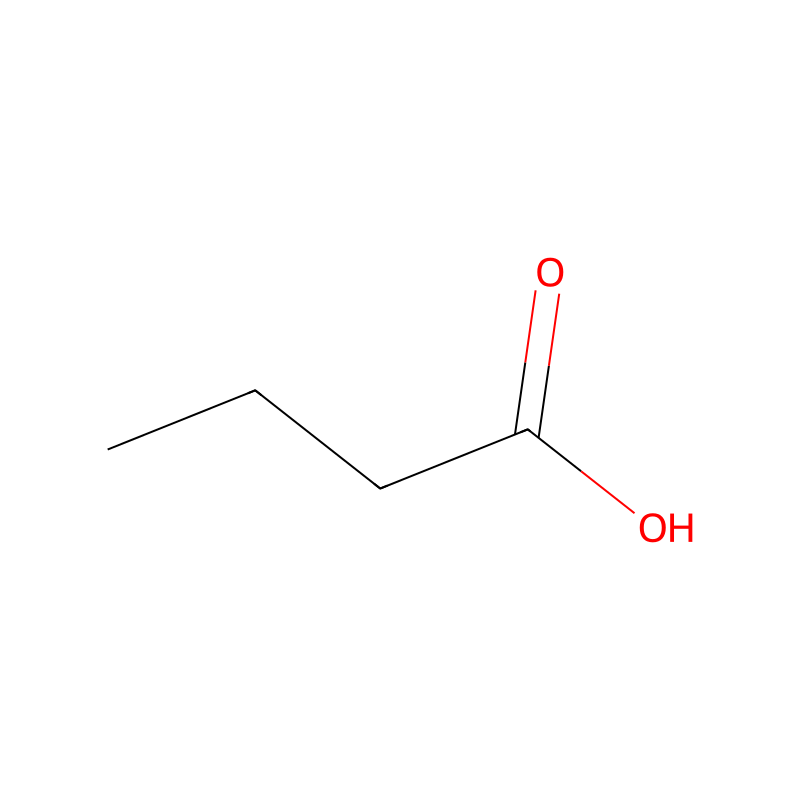
Identifiers & Physical Properties
| CAS No. | 107-92-6 |
|---|---|
| Molecular formula | C4H8O2 |
| Average molar mass | 88.11 g/mol |
| Monoisotopic mass | 88.0524295 g/mol |
| SMILES | CCCC(=O)O |
| InChIKey | FERIUCNNQQJTOY-UHFFFAOYSA-N |
| PubChem CID | 264 |
| ChEMBL | CHEMBL14227 |
| ChEBI | CHEBI:30772 |
| EC No. | 203-532-3 |
| DTXSID | DTXSID8021515 |
Chemical & Physical Properties
| XLogP | 0.8 |
|---|---|
| Topological polar surface area | 37.3 |
| Hydrogen bond donors | 1 |
| Hydrogen bond acceptors | 2 |
| Rotatable bonds | 2 |
| Heavy atoms | 6 |
| Formal charge | 0 |
| Complexity | 49.5 |
| Chemical classes | Other Classes -> Organic AcidsCorrosives |
| Lipids | Fatty Acyls [FA] -> Fatty Acids and Conjugates [FA01] -> Straight chain fatty acids [FA0101] |
| SpringerMaterials Properties | Boiling point |
| Fragrances | Fragrance Ingredient (Butyric acid) -> IFRA transparency List |
| LogP (partition coefficient) | log Kow= 0.79 |
| Odor | Unpleasant, rancid odorPenetrating and obnoxious odorat 1.00 % in dipropylene glycol. sharp acetic cheese butter fruit |
| Taste | Butter-fat taste |
| Food additives | ANTIOXIDANT, FLAVORING AGENT OR ADJUVANT, PH CONTROL AGENT -> FDA Substance added to food |
| Density | 0.958 at 68 °F (USCG, 1999) - Less dense than waterwill float0.959 at 20 °C/4 °CRelative density (water = 1): 0.960.952-0.9560.959 @25 °C0.964 g/mL at 25 °C (lit.) |
| Flavoring agents | EU Flavoring substances |
| Viscosity | 1.426 mPa-s at 25 °C |
| Color/Form | Oily liquidColorless liquid |
| Melting point | -6--3 °C (lit.) |
| Boiling point | 162 °C (lit.) |
| Vapor density | 3.04 (vs air) |
| Vapor pressure | 0.43 mm Hg ( 20 °C) |
| Refractive index | n20/D 1.398(lit.) |
| FEMA | 2221 | BUTYRIC ACID |
| FLAVIS Number | 08.005 | Butyric acid |
| Flash point | 170 °F |
| Storage conditions | Store below +30°C. |
| Solubility | Chloroform (Soluble), Isopropanol (Sparingly), Methanol (Slightly)Miscible with water, Propylene glycol, Glycerin, alcohol and oils. |
| pKa (acidity coefficient) | 4.83(at 25℃) |
| Physical state | Liquid |
| Color | Clear colorless |
| Specific gravity | 0.960 (20/4℃) |
| pH | 3.94(1 mM solution)3.42(10 mM solution)2.92(100 mM solution) |
| Explosive limits | 2-12.3%(V) |
| Odor type | cheesy |
| Odor threshold | 0.00019ppm |
| Biological source | synthetic |
| Specific heat capacity | Cp(liquid): 2.03 J/(g·K), at 25℃ |
| Merck | 14,1593 |
| JECFA Number | 87 |
| BRN | 906770 |
| Henry's law constant | 4.3×101 mol/(m3Pa) at 25℃, Kim and Kim (2016) |
| Dielectric constant | 3.0(Ambient) |
| Stability | Flammable. Incompatible with strong oxidizing agents, aluminium and most other common metals, alkalies, reducing agents. |
| Major applications | flavors and fragrances |
| Cosmetics Ingredients Functions | FRAGRANCE |
| InChI | 1S/C4H8O2/c1-2-3-4(5)6/h2-3H2,1H3,(H,5,6) |
| InChIKey | FERIUCNNQQJTOY-UHFFFAOYSA-N |
| SMILES | CCCC(O)=O |
| LogP (partition coefficient) | 1.1 at 25℃ |
| Surface tension | 26.71mN/m at 293.15K |
| CAS DataBase Reference | 107-92-6(CAS DataBase Reference) |
| Substances Added to Food (formerly EAFUS) | BUTYRIC ACID |
| EWG's Food Scores | 1 |
| FDA UNII | 40UIR9Q29H |
| NIST Chemistry Reference | Butanoic acid(107-92-6) |
| EPA Substance Registry System | Butyric acid (107-92-6) |
| UNSPSC Code | 85151701 |
| NACRES | NA.24 |
| GHS pictogram | GHS05,GHS06,GHS08 |
| Signal word | Danger |
| GHS hazard statements | H311-H302-H314-H371-H402-H227-H290 |
| GHS precautionary statements | P501-P273-P270-P260-P210-P234-P264-P280-P370+P378-P390-P308+P311-P361+P364-P303+P361+P353-P301+P330+P331-P301+P312+P330-P304+P340+P310-P305+P351+P338+P310-P403+P235-P406-P405 |
| Target organs | Respiratory system |
| Personal protective equipment (PPE) | Faceshields, Gloves, Goggles, type ABEK (EN14387) respirator filter |
| Hazard symbols | C,Xi |
| Risk statements (R) | 34 |
| Safety statements (S) | 26-36-45 |
| UN transport number | UN 2820 |
| Water hazard class (WGK) | 1 |
| RTECS number | ES5425000 |
| F | 13 |
| Autoignition temperature | 824 °F |
| Hazard Note | Irritant |
| TSCA inventory status | TSCA listed |
| Customs code | 2915 60 19 |
| Hazard class | 8Acute Tox. 4 OralEye Dam. 1Skin Corr. 1BSTOT SE 3 |
| Packing group | III |
| Storage class | 8A - Combustible corrosive hazardous materials |
| Hazardous substances data | 107-92-6(Hazardous Substances Data) |
| Toxicity | LD50 orally in rats: 8.79 g/kg (Smyth) |
| REACH registrations | Active |
| Limited quantities | 5.0 L (1.3 gallons) (liquid) or 5.0 kg (11 lbs) (solid) |
| Excepted quantities | Max Inner Pack (30g or 30ml) and Max Outer Pack (1Kg or 1L) |
Safety & Regulations
| GHS classification | DangerH314: Causes severe skin burns and eye damage [Danger Skin corrosion/irritation]P260, P264, P280, P301+P330+P331, P302+P361+P354, P304+P340, P305+P354+P338, P316, P321, P363, P405, and P501 (click each P-code to see the statement)H302 (15.5%): Harmful if swallowed [Warning Acute toxicity, oral]P260, P264, P264+P265, P270, P280, P301+P317, P301+P330+P331, P302+P361+P354, P304+P340, P305+P354+P338, P316, P317, P321, P330, P363, P405, and P501 (click each P-code to see the statement) |
|---|---|
| Regulatory information | Chemical: Butanoic acidButanoic acid is listed on the EPA's Chemical Data Reporting (CDR) system. Manufacturers and importers of Butanoic acid are required to report information about their production and use of this chemical to the EPA under the Toxic Substances Control Act (TSCA). (40 eCFR Part 711)Status: Active Update: 27-07-2021 https://echa.europa.eu/registration-dossier/-/registered-dossier/13507Butyric acid: Does not have an individual approval but may be used under an appropriate group standardThe New Jersey Worker and Community Right to Know Act requires public and private employers to provide information about hazardous substances at their workplaces. (N.J.S.A. 34:5A-1 et. seq.) |
| Other safety information | IMAP assessments - Butanoic acid: Environment tier I assessment |
| DOT label | Corrosive |
| Fire hazards | Excerpt from ERG Guide 153 [Substances - Toxic and/or Corrosive (Combustible)]:· Combustible material: may burn but does not ignite readily.Combustible. Gives off irritating or toxic fumes (or gases) in a fire. Above 72 °C explosive vapour/air mixtures may be formed. |
| Fire potential | ... Combustible liquid |
| Health hazards | Inhalation causes irritation of mucous membrane and respiratory tractmay cause nausea and vomiting. Ingestion causes irritation of mouth and stomach. Contact with eyes may cause serious injury. Contact with skin may cause burnschemical is readily absorbed through the skin and may cause damage by this route. (USCG, 1999)· TOXIC and/or CORROSIVE |
Applications & Uses
Description
Butyric acid is a carboxylic acid also classified as a fatty acid. It exists in two isomeric forms as shown previously, but this entry focuses on n-butyric acid or butanoic acid. It is a colorless, viscous, rancid-smelling liquid that is present as esters in animal fats and plant oils. Butyric acid exists as a glyceride in butter, with a concentration of about 4%; dairy and egg products are a primary source of butyric acid. When butter or other food products go rancid, free butyric acid is liberated by hydrolysis, producing the rancid smell. It also occurs in animal fat and plant oils.
Occurrence
Normally occurs in butter as a glyceride. It has been reported found in the essential oils of citronella Ceylon, Eucalyptus globules, Araucaria cunninghamii, Lippia scaberrima, Monarda fistulosa, cajeput, Heracleum giganteum, lavender, Hedeoma pulegioides, valerian, nutmeg, hops, Pastinaca sativa, Spanish anise and others. It has been identified in strawberry aroma, apricot, American cranberry, sour cherry, black currants, butter, milk, strawberry jam, cheeses (blue, cheddar, feta, Swiss, Camembert and romano), raspberry, papaya, coffee mutton, beer, rum, bourbon whiskey and cider.
History
Butyric acid gets its name from the Latin butyrum, or butter. It was discovered by Adolf Lieben (1836–1914) and Antonio Rossi in 1869. Butyric acid is one of the simplest fatty acids.
Uses
Butyric Acid is a fatty acid that is commonly obtained from butter fat. it has an objectionable odor which limits its uses as a food acid- ulant or antimycotic. it is an important chemical reactant in the manufacture of synthetic flavoring, shortening, and other edible food additives. in butter fat, the liberation of butyric acid which occurs during hydrolytic rancidity makes the butter fat unusable. it is used in soy milk-type drinks and candies.
Uses
It is used in plastics as a raw material for the cellulose acetate butyrate (CAB). Other uses of butyric acid are in disinfectants, pharmaceuticals, and feed supplements for plant and animals. Butyric acid derivatives play an important role in plant and animal physiology.
Uses
Butyric acid is used in the preparation of various butyrate esters. Low-molecular-weight esters of butyric acid, such as methyl butyrate, have mostly pleasant aromas or tastes. As a consequence, they find use as food and perfume additives. It is also used as an animal feed supplement, due to the ability to reduce pathogenic bacterial colonization. It is an approved food flavoring in the EU FLAVIS database (number 08.005). Due to its powerful odor, it has also been used as a fishing bait additive. Many of the commercially available flavors used in carp (Cyprinus carpio) baits use butyric acid as their ester base; however, it is not clear whether fish are attracted by the butyric acid itself or the substances added to it. Butyric acid was, however, one of the few organic acids shown to be palatable for both tench and bitterling. The substance has also been used as a stink bomb by Sea Shepherd Conservation Society to disrupt Japanese whaling crews, as well as by anti-abortion protesters to disrupt abortion clinics.
Preparation & Synthesis
Preparation
Obtained by fermentation of starches and molasses with selective enzymes (Granulo saccharobutyricum); it is subsequently isolated as the calcium salt.