HomeMCPWorkbenchSkills
HomeWorkbenchNotificationsMe
llms.txt · MCP GuidePrivacy Policy · Terms of Service · Supportv1.8.3
  1. Home
  2. /Compound

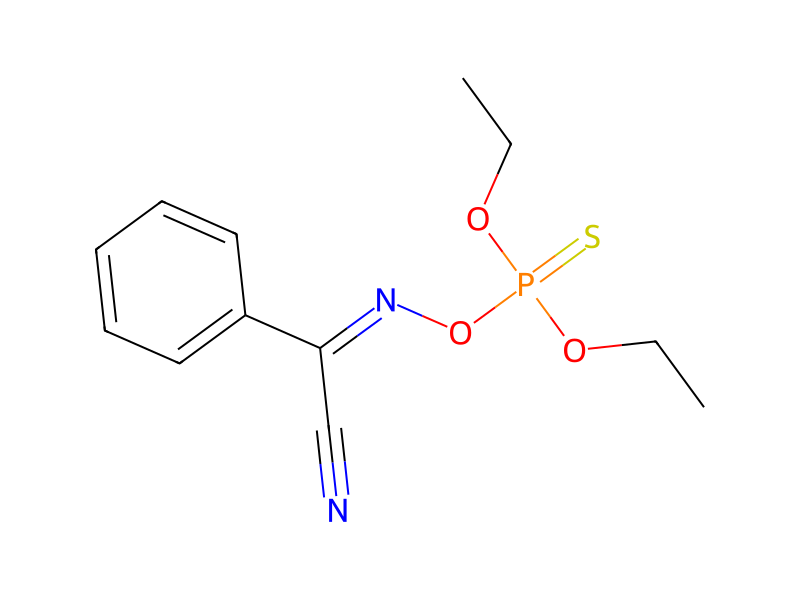
Phoxim

HCID 26927
New reaction
Print
Basic informationOverviewNames & identifiersPropertiesSafety & regulationChemistry & industryRelated reactionsCompound notes
Substructure searchFind similar structures

Basic information

CAS
14816-18-3
Standard SMILES
CCOP(=S)(OCC)ON=C(C#N)c1ccccc1
InChIKey
ATROHALUCMTWTB-UHFFFAOYSA-N
Molecular formula
C12H15N2O3PS
Average molar mass
298.3 g/mol
Monoisotopic mass
298.05410052

Overview

Phoxim is a synthetic organophosphate acetylcholinesterase inhibitor that is used as a pesticide. It is characterized as a yellow liquid, and exposure occurs by inhalation, ingestion, or contact.

Names & identifiers

Preferred name
Phoxim
IUPAC
N-diethoxyphosphinothioyloxybenzenecarboximidoyl cyanide
English name
Phoxim
Molecular formula
C12H15N2O3PS
Molecular weight
298.3

Names & synonyms

PHOXIM14816-18-3BaythionPhoximeSebacil (insecticide)PhoxinSebacil Pour-on6F5V775VPOBAYER-9053Bay-77488BAY 77488alpha-(((Diethoxyphosphinothioyl)oxy)imino)benzeneacetonitrile
Show more names
Foximb77488VOLATONoms1170Sebacilsra7502Valexon
phenylglyoxylonitrile oxime O,O-diethylphosphorothioateDTXSID8034324Phenylglyoxylnitrile oxime O,O-diethyl phosphorothioateO,O-Diethyl-alpha-cyanobenzylidineaminooxyphosphonothiateCHEBI:38812RefChem:863020DTXCID20810007238-887-3

Database identifiers

CAS
14816-18-3
PubChem CID
26927
DTXSID
DTXSID8034324
ChEMBL
CHEMBL1906626
UNII
6F5V775VPO
EC Number
238-887-3

Properties

Computed structural properties

XLogP
4.4
Topological polar surface area
95.9 Ų
Hydrogen bond donors
0
Hydrogen bond acceptors
6
Rotatable bonds
7
Heavy atoms
19
Formal charge
0
Complexity
389

Experimental & physicochemical properties

Pesticides · 3 items

Insecticides

Active substance -> EU Pesticides database: Not approved

Pesticide (Phoxim) -> USDA PDB

Endocrine DisruptorsPotential endocrine disrupting compound
Collision Cross Section165.7 Ų [M-H]- [CCS Type: DT; Buffer gas: N2; Ionization: ESI-; Dataset: TOXCAST; Source Identifier: DTXSID8034324]

Physicochemical properties

Melting point
5.55 °C · 5.55°C
Boiling point
0.01 · bp0.01 102°
Density
420 · d420 1.176
vapor pressure
2.1 · 2.1×10-3 Pa (20 °C)
refractive index
20 · nD20 1.5405
storage temp.
0 · 0-6°C
solubility
Acetonitrile (Slightly), Chloroform (Slightly), Methanol (Slightly)
Water Solubility

Safety & regulation

Safety information is for reference only and does not replace the supplier’s Safety Data Sheet (SDS), applicable regulations, or professional assessment.

GHS classification

GHS Classification · 6 items

Warning

H302: Harmful if swallowed [Warning Acute toxicity, oral]

P203, P261, P264, P270, P272, P273, P280, P301+P317, P302+P352, P318, P321, P330, P333+P317, P362+P364, P391, P405, and P501 (click each P-code to see the statement)

Danger

H301 (33.6%): Toxic if swallowed [Danger Acute toxicity, oral]

P203, P260, P261, P262, P264, P270, P271, P272, P273, P280, P284, P301+P316, P301+P317, P302+P352, P304+P340, P316, P318, P320, P321, P330, P333+P317, P361+P364, P362+P364, P391, P403+P233, P405, and P501 (click each P-code to see the statement)

Hazard information

Other Safety InformationIMAP assessments - 3,5-Dioxa-6-aza-4-phosphaoct-6-ene-8-nitrile, 4-ethoxy-7-phenyl-, 4-sulfide: Human health tier I assessment
Hazard Classes and Categories · 3 items

Acute Tox. 3 (33.6%)

Reproductive toxicity - category 2

Repr. 2

Toxicology

Acute Toxicity LinkChemical: PHOXIM

Safety data

wgk
3
rtecs
MD4740000
ridadr
UN 2810
hs_code
29269090
Toxicity
LD50 orally in mice: >2000 mg/kg (Vinopal, Fukuto)
risk_code
22-50/53-62-43

Chemistry & industry

Pharmacology

ATC CodeQP - Antiparasitic products, insecticides and repellents
MeSH Pharmacological Classification · 2 items

Drugs that inhibit cholinesterases. The neurotransmitter ACETYLCHOLINE is rapidly hydrolyzed, and thereby inactivated, by cholinesterases. When cholinesterases are inhibited, the action of endogenously released acetylcholine at cholinergic synapses is potentiated. Cholinesterase inhibitors are widely used clinically for their potentiation of cholinergic inputs to the gastrointestinal tract and urinary bladder, the eye, and skeletal muscles; they are also used for their effects on the heart and the central nervous system.

Pesticides designed to control insects that are harmful to man. The insects may be directly harmful, as those acting as disease vectors, or indirectly harmful, as destroyers of crops, food products, or textile fabrics.

Uses & manufacturing

Use Classification · 4 items

Veterinary Drug -> INSECTICIDE -> JECFA Functional Classes

Veterinary Drug -> INSECTICIDE -> JECFA Functional Classes

Veterinary Drug -> INSECTICIDE -> JECFA Functional Classes

INSECTICIDES

Applications · 3 items

DescriptionPhoxim is a light yellow liquid, Solubility in water is 1.5 mg/L (20 C). It is readily soluble in most organic solvents and slightly in aliphatic hydrocarbons. Log Kow = 3.38. It is relatively slowly hydrolyzed in aqueous media; DT50 (22 C) at pH 4, 7, and 9 is 26.7, 7.2, and 3.1 d, respectively.

UsesInsecticide.

UsesPhoxim is used to control stored product insect pests in silos and barns. It is also used to control household insects such as ants and other public health pests. Agricultural targets include caterpillars and soil insects in maize, vegetables, cotton and potatoes.

Related reactions

1 records
New reaction record
HRID 319328 reaction equation
HRID 319328As reactant
Compound notes

On this pageBasic informationOverviewNames & identifiersPropertiesSafety & regulationChemistry & industryRelated reactionsCompound notes
1.5 mg · 1.5 mg l-1 (20 °C)
form
liquid
color
Colorless to light yellow
Henry's Law Constant
5 · 5.0×101 mol/(m3Pa) at 25℃, Ebert et al. (2023)
Stability
Hygroscopic, Moisture Sensitive
InChIKey
ATROHALUCMTWTB-WYMLVPIESA-N
CAS DataBase Reference
14816 · 14816-18-3(CAS DataBase Reference)
EWG's Food Scores
3 · 3
FDA UNII
6 F5V775VPO · 6F5V775VPO
NIST Chemistry Reference
Phoxim(14816-18-3)
EPA Substance Registry System
Phoxim (14816-18-3)
Symbol(GHS)
6 · GHS06,GHS08,GHS09
Signal word
Danger
Hazard statements
302 · H302-H311-H317-H330-H361f-H410
Precautionary statements
201 · P201-P260-P273-P280-P304+P340+P310-P403+P233
Hazard Codes
Xn;N,N,Xn
Risk Statements
22 · 22-50/53-62-43
Safety Statements
36 · 36-60-61-46-36/37
RIDADR
2810 · UN 2810
WGK Germany
3 · 3
RTECS
4740000 · MD4740000
HazardClass
6.1 · 6.1(b)
PackingGroup
III
HS Code
29269090 · 29269090
Toxicity
50 orally · LD50 orally in mice: >2000 mg/kg (Vinopal, Fukuto)
Signal word
Danger
Symbol(GHS)
GHS06,GHS08,GHS09
hazard_code
Xn;N,N,Xn
safety_code
36-60-61-46-36/37
hazard_class
6.1(b)
packing_group
III
Hazard statements
H302-H311-H317-H330-H361f-H410
Precautionary statements
P201-P260-P273-P280-P304+P340+P310-P403+P233

Upstream & downstream products

Upstream raw materials

EthanolChlorineTriethylaminePhosphorus pentasulfideWaterThiophosphoryl chlorideBenzeneacetonitrileSodium nitriteEthanol 95%Diethyl chlorothiophosphateMethanolIndustrial ethanolEthyl nitrite2-CyanobenzyloximePhosphine crude oilSulfuric acid

Downstream products

Fenpropathrin+Phoxim,E.C.