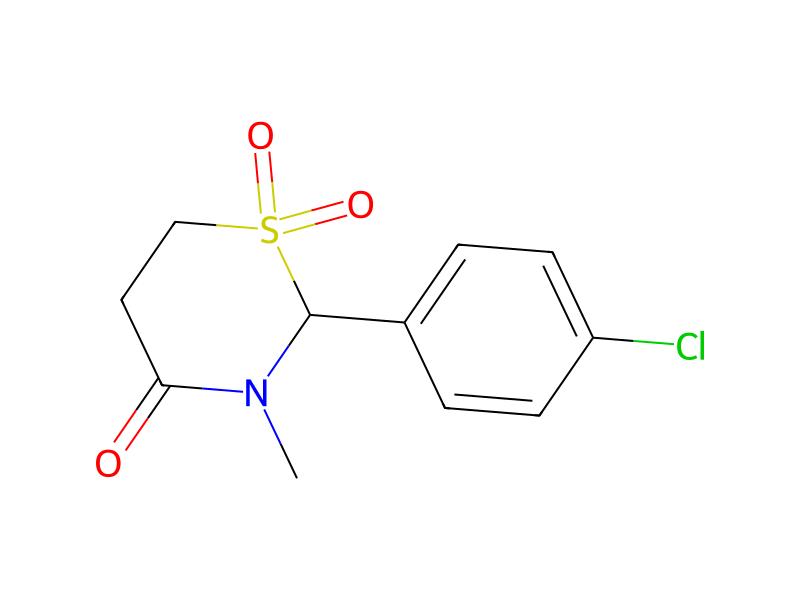
Basic information
- CAS
102818-66-6- Standard SMILES
CN1C(=O)CCS(=O)(=O)C1c1ccc(Cl)cc1- InChIKey
WEQAYVWKMWHEJO-UHFFFAOYSA-N- Molecular formula
- C11H12ClNO3S
- Average molar mass
- 273.74 g/mol
- Monoisotopic mass
- 273.02264192
Overview
Chlormezanone is a 1,3-thiazine that is 1,3-thiazinan-4-one S,S-dioxide in which a hydrogen at position 2 is substituted by a 4-chlorophenyl group and the hydrogen attached to the nitrogen is substituted by methyl. A non-benzodiazepine muscle relaxant, it was used in the management of anxiety and in the treatment of muscle spasms until being discontinued worldwide by its manufacturer in 1996, due to rare but serious cutaneous reactions. It has a role as an anxiolytic drug, an antipsychotic agent and a muscle relaxant. It is a lactam, a sulfone, a 1,3-thiazine and a member of monochlorobenzenes.
Names & identifiers
- Preferred name
- Chlormezanone
- IUPAC
- 2-(4-chlorophenyl)-3-methyl-1,1-dioxo-1,3-thiazinan-4-one
- English name
- Chlormezanone
- Molecular formula
- C11H12ClNO3S
- Molecular weight
- 273.74
Names & synonyms
Show more names
Database identifiers
- CAS
102818-66-6、102818-67-7、80-77-3- PubChem CID
- 2717
- DTXSID
DTXSID3022798- ChEMBL
CHEMBL1200714- ChEBI
CHEBI:3619- UNII
- 4BU37OM8KL、C14WB33Y0S、GP568V9G19
- EC Number
- 201-307-4
Properties
Computed structural properties
- XLogP
- 1.1
- Topological polar surface area
- 62.8 Ų
- Hydrogen bond donors
- 0
- Hydrogen bond acceptors
- 3
- Rotatable bonds
- 1
- Heavy atoms
- 17
- Formal charge
- 0
- Complexity
- 395
Experimental & physicochemical properties
Solubility
SOL (% WT/VOL) @ 25 °C: LESS THAN 0.25% IN WATER, LESS THAN 1.0% IN 95% ETHANOL
FREELY SOL IN CHLOROFORM; SLIGHTLY SOL IN DIETHYL ETHER; SPARINGLY SOL IN N-HEXANE
1.61e+00 g/L
Human Drugs
FDA approved drugs -> Active ingredient
FDA approved drugs -> Active ingredient
Pharmaceuticals
Melting Point
116.2-118.6
116.2-118.2 °C
116.2 °C
Collision Cross Section
154.1 Ų [M-H]- [CCS Type: DT; Buffer gas: N2; Ionization: ESI-; Dataset: TOXCAST; Source Identifier: DTXSID3022798]
156.85 Ų [M+H]+ [CCS Type: TW; Method: calibrated with polyalanine and drug standards]
158.2 Ų [M+H]+ [CCS Type: TW; Method: calibrated with polyalanine and drug standards]
Physicochemical properties
- Melting point
- 114 °C · 114 °C
- Boiling point
- 534.5 · 534.5±50.0 °C(Predicted)
- Density
- 1.2205 · 1.2205 (rough estimate)
- refractive index
- 1.63 · 1.6300 (estimate)
- storage temp.
- Sealed in dry,Room Temperature
- solubility
- Chloroform (Slightly), Ethyl Acetate (Slightly), Methanol (Slightly)
- form
- Solid
- pka
- -2.37 · -2.37±0.40(Predicted)
- color
- White to Pale Yellow
- Merck
- 14 · 14,2106
- InChI
- InChI=1S/C11H12ClNO3S/c1-13-10(14)6-7-17(15,16)11(13)8-2-4-9(12)5-3-8/h2-5,11H,6-7H2,1H3
- InChIKey
- WEQAYVWKMWHEJO-UHFFFAOYSA-N
- SMILES
- S1(=O)(=O)CCC(=O)N(C)C1C1=CC=C(Cl)C=C1
- FDA UNII
- 568 V9G19 · GP568V9G19
- ATC code
- 3 BB02 · M03BB02
- NIST Chemistry Reference
- Chlormezanone(80-77-3)
- UNSPSC Code
- 12352119 · 12352119
- NACRES
- 21 · NA.21
- Symbol(GHS)
- 7 · GHS07
- Signal word
- Warning
- Hazard statements
- 302 · H302
- Precautionary statements
- 301 · P301+P312a-P330-P501a-P264-P270-P301+P312+P330-P501
- RTECS
- 1050000 · XJ1050000
- HS Code
- 2934.99 · 2934.99.4400
- Storage Class
- 11 · 11 - Combustible Solids
- Hazard Classifications
- 4 Oral · Acute Tox. 4 Oral
- Hazardous Substances Data
- 80 · 80-77-3(Hazardous Substances Data)
Safety & regulation
GHS classification
GHS Classification
Warning
H302 (100%): Harmful if swallowed [Warning Acute toxicity, oral]
P264, P270, P301+P317, P330, and P501 (click each P-code to see the statement)
Aggregated GHS information provided per 4 reports by companies from 2 notifications to the ECHA C&L Inventory.
Hazard information
Toxicology
Interactions
CHLORMEZANONE MAY LOWER TOLERANCE OF PATIENTS TO ALCOHOL...POSSIBLE ADDITIVE EFFECTS /WITH CHLORMEZANONE &/ CNS DEPRESSANTS SUCH AS ALCOHOL, PHENOTHIAZINES, BARBITURATES, NARCOTICS, OTHER PSYCHOTHERAPEUTIC AGENTS, & MONOAMINE OXIDASE INHIBITORS.
Toxicity Summary
Chlormezanone binds to central benzodiazepine receptors which interact allosterically with GABA receptors. This potentiates the effects of the inhibitory neurotransmitter GABA, increasing the inhibition of the ascending reticular activating system and blocking the cortical and limbic arousal that occurs following stimulation of the reticular pathways.
Human Toxicity Excerpts
...COMMONLY PRODUCE DROWSINESS, DIZZINESS, HEADACHE, BLURRED VISION, WEAKNESS, LETHARGY, ATAXIA, & NYSTAGMUS. NAUSEA, VOMITING, HEARTBURN, & ABDOMINAL DISTRESS...ESP AFTER LARGE ORAL DOES. ...SKIN RASH & PRURITUS &, RARELY, ANAPHYLACTOID REACTIONS & LEUKOPENIA. /CENTRALLY ACTING MUSCLE RELAXANTS/
INCIDENCE OF UNTOWARD REACTIONS IS ABOUT 3% & MINOR IN NATURE...MALAISE, EXCITEMENT... PETECHIAE, OR ECCHYMOSES SOMETIMES DEVELOP; LIVER DAMAGE...OR ANGIONEUROTIC EDEMA ARE RARE.
LETHARGY & FLUSHING HAVE BEEN OBSERVED & JAUNDICE HAS OCCURRED RARELY.
...ORAL TOXICITY LESS THAN MEPROBAMATE, ZOXAZOLAMINE, OR METHOCARBAMOL. ... IN CLINICAL TRIALS ONLY 2.3% OF 4653 PT HAS SIDE EFFECTS... OVERDOSAGE UP TO 10 G HAS NOT CAUSED DEATH. EVEN LARGE AMT PRODUCE ONLY MILD SIDE EFFECTS.
Drug Induced Liver Injury
Drug Induced Liver Injury Rank (DILIrank 2.0)
Chlormezanone
vMost-DILI-concern
8
Withdrawn
DOI:10.1016/j.drudis.2016.02.015
Safety data
- rtecs
- XJ1050000
- hs_code
- 2934.99.4400
- Signal word
- Warning
- Symbol(GHS)
- GHS07
- Storage Class
- 11 - Combustible Solids
- Hazard statements
- H302
- Hazard Classifications
- Acute Tox. 4 Oral
- Precautionary statements
- P301+P312a-P330-P501a-P264-P270-P301+P312+P330-P501
- Hazardous Substances Data
- 80-77-3(Hazardous Substances Data)
Chemistry & industry
Pharmacology
ATC Code
M - Musculo-skeletal system
QM - Musculo-skeletal system
Mechanism of Action
Chlormezanone binds to central benzodiazepine receptors which interact allosterically with GABA receptors. This potentiates the effects of the inhibitory neurotransmitter GABA, increasing the inhibition of the ascending reticular activating system and blocking the cortical and limbic arousal that occurs following stimulation of the reticular pathways.
NEURONAL CONDUCTION, NEUROMUSCULAR TRANSMISSION, & MUSCLE EXCITABILITY ARE NOT DEPRESSED EXCEPT AFTER NEARLY LETHAL DOSES. PROMINENT EFFECT...IS TO DEPRESS SPINAL POLYSYNAPTIC REFLEXES PREFERENTIALLY OVER MONOSYNAPTIC REFLEXES. /CENTRALLY ACTING MUSCLE RELAXANTS/
IN ABSENCE OF DEFINITIVE STUDIES IT APPEARS REASONABLE TO ASCRIBE BENEFICIAL EFFECTS...TO THEIR SEDATIVE PROPERTIES. /CENTRALLY ACTING MUSCLE RELAXANTS/
Metabolism/Metabolites
CHLORMEZANONE...IS EXCRETED UNCHANGED IN HUMAN URINE & DOG BILE. FORMATION OF 4-CHLOROHIPPURIC ACID, MAJOR URINARY METABOLITE IN MAN, INVOLVES NON-ENZYMIC HYDROLYSIS, FOLLOWED BY OXIDATION & CONJUGATION OF 4-CHLOROBENZALDEHYDE PRODUCT OF HYDROLYSIS.
(14)C-CHLORMEZANONE, METABOLITES IN URINE OF RATS & MICE WERE P-CHLOROBENZOIC ACID, P-CHLOROHIPPURIC ACID, N-METHYL-P-CHLOROBENZAMIDE, 2-[N-METHYL-N-(P-CHLOROBENZOYL)]CARBAMOYLETHYLSULFONIC ACID, 3-SULFOPROPIONIC ACID & GLUCURONIDE OF P-CHLOROBENZOIC ACID.
MeSH Pharmacological Classification
A heterogeneous group of drugs used to produce muscle relaxation, excepting the neuromuscular blocking agents. They have their primary clinical and therapeutic uses in the treatment of muscle spasm and immobility associated with strains, sprains, and injuries of the back and, to a lesser degree, injuries to the neck. They have been used also for the treatment of a variety of clinical conditions that have in common only the presence of skeletal muscle hyperactivity, for example, the muscle spasms that can occur in MULTIPLE SCLEROSIS. (From Smith and Reynard, Textbook of Pharmacology, 1991, p358)
Agents that alleviate ANXIETY, tension, and ANXIETY DISORDERS, promote sedation, and have a calming effect without affecting clarity of consciousness or neurologic conditions. ADRENERGIC BETA-ANTAGONISTS are commonly used in the symptomatic treatment of anxiety but are not included here.
Absorption, Distribution and Excretion
RAPIDLY ABSORBED FROM GI TRACT...EFFECT WITHIN 15 TO 30 MIN...DURATION OF ACTION OF 4 TO 6 HR...FREE DRUG & /4-CHLOROHIPPURIC ACID/ EXCRETED IN URINE /HUMAN, ORAL/...PRESENT IN HIGH CONCN IN KIDNEY, LIVER, MUSCLE, HEART, & BODY FAT, & IN LESSER CONCN IN LUNG & PLASMA /RATS, ORAL/.
AFTER ORAL ADMIN OF (14)C-CHLORMEZANONE, ABOUT 74% OF DOSE WAS EXCRETED INTO URINE OF RATS WITHIN 24 HR & 21% INTO URINE OF MICE WITHIN 2 HR. BILIARY EXCRETION OF RADIOACTIVITY WAS ABOUT 10% OF DOSE IN RATS.
Uses & manufacturing
Uses
MEDICATION
Used in the management of anxiety and in the treatment of muscle spasm.
Applications
UsesSkeletal muscle relaxant
UsesChlormezanone improves the emotional state of the patient, relieving moderate anxiety and stress. However, it has a number of side effects, and because it does not have any advantage over other anxiolytics, it is rarely used in practice.
UsesThe use of chlormezanone is associated with large increases in the risk of Stevens-Johnson syndrome or toxic epidermal necrolysis.
Upstream & downstream products
Upstream raw materials
Downstream products
Suppliers94 total
Additional notes
DefinitionChEBI: A 1,3-thiazine that is 1,3-thiazinan-4-one S,S-dioxide in which a hydrogen at position 2 is substituted by a 4-chlorophenyl group and the hydrogen attached to the nitrogen is substituted by methyl. A non-benzodiazepine muscle relaxant, it was used in the management of anxiety and in the treatment of muscle spasms until being discontinued worldwide by its manufacturer in 1996, due to rare but serious cutaneous reactions.
Related reactions
No reaction records under the current filter.
Compound notes
Loading…