

Basic information
- CAS
25952-53-8- Standard SMILES
CCN=C=NCCCN(C)C.Cl- InChIKey
FPQQSJJWHUJYPU-UHFFFAOYSA-N- Molecular formula
- C8H18ClN3
- Average molar mass
- 191.7 g/mol
- Monoisotopic mass
- 191.1189253
Names & identifiers
- Preferred name
- 1,3-Propanediamine, N'-(ethylcarbonimidoyl)-N,N-dimethyl-, monohydrochloride
- IUPAC
- 3-(ethyliminomethylideneamino)-N,N-dimethylpropan-1-amine;hydrochloride
- English name
- 1-(3-Dimethylaminopropyl)-3-ethylcarbodiimide hydrochloride
- Molecular formula
- C8H18ClN3
- Molecular weight
- 191.7
Names & synonyms
25952-53-8EDC hydrochloride1-Ethyl-3-(3-dimethylaminopropyl)carbodiimide hydrochloride19W5TL0WJ41,3-Propanediamine, N'-(ethylcarbonimidoyl)-N,N-dimethyl-, monohydrochloride1-Ethyl-3-(3'-dimethylaminopropyl)carbodiimide hydrochlorideNSC-97064N'-(Ethylcarbonimidoyl)-N,N-dimethylpropane-1,3-diamine monohydrochlorideEDC HYDROCHLORIDE [MI]1-ethyl-3-(3'-dimethylaminopropyl)carbodiimide monohydrochlorideDTXSID508800761,3-Propanediamine, N3-(ethylcarbonimidoyl)-N1,N1-dimethyl-, hydrochloride (1:1)
Show more names
EDCIEDC.HClEDACWSCEDARAVONE1-ETHYL-3-(3-DIMETHYLAMINOPROPYL) CARBODIIMIDEWSCIWSCDEDC.HCI1-(3-dimethylaminopropyl)-3-ethylcarbodiimide HCI (EDCI·HCl)
3-[3-(Dimethylamino)propyl]-1-ethylcarbodiimide hydrochloride3-(3-(DIMETHYLAMINO)PROPYL)-1-ETHYLCARBODIIMIDE HYDROCHLORIDE1-ethyl-3-(3-dimethylaminopropyl]carbodiimide hydrochloride1-ethyl-3-[3-dimethylaminopropyl]carbodiimide hydrochlorideRefChem:415422DTXCID7010216721(3Dimethylaminopropyl)3ethylcarbodiimide hydrochloride1Ethyl3(3dimethylaminopropyl)carbodiimide hydrochloride
Properties
Computed structural properties
- Topological polar surface area
- 28 Ų
- Hydrogen bond donors
- 1
- Hydrogen bond acceptors
- 3
- Rotatable bonds
- 5
- Heavy atoms
- 12
- Formal charge
- 0
- Complexity
- 134
Experimental & physicochemical properties
Physical DescriptionWhite powder; [Aldrich MSDS]
Physicochemical properties
- Melting point
- 110 · 110-115 °C(lit.)
- Density
- 0.877 g/mL · 0.877 g/mL at 20 °C(lit.)
- vapor pressure
- 0.002 Pa · 0.002Pa at 20℃
- refractive index
- 20 · n20/D 1.461
- storage temp.
- -20 °C · -20°C
- solubility
- 2 O: · H2O: soluble1 gm/10 ml, clear to very slightly hazy, colorless to very faintly yellow
- form
- Crystalline Powder
- color
- White to off-white
- Appearance
- white solid
- Water Solubility
- Soluble
- Sensitive
- Hygroscopic
- BRN
- 5764110 · 5764110
- Stability
- Stable, but sensitive to moisture. Incompatible with strong acids, strong oxidizing agents, moisture.
Safety & regulation
GHS classification
GHS Classification
Danger
H302 (73.7%): Harmful if swallowed [Warning Acute toxicity, oral];H311 (56.5%): Toxic in contact with skin [Danger Acute toxicity, dermal];H315 (100%): Causes skin irritation [Warning Skin corrosion/irritation];H317 (60.6%): May cause an allergic skin reaction [Warning Sensitization, Skin];H318 (10.2%): Causes serious eye damage [Danger Serious eye damage/eye irritation];H319 (75.2%): Causes serious eye irritation [Warning Serious eye damage/eye irritation];H335 (43.2%): May cause respiratory irritation [Warning Specific target organ toxicity, single exposure; Respiratory tract irritation];H373 (55.9%): May causes damage to organs through prolonged or repeated exposure [Warning Specific target organ toxicity, repeated exposure];H400 (56.2%): Very toxic to aquatic life [Warning Hazardous to the aquatic environment, acute hazard];H410 (56.5%): Very toxic to aquatic life with long lasting effects [Warning Hazardous to the aquatic environment, long-term hazard]
P260, P261, P262, P264, P264+P265, P270, P271, P272, P273, P280, P301+P317, P302+P352, P304+P340, P305+P351+P338, P305+P354+P338, P316, P317, P319, P321, P330, P332+P317, P333+P317, P337+P317, P361+P364, P362+P364, P391, P403+P233, P405, and P501 (click each P-code to see the statement)
Aggregated GHS information provided per 315 reports by companies from 35 notifications to the ECHA C&L Inventory. Each notification may be associated with multiple companies.;Information may vary between notifications depending on impurities, additives, and other factors. The percentage value in parenthesis indicates the notified classification ratio from companies that provide hazard codes. Only hazard codes with percentage values above 10% are shown. For more detailed information, please visit ECHA C&L website.
Hazard information
Regulatory Information
Chemical: 1,3-Propanediamine, N'-(ethylcarbonimidoyl)-N,N-dimethyl-, monohydrochloride
Status: Active Update: 08-06-2022 https://echa.europa.eu/registration-dossier/-/registered-dossier/23229;Status: Active Update: 28-04-2023 https://echa.europa.eu/registration-dossier/-/registered-dossier/17871
N-(3-Dimethylaminopropyl)-N'-ethylcarbodiimide hydro chloride: Does not have an individual approval but may be used under an appropriate group standard
Chemistry & industry
Uses & manufacturing
General Manufacturing Information1,3-Propanediamine, N3-(ethylcarbonimidoyl)-N1,N1-dimethyl-, hydrochloride (1:1): ACTIVE
Applications
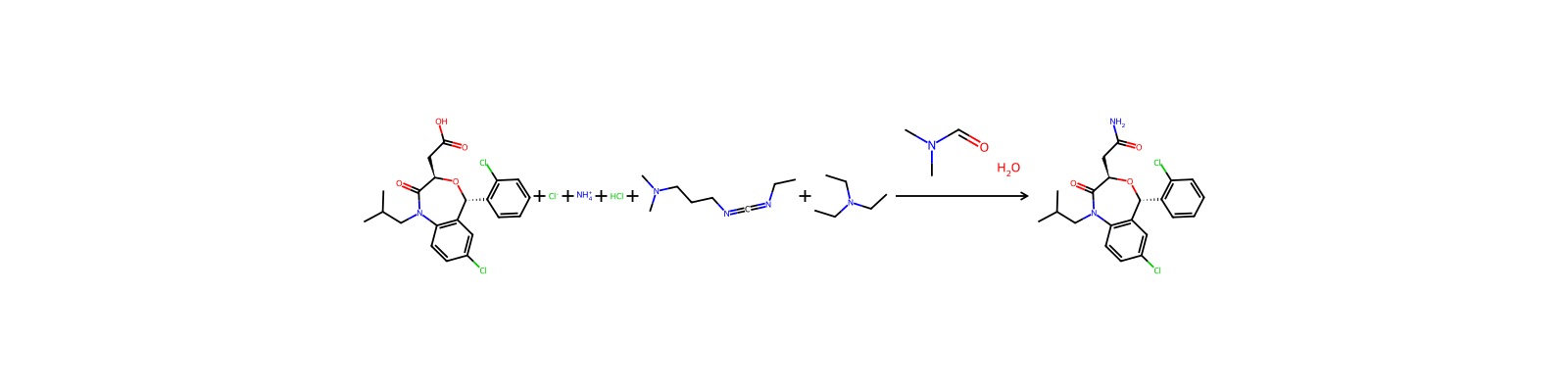
DescriptionEDC (N-ethyl-N’-(3-dimethylaminopropyl)carbodiimide) carbodiimide reagent for the activation of carboxylic acid and their subsequent coupling with amines. EDC is water soluble and provides a reliable method for activating carboxylic acids in aqueous media.
Uses1-(3-Dimethylaminopropyl)-3-ethylcarbodiimide hydrochloride is used as a carboxyl activating agent. It plays a vital role for immobilization of large biomolecules in association with N-hydroxysuccinimide. It is also used in the acylation of phosphoranes.
General DescriptionEDC hydrochloride is a water-soluble derivative of carbodiimide useful for conjugating haptens to proteins and polypeptides. Used to modify NMDA receptors and as a condensing agent in peptide synthesis. The major advantage of EDAC coupling is the easy removal of excess reagent and the corresponding urea by washing with dilute acid or water. Carbodiimides catalyze the formation of amide bonds, carboxylic acids, and amines by activating the carboxylate to form an O-acylurea. This intermediate can be attacked by an amine directly to form an amide. EDAC is released as a soluble urea derivative.
Upstream & downstream products
Upstream raw materials
Related reactions
25,665 records






Compound notes
Loading…