
HRID 16618As reactant
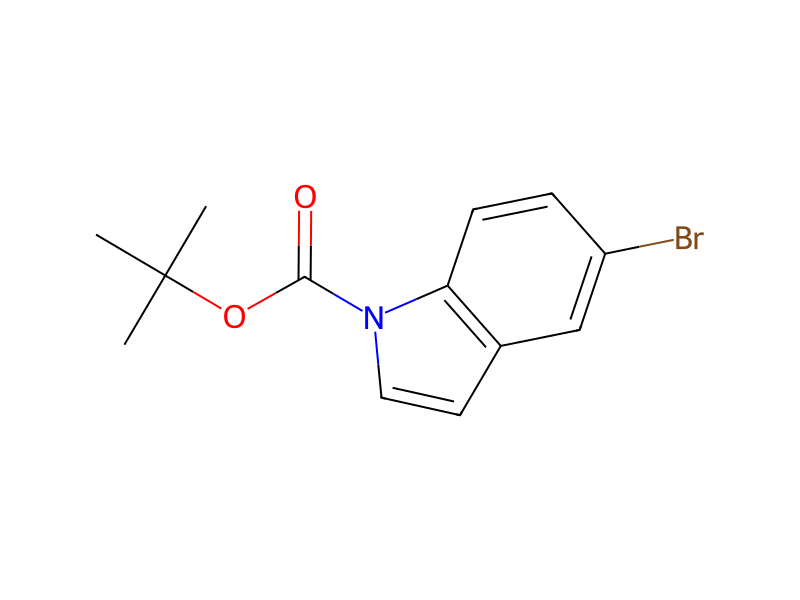
182344-70-3CC(C)(C)OC(=O)n1ccc2cc(Br)ccc21PBWDRTGTQIXVBR-UHFFFAOYSA-N182344-70-3DTXSID90369512Safety information is for reference only and does not replace the supplier’s Safety Data Sheet (SDS), applicable regulations, or professional assessment.
Warning
H315 (100%): Causes skin irritation [Warning Skin corrosion/irritation]
P261, P264, P264+P265, P271, P280, P302+P352, P304+P340, P305+P351+P338, P319, P321, P332+P317, P337+P317, P362+P364, P403+P233, P405, and P501 (click each P-code to see the statement)
Aggregated GHS information provided per 40 reports by companies from 3 notifications to the ECHA C&L Inventory. Each notification may be associated with multiple companies.
UsesN-Boc-5-bromoindole is formed as an intermediate for the synthesis of di-Boc-protected 5-aminoindole via a Buchwald-Hartwig amination with tBu-carbamate followed by regioselective bromination[1].
General DescriptionN-Boc-5-bromoindole can undergo Sonogashira coupling reaction with N,N-diisopropylprop-2-ynylamine to afford the corresponding propargylic diisopropylamine. N-Boc-5-bromoindole is formed as an intermediate during the synthesis of 2-(5-substituted-1H-indol-3-yl)-N-hydroxyacetamide derivatives.